Dharma Myth Meaning & Symbolism
The myth of Dharma, the divine bull of cosmic order, who descends to a suffering world, is crippled, and must be restored by a righteous king.
The Tale of Dharma
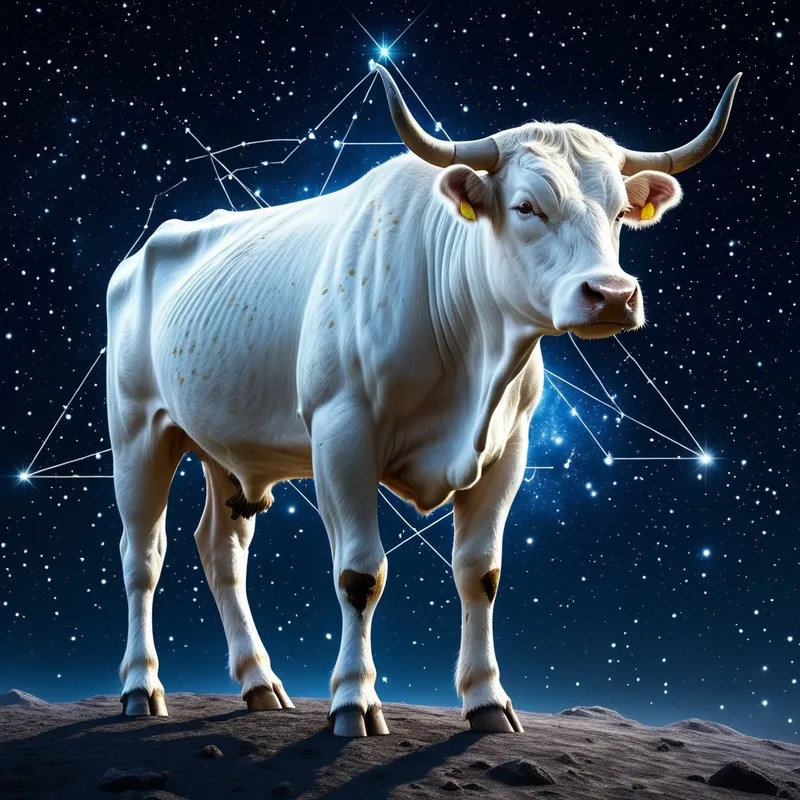
Listen. In the beginning, when the worlds were young and the Yugas turned with the weight of stars, there walked a being of pure principle. He was Dharma, and his form was that of a bull, magnificent and white as the heart of a lotus. Not a bull of flesh, but of essence—his four sturdy legs were the four pillars of all that is good and true: Satya, Shaucha, Daya, and Dana. Where he trod, harmony blossomed. Seasons followed their course, kings ruled justly, sages spoke wisdom, and every creature knew its place in the great tapestry.
But the wheel turns. The age of perfection, the Satya Yuga, gave way to the Treta, and then to the Dvapara. With each passing age, a shadow grew in the hearts of beings. Greed tarnished generosity. Lies corroded truth. Cruelty withered compassion. And as the world forgot, Dharma began to limp.
It was a slow, terrible crippling. In the Treta, as conflict and desire took root, one leg—the leg of Shaucha—shattered. The bull stumbled, but stood on three. In the Dvapara, as deceit became commonplace, the leg of Satya buckled. Now he hobbled on two, a pitiful sight, his divine light dimmed by the world’s thickening ignorance.
Then came the age we know, the Kali Yuga. The air itself grew heavy with discord. In this time, a king was born, named Parikshit. He was a just ruler, a grandson of the great Arjuna, and he felt the world’s sickness in his own bones. One day, wandering his kingdom, he saw the impossible: the divine bull, the very form of order, reduced to a single leg—the leg of Daya. The other three were mere stumps. The bull was trembling, sinking into the mire of a world that could no longer recognize, let alone support, the principle that gave it form.
King Parikshit wept. His royal heart broke at the sight. He saw a demonic figure, the personification of the age itself—Kali—standing over the crippled bull, striking the last remaining leg with a cruel mallet. Rage, pure and righteous, flared in the king. This was not an enemy of flesh to be slain with an arrow, but an enemy of spirit, of reality itself. His duty, his own svadharma, crystallized in that moment. He raised his voice, not in war-cry, but in sovereign decree. He banished the spirit of Kali from his lands, confining its influence to places of gambling, intoxication, prostitution, and gold—the haunts of chaos.
Then, with infinite care, the king approached the broken bull. He did not offer a hand to lift it, for how does one lift a principle? Instead, he knelt. He vowed to rule so justly, to live so truthfully, to act with such compassion, that the world itself would become a crutch for Dharma. He would become the living embodiment of the missing legs. And as he took his vow, a tremor of potential—not yet healing, but the promise of it—passed through the wounded earth. The bull, supported by the king’s resolve, did not sink. It stood, poised on one leg, a fragile monument to what remains, and a silent question for all who behold it.
Cultural Origins & Context
This poignant allegory is woven into the vast epic of the Mahabharata, specifically within the Shanti Parva. It was not a standalone myth for entertainment, but a central teaching story recited by the dying grandsire Bhishma to the victorious but traumatized king Yudhishthira. Its function was societal and psychological: to explain the perceived moral decay of the world after the cataclysmic Kurukshetra war, and to provide a blueprint for leadership in dark times.
Passed down through oral tradition by sutas and scholars, the myth served as a mirror for society. It diagnosed the collective illness—the erosion of dharma—and prescribed the cure: righteous kingship and personal duty. It transformed the abstract concept of cosmic order into a visceral, suffering image, making the health of the world intimately connected to the ethical actions of every individual, especially those in power. It was a myth for the age of consequences, a narrative anchor in a sea of social and spiritual change.
Symbolic Architecture
The myth’s power lies in its devastatingly clear symbolic architecture. Dharma as the bull is profound. The bull represents steadfast strength, foundational support, and fertile power—the very qualities of a sustainable world order. Its crippling is not a random punishment, but a direct reflection of humanity’s inner state.
The four legs are not external rules, but the internal pillars of a coherent psyche and a coherent society. To lose one is to become unbalanced; to lose three is to teeter on the brink of existential collapse.
The sequential loss maps the devolution of consciousness: from holistic integrity (four legs) to a focus on ritual and compensation (three legs), to conflict and duality (two legs), and finally to a fragile, sentimental clinging to mere pity, devoid of truth, purity, or generosity (one leg). Kali is not an external devil, but the personified shadow of the age—the collective acceptance of strife, hypocrisy, and short-term desire as the norm. King Parikshit represents the awakened ego-consciousness that finally sees the devastation and chooses to engage. His banishment of Kali is the act of psychological discrimination—identifying and quarantining the sources of chaos within one’s own realm (the personal psyche).
The Dreamer's Resonance
When this myth stirs in the modern dreamer, it often manifests as profound somatic and psychological experiences of crippling and fragile support. One may dream of a beloved animal limping; of a house or temple with collapsing foundations where only one corner remains intact; of trying to run but having legs turn to clay or vanish entirely. The body in the dream feels the weight of an unsustainable position.
Psychologically, this signals a process where the dreamer’s inner moral or ethical structure—their personal svadharma—is under extreme duress. This isn’t about social rules, but about the deep, authentic principles that give one’s life integrity and meaning. The dream reveals a psyche that has, often through compromise, neglect, or trauma, allowed its pillars of truth, self-respect, or compassion to erode. The dream-ego is in the role of King Parikshit witnessing this inner devastation. The terror and grief in the dream are the first, necessary awakenings to the reality of one’s own spiritual condition. It is the psyche’s urgent call to sovereignty.
Alchemical Translation
The alchemical process modeled here is the transmutation of a wounded, collapsing structure into a consciously upheld, authentic one. It is the journey from being a victim of the “age” (one’s personal circumstances, neuroses, or history) to becoming the sovereign who contains and transforms it.
The first stage is Nigredo: the blackening, witnessed in the stark vision of the crippled bull. This is the confrontation with the shadow, with the reality of one’s own participation in chaos (Kali). There is no bypassing this grief. The second stage is Albedo: the whitening, represented by King Parikshit’s clear, discerning action—banishing chaos to its specific quarters. This is the work of psychological discrimination, of saying “this behavior, this thought-pattern, this compromise, no longer has free reign in my inner kingdom.”
The final, ongoing stage is Rubedo: the reddening, the great work. It is not about miraculously restoring the four legs. It is the king’s vow—the ego’s commitment to become the support. The alchemical gold is the integrated personality that willingly bears the weight of the one remaining principle (compassion) and, through conscious living, regenerates the others.
For the modern individual, this means we do not wait for the world to become righteous to live righteously. We do not wait for truth to be popular to speak it. Our individuation requires us to become the local, psychic point of resistance against inner and outer chaos. We must identify where our own “legs” have grown weak—where we lie to ourselves (loss of Satya), neglect self-care (loss of Shaucha), or hoard our energy (loss of Dana). Then, we must kneel before that wounded truth within us and make a sovereign vow. We uphold the dharma not because the world supports it, but so that, in our small, steadfast realm, the bull may yet stand.
Associated Symbols
Explore related symbols from the CaleaDream lexicon: