Deucalion's Stones Myth Meaning & Symbolism
After a world-ending flood, the survivors Deucalion and Pyrrha repopulate the earth by casting stones over their shoulders, which transform into a new race of humans.
The Tale of Deucalion's Stones
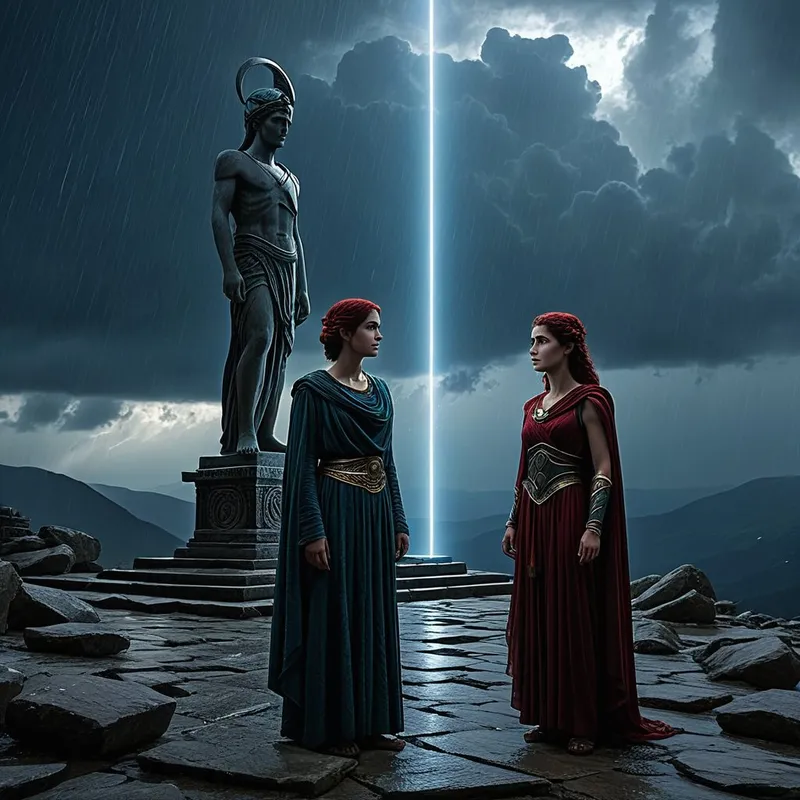
The sky did not weep; it roared. It was not a storm of rain, but of the world’s undoing. Zeus, seated on his cloud-wreathed throne, looked upon the age of bronze and saw only the clangor of wickedness, the smoke of hubris rising from a thousand altars. His heart, a forge of divine judgment, grew cold. He would wash the slate of earth clean.
But in the dark valleys of Phocis, a different light flickered. Deucalion, son of the gentle Titan Prometheus, and his wife Pyrrha, daughter of the doomed Pandora, lived with a quiet piety. Warned by his foresighted father, Deucalion had built a great chest, a wooden ark. Into it, they climbed as the first drops fell—drops that soon became a deluge to drown the stars themselves.
For nine days and nights, the wooden world tossed upon a churning grave. All life, all sound, all memory of the dry world was swallowed. Only the twin peaks of Mount Parnassus pierced the watery shroud, a lonely island in a universe of grey. There, at last, the chest ground to a halt.
They stepped onto the mud-slicked stone, the last two breaths in a silent cosmos. The air was sharp, scoured clean of life. The temples were drowned, the cities silt, the songs of men and birds alike extinguished. A profound and terrible loneliness settled upon them, deeper than the abyss they had escaped. They were relics in an empty museum.
Driven by this desolation, they sought an oracle. Climbing the sacred slopes, they came to the shrine of Themis, its stones still weeping. With ashes from a cold altar smeared on their heads and arms, they fell to their knees. Their voices, hoarse from the storm, formed the only prayer in the world: "O goddess, how can the ruin of the human race be repaired? How can we, two alone, fill this vast silence?"
The air in the shrine grew still. Then, a voice, not heard but felt in the marrow of their bones, issued from the ancient stone: "Depart from my temple. Veil your heads. Loosen the girdles of your garments. And cast behind you the bones of your great mother."
They stumbled out, shrouded in linen, hearts sinking. The bones of their mother? To disturb a tomb in this lifeless world was a horror. Pyrrha wept. "I cannot. I will not dig up my mother's sacred remains."
But Deucalion, the son of the clever Titan, stood still. His mind, a loom, began to weave. "My love," he said, his voice a whisper. "What if the great mother is not our flesh mother, but the Earth herself? Gaia. And what are the bones of the Earth, if not the stones that lie upon her body?"
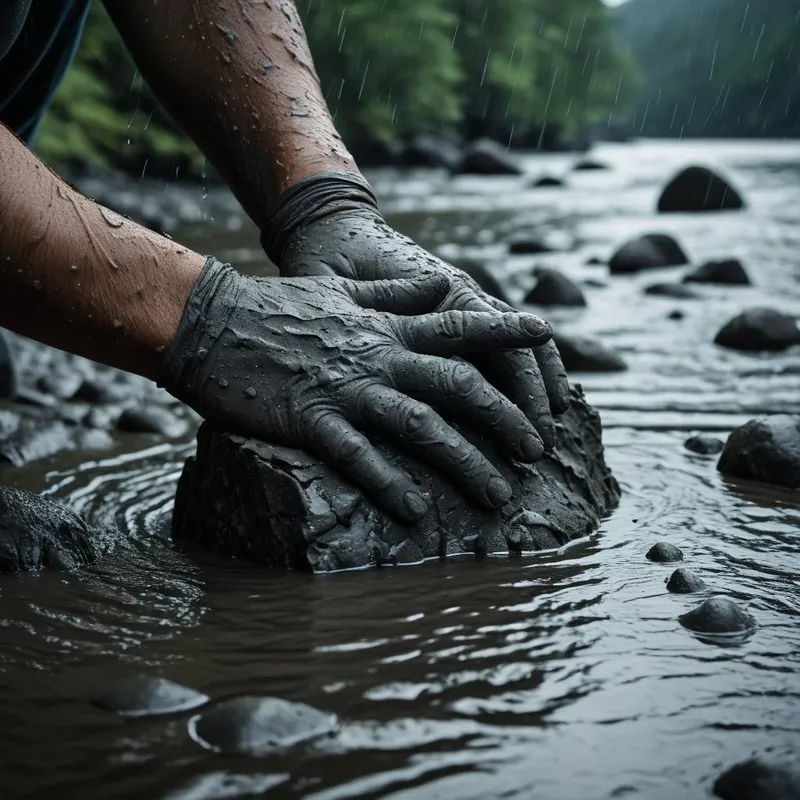
Hope, fragile as a newborn leaf, unfurled. They walked to the edge of the plateau, where the floodwaters had strewn a field of stones—smooth and round from the river, jagged and raw from the mountain. With heads turned away, they loosened their robes. Deucalion picked up a rough rock, heavy with the memory of the mountain. He cast it over his shoulder. It struck the mud with a solid thud.
Where it landed, the stone began to soften. Its grey hardness melted into tan flesh, its shape lengthened, stretched, and rose from the earth. A man, breathing, blinking in the new light, stood where the stone had fallen.
Pyrrha, seeing this miracle, seized a smaller, water-worn stone and cast it behind her. From it arose a woman, her form graceful, her eyes wide with the wonder of first sight.
And so they continued, stone after stone flying from their hands. Each rock that struck the earth shed its mineral sleep and woke into human form. The stones Deucalion threw became men, strong-limbed and sturdy. The stones from Pyrrha's hand became women, resilient and life-bearing. The silent mountain slope began to murmur with voices, with gasps of astonishment, with the first cries of a race newborn not from clay, but from the very skeleton of the world.
Cultural Origins & Context
This myth of cosmic renewal is primarily preserved for us in the epic compendium of Ovid's Metamorphoses and, in an earlier form, in fragments from the catalogues of the pseudo-Hesiod. It represents a distinctly Greek iteration of a near-universal flood narrative, a mythic motif found from Mesopotamia to the Americas. In the Greek context, it served a crucial etiological function—explaining the origins of humanity's current, "hardier" age (the age of iron, following the flood) and the very name of the Greek people. The word laos (people) was poetically linked to laas (stone).
Told and retold across generations, it was not merely a story of survival but a foundational narrative of identity. It answered profound questions: Why are we here? How did we begin again? It positioned humanity not as a first creation, but as a second one, born from catastrophe and divine instruction. This placed a sacred responsibility upon the community; they were literally "children of the earth," their existence a direct result of pious obedience to an enigmatic oracle. The myth was a pillar in the temple of Greek nomos, demonstrating that even in total annihilation, the correct relationship with the gods—marked by humility, ritual, and clever interpretation—could lead to rebirth.
Symbolic Architecture
At its core, the myth is a masterclass in symbolic thinking and psychic resilience. The flood represents the total dissolution of the known world, the ego's structures, and the conscious personality. It is the overwhelming crisis—be it trauma, loss, depression, or a profound life transition—that washes away all familiar landmarks.
The oracle's command is the voice of the Self, the central archetype of wholeness. It speaks in riddles, demanding we turn our back on conscious understanding to engage the transformative mystery.
Deucalion and Pyrrha together embody the coniunctio, the sacred marriage of complementary principles needed for creation: foresight (Promethean intelligence) and embodied hope (the daughter of Pandora, whose jar also contained elpis, hope). Their ritual actions—veiling their heads, loosening their garments—symbolize a surrender of individual identity and defenses, a return to a vulnerable, almost prenatal state receptive to the unconscious.
The "bones of the great mother" are the ultimate symbol. They are the durable, essential structures that survive the flood of emotion and chaos. Psychologically, they are the core complexes, the ancestral patterns, the archetypal bedrock of the psyche that cannot be dissolved. They are not pretty; they are hard, unfeeling, and inert—our traumas, our stubborn flaws, our ancestral burdens. The genius of the myth is the alchemical instruction: do not worship these bones, nor flee from them. Cast them behind you. Engage them through action, without staring directly at them (turning away your head). In doing so, you give them to the fertile mud of the present moment, where they can undergo a miraculous transmutation.
The Dreamer's Resonance
When this myth stirs in the modern dreamer, it often signals a profound process of psychic reconstitution. One may dream of wandering in a vast, empty landscape after a great storm or flood. There is a feeling of being the "last one," carrying an immense loneliness and responsibility. The dreamer might find themselves in front of an ancient, crumbling temple or a simple altar, receiving an incomprehensible message.
The somatic sensation is key: a heaviness in the hands and shoulders, as if carrying a load of stones. The act of "casting behind" in a dream can feel both terrifying and liberating. One is throwing away a part of oneself, yet that discarded part miraculously comes to life. This mirrors the psychological process where we must consciously engage with our most rigid, "stony" aspects—our defensive cynicism, our petrified grief, our inflexible opinions—and, by integrating them through a creative act (casting them into the flow of life), discover they contain the seed of a new vitality. The dream is an affirmation from the deep psyche: you have the materials for rebirth within your very burdens. The flood was not an end, but a necessary clearing.
Alchemical Translation
The journey of Deucalion and Pyrrha is a perfect map of the individuation process. It begins with the nigredo: the blackening, the flood of despair that destroys the old, outmoded conscious attitude. The ego is reduced to its bare essence, floating on an unconscious sea.
The climb to the oracle is the beginning of the albedo, the whitening. It is a turning inward, a seeking of guidance from the central, ordering principle (the Self/Themis). The enigmatic instruction represents the paradoxical nature of psychic work: the solution is found in what appears to be a grotesque or nonsensical command. The conscious mind must surrender its logic.
The act of casting the stones is the rubedo, the reddening. It is the sacred marriage of conscious intention (picking up the stone) and unconscious, fateful action (casting it behind, without looking). This is the moment of transmutation.
The stones—our hardened neuroses, our core wounds—are not eliminated. They are transformed. The psychological "stone" of isolation becomes the foundation for genuine connection. The "stone" of a traumatic memory becomes the bedrock of profound empathy. The new humanity that rises is not a return to a lost innocence, but the creation of a more conscious, resilient, and grounded being. We are not born from the idealized clay of a distant god, but from the worked-through, hard-won fragments of our own experience. The myth teaches that our wholeness is forged in the recognition that we are, at once, the thrower, the stone, and the newly formed human rising from the mud—a trinity of action, material, and becoming. We rebuild the world, and our selves, from the ruins.
Associated Symbols
Explore related symbols from the CaleaDream lexicon: