Deucalion's Flood Myth Meaning & Symbolism
Zeus floods the world to cleanse human wickedness. Only the pious Deucalion and Pyrrha survive, instructed to repopulate the earth by casting stones behind them.
The Tale of Deucalion's Flood
Hear now the story of the great deluge, when the breath of the gods grew hot with fury. In the Age of Bronze, humanity had turned its heart to stone. Not the noble stone of the altar, but the cold, hard stone of the blade. Prayers were forgotten, oaths were broken, and the smoke of sacrifice carried the stench of arrogance to the high halls of Olympus. Zeus, cloaked in storm clouds, looked down from Mount Olympus. What he saw was not the ordered world of Themis, but a seething pit of violence. The decision was made, not in haste, but in a terrible, slow-burning resolve. The world would be washed clean.
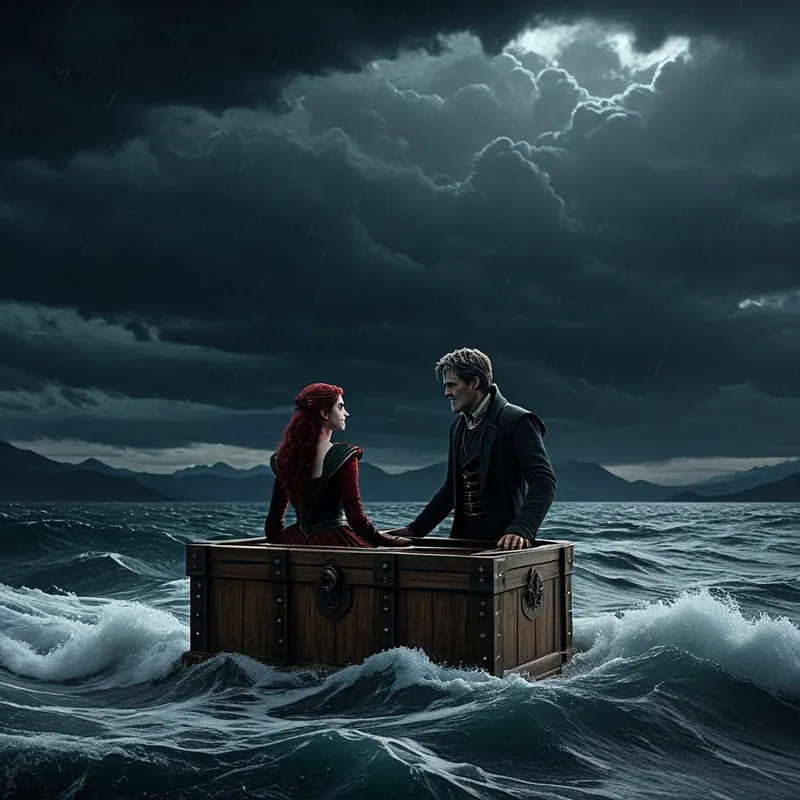
But in the land of Thessaly, there lived a king and queen whose hearts remembered the old ways. Deucalion, son of Prometheus, and his wife Pyrrha, were pious. They honored the gods and lived with justice. Seeing the storm gathering in the heart of heaven, Prometheus, the forethinker, whispered a warning to his son. "Build a chest," he said, "a great wooden ark. Store it with provisions. When the south wind brings not warmth but a great roaring, enter it and trust the waters."
And so it came to pass. Zeus loosed the Notus wind, and with it, all the gates of the celestial rivers were thrown open. Rain fell not in drops but in solid sheets, a deafening roar that swallowed the cries of men. Rivers burst their banks, the sea rose up in fury to meet the drowning sky, and the green earth vanished beneath a churning, grey abyss. For nine days and nine nights, the great chest of Deucalion was tossed upon the waters, a single speck of life in a universe of death. All else—the cities, the fields, the generations of mankind—were erased.
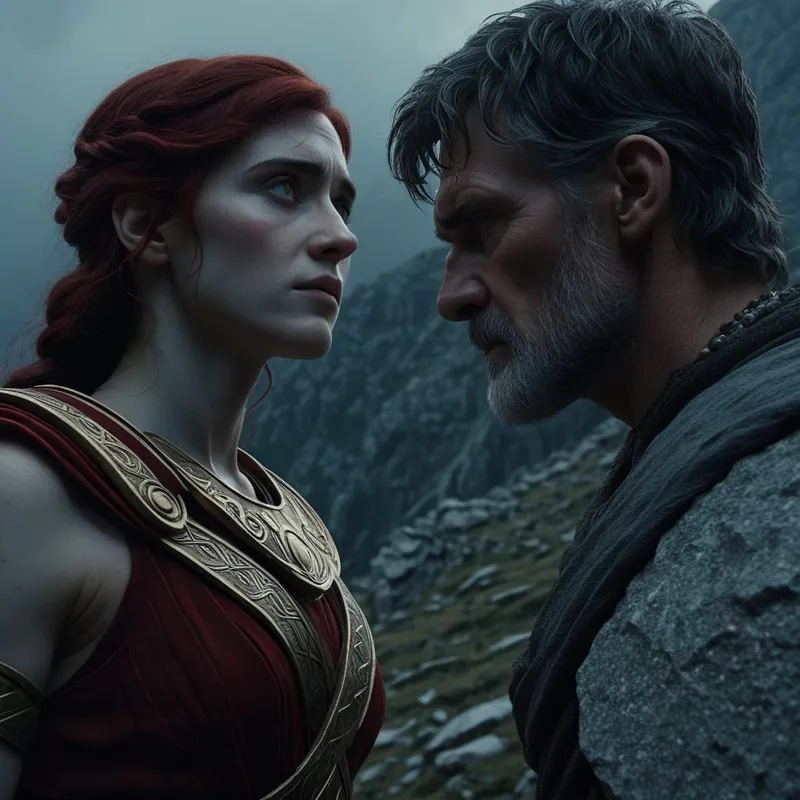
On the tenth day, the rains ceased. The winds grew quiet, exhausted. The waters began to recede, slowly, leaving behind a world of mud and silence. The chest came to rest, not on a shore, but on the highest peak still piercing the watery waste: the twin-summitted Mount Parnassus. Deucalion and Pyrrha stepped out onto the sodden rock. The world was empty. The silence was a weight upon their souls. They made their way to a ruined altar of Themis and wept, offering prayers for guidance in this lifeless world.
Then a voice, echoing as if from the stone itself, spoke the will of the goddess. "Veil your heads," it commanded. "Loosen the girdles of your garments. Then cast behind you the bones of your great mother."
The words were a riddle that froze their blood. To disturb the bones of the dead was a profound sacrilege. Pyrrha recoiled. But Deucalion, the son of the forethinker, pondered. Their great mother was Gaia, the Earth herself. Her bones… were the stones that lay upon her body.
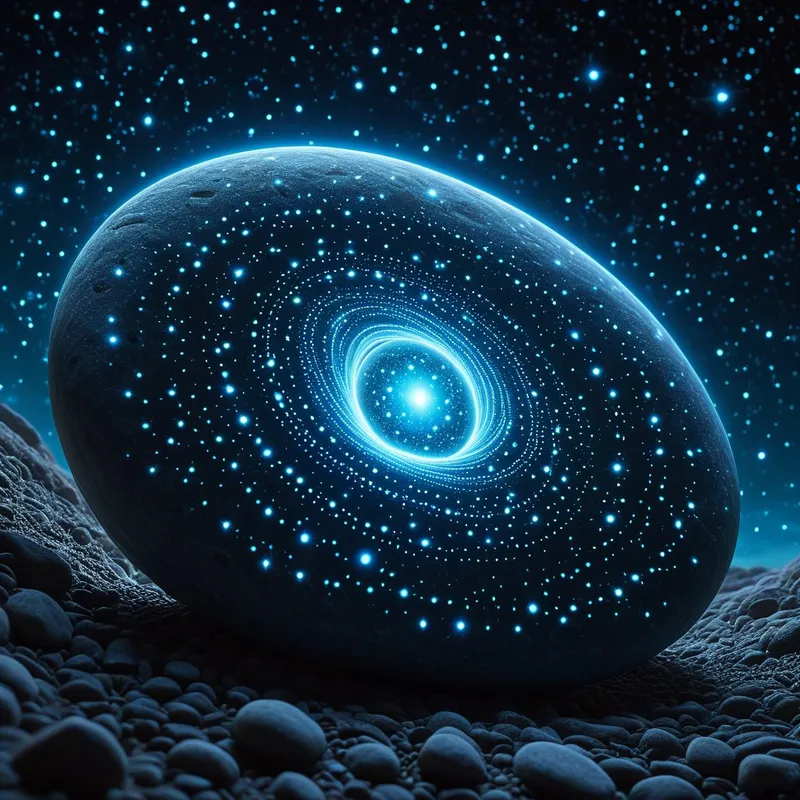
With trembling hands, heads covered in reverence, they obeyed. They picked up stones from the mountainside and cast them over their shoulders without looking back. A miracle, soft and silent, began. Where Deucalion's stones fell, men rose from the mud, whole and breathing. Where Pyrrha's stones fell, women emerged. The stones had lost their hardness, becoming flesh; the earth had given forth a new race, resilient and enduring. From this act, the Laoi, the people, were born.
Cultural Origins & Context
This myth is not a singular, fixed tale but a powerful current in the river of Greek storytelling. Our primary sources are the epic poet Hesiod and the later compiler Apollodorus, with echoes in the Roman poet Ovid. It functioned as a foundational aition—a story explaining origins. It answered profound questions: Why are we here? How did humanity survive its own self-destruction? Why is life so hard?
The myth places the flood within Hesiod's Five Ages of Man, specifically as the cataclysmic end of the violent Bronze Age. It served a critical societal function: it was a divine sanction for the moral order. The story taught that impiety (asebeia) and hubris (arrogance before the gods) have cosmic consequences. Yet, it also offered a template for survival: piety (eusebeia), foresight, and obedience to divine law (Themis) are the anchors that hold fast against the flood of chaos. It was a story told to reinforce cultural norms, to explain the harshness of existence as a legacy of a fallen age, and to affirm that from total ruin, a new, if more difficult, order can be born.
Symbolic Architecture
At its core, Deucalion's Flood is an archetypal narrative of death and rebirth on a cosmic scale. The floodwaters symbolize the unconscious itself—a formless, chaotic, and potentially annihilating force that can also be a medium of purification.
The flood is not merely punishment; it is the necessary dissolution of a petrified consciousness, the overwhelming return of all that has been repressed and dishonored.
Zeus's wrath represents the psyche's own self-correcting impulse, a brutal but ultimately restorative justice that dismantles a corrupt and unsustainable ego-structure (the violent Bronze Age humanity). Deucalion and Pyrrha are the surviving nucleus of consciousness—the allied masculine and feminine principles of wisdom (from Prometheus) and innate piety. Their chest is the vessel of the individuating Self, the protective container that allows a nascent consciousness to endure the catastrophic breakdown of its known world.
The casting of the stones is the myth's master symbol. It represents the alchemical solve et coagula—dissolve and coagulate. The old, hardened "bones" of the Earth (the material, instinctual base of life) are thrown away, surrendered. In that act of faithful, backward-throwing—an act not of creation but of obedient reception—they are miraculously transmuted. The mineral becomes animate; the inanimate becomes human. This is the birth of consciousness from the unconscious, of culture from nature, of soul from matter.
The Dreamer's Resonance
When this myth stirs in the modern dreamer, it often signals a profound psychological crisis that feels both personal and apocalyptic. To dream of overwhelming floods, of being the sole survivor on a mountaintop, or of turning stones into living beings is to experience the psyche's version of Deucalion's ordeal.
Somatically, this may manifest as a feeling of being emotionally "drowned"—by grief, anxiety, or the burdens of life. Psychologically, it indicates that an old way of being, a long-held identity or set of beliefs (the "Bronze Age" of one's personal history), has become corrupt, rigid, or violent to the soul's true nature. The ego is being inundated by contents from the unconscious too powerful to integrate through gentle means. The dream is not forecasting literal doom, but mapping the terrifying yet necessary process of ego-death. The "Mount Parnassus" in the dream is the emerging, higher vantage point of the Self—a perspective of survival and meaning that can only be found after everything else has been swept away.

Alchemical Translation
For the individual on the path of individuation, Deucalion's Flood models the phase of radical dissolution. This is the "dark night of the soul," where all one's previous adaptations, achievements, and self-concepts are revealed as inadequate or false. The conscious attitude is flooded by shadow material, by repressed grief, rage, or vulnerability.
The alchemical work begins with the "building of the chest": the cultivation of a conscious container—through therapy, reflection, art, or spiritual practice—that can hold the individual through the turmoil. Deucalion's heeding of Prometheus (intuitive foresight) and Pyrrha's steadfast piety represent the necessary alliance of logos (reasoned action) and eros (connecting relatedness) to navigate the crisis.
The pivotal transmutation occurs not in fighting the flood, but in the obedient, backward gesture of throwing the stones. Psychologically, this is the act of reclaiming and re-animating what has been cast aside as mere "stone"—one's bedrock instincts, forgotten talents, or hardened traumas.
The instruction to not look back as one throws is crucial. It signifies an act of faith in the unconscious process, a surrender of conscious control over the outcome. One must offer up one's most basic, "stony" complexes to the transformative mystery without demanding to see how they will change. The new humanity that rises—the integrated Self—is literally built from this redeemed, re-animated base material. One is not reborn as a different person, but as a more complete version of oneself, forged in the waters of chaos and founded upon the reclaimed bones of the earth. The myth concludes that true rebirth is not an escape from the material or the past, but its profound and miraculous transmutation.
Associated Symbols
Explore related symbols from the CaleaDream lexicon: