Democritus' Atom Myth Meaning & Symbolism
A philosopher's vision of the indivisible, eternal seed of reality, hidden within the ceaseless dance of matter and void.
The Tale of Democritus' Atom
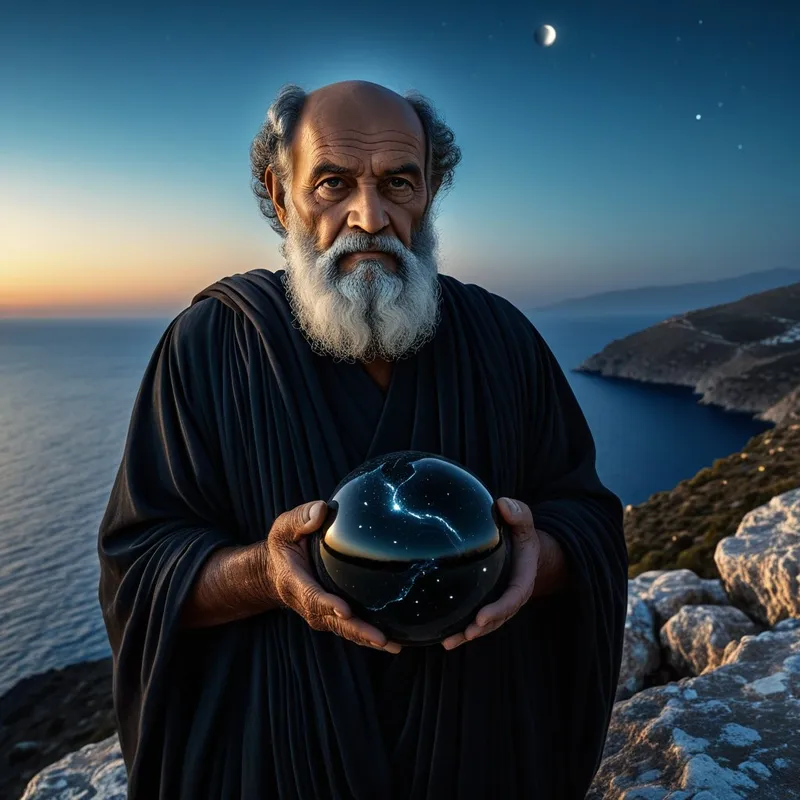
Listen, and hear a tale not of gods on Olympus, but of a truth whispered by the void itself. In the sun-baked city of Abdera, there lived a man whose eyes saw not the world, but the ghost behind its mask. His name was Democritus, and his laughter was a riddle that echoed in the marketplace, for he laughed at the folly of men who believed the marble was solid, the wine was wet, and the world was as it seemed.
He walked not with the stride of a king, but with the slow, measured pace of one who listens to the hum between heartbeats. He would sit for hours, his fingers tracing the grain of a wooden table, feeling not the wood, but the silent, desperate dance within it. He would gaze at the sea until his eyes burned with salt, seeing not the waves, but the infinite, frantic swarm beneath the surface.
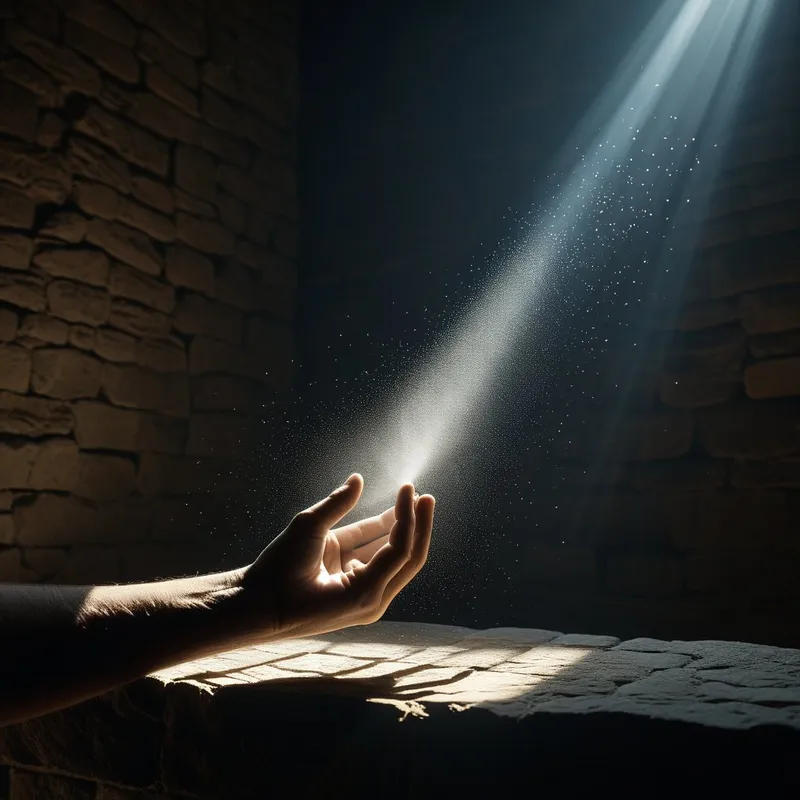
One evening, as the last copper light of Helios bled into the indigo sea, Democritus sat in his chamber, a single oil lamp fighting the encroaching dark. Before him was a slab of honey-colored amber. He struck it with a small hammer. A piece flaked away. He struck the piece. It shattered into dust. He took a grain of that dust and, with a breath as soft as a ghost’s sigh, blew upon it. The motes scattered into the lamplight, becoming a swirling cosmos of tiny, glittering worlds.
And in that moment, the veil tore.
He did not see the dust. He saw through it. He perceived the final, desperate frontier of division. He saw that if one could keep dividing, forever and ever, one would eventually arrive at a thing that could not be cut. A thing without parts. A thing that was itself, eternal and unyielding. He named it the Atom.
But the Atom was not alone. For Democritus saw that between these eternal seeds was the true mother of all things: the Kenon, the Void. Not nothingness, but a fertile, receptive nothingness—the stage upon which the drama of reality played out. The Atoms, infinite in number and form—hooked, smooth, round, jagged—eternally fell through this void. They collided. They hooked together. From the blind, necessary clash of these uncuttables, a vortex was born. From the vortex, a world. From the world, a sea, a stone, a tree, a laughing philosopher.
The myth was not of creation by a hand, but of generation by a dance. The sweetness of honey, the bitterness of brine, the hardness of iron, the softness of wool—all were but the ghostly sensations born from the shape and arrangement of these invisible, eternal dancers. The soul itself, he whispered, was made of special, swift, and fiery Atoms. Even the gods were but long-lived conglomerations of them, born from the same whirlwind.
The resolution was not a battle won, but a truth seen. Democritus looked up from his dust, and his laughter this time was different. It was not mocking, but awe-filled. He saw the cosmos in the motes, and the motes in the cosmos. He had found the indivisible seed in the heart of fragmentation, the still point in the turning world. The tale ends not with a kingdom gained, but with a man who, having seen the skeleton of reality, could truly love its flesh.
Cultural Origins & Context
This is not a myth from the epic poets, but from the school of the Physiologoi, the "inquirers into nature." Democritus of Abdera (c. 460 – c. 370 BCE) was its most eloquent voice, building upon the work of his teacher, Leucippus. The tale was passed down not in hexameter verse sung at symposia, but in prose treatises with titles like The Great World-System and On the Mind.
Its societal function was radical and subversive. In a culture where the caprices of the Olympians were invoked to explain everything from thunderstorms to love, atomism proposed a cosmos governed by Ananke, not by Zeus's whims. It was a philosophy for the emerging intellectual, the citizen-scientist. It offered a vision of a universe that was material, yet infinite; deterministic, yet generative of immense complexity. It was told among the learned in the Stoa and the garden, a secret key to decoding the sensory illusion of the world. While much of Democritus's own writing is lost, the myth of the Atom was preserved and debated by later giants like Lucretius, who carried its torch into the Roman world, ensuring its ghost would haunt Western thought forever.
Symbolic Architecture
The myth is a profound map of the psyche's relationship with reality. The Atom symbolizes the irreducible core of the Self—the eternal, indestructible spark of individual being that persists beneath the constant flux of personality, emotion, and experience. It is the bedrock of identity.
The Atom is the psyche's ultimate fact: that which cannot be dissolved by analysis, trauma, or time.
The Kenon is equally critical. It represents the fertile space of potential, the unconscious, the interval between thoughts, the silence between notes. It is not emptiness, but the necessary ground for being. Without the Void, the Atoms would be a solid, motionless mass—eternal but dead. The Void is the principle of freedom, possibility, and relationship.
The eternal falling and collision of the Atoms symbolizes the ceaseless dynamism of the psyche. Thoughts, feelings, memories, and archetypes are in constant motion, hooking together to form the complex, temporary constellations we call "my mood," "my opinion," "my life." The sensory world—the sweet, the bitter, the hard—is but the surface phenomenon of these deep, archetypal collisions. It tells us that our perceived reality is a secondary effect, a story our senses tell us about the primary, invisible dance of psychic units.
The Dreamer's Resonance
When this myth stirs in the modern unconscious, it often manifests in dreams of fragmentation and search for a core. One may dream of a precious gem that keeps splitting into smaller, identical gems; of a house with endless, dividing rooms; or of one's own body dissolving into sand, with the imperative to find the one grain that is "you."
Somatically, this can correlate with feelings of dissociation, of being "scattered," or of existential anxiety where the solidity of the world feels thin and illusory. The psychological process is one of deconstruction. The psyche is breaking down a perceived whole (a belief, a self-image, a life situation) to its constituent parts. This is not a pathological breaking, but a necessary one. The dream is enacting the Democritean hammer, asking: "What remains when everything non-essential is stripped away? What is your indivisible atom?"
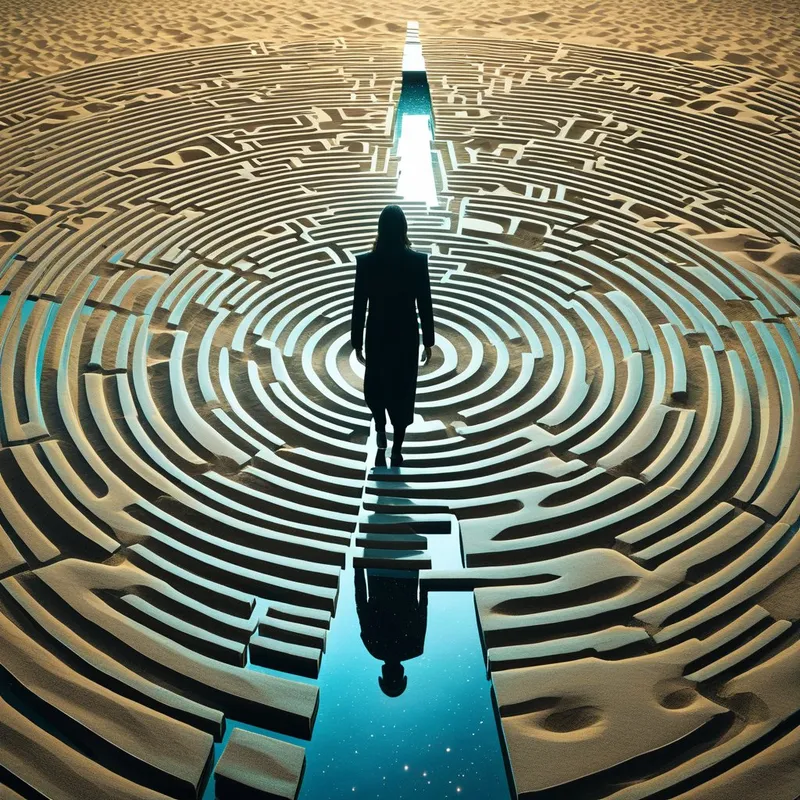
The healing movement in such dreams is the discovery of that single, still point—the grain of sand that does not divide, the room at the center of the labyrinth that is empty yet whole. This is the moment of contacting the Self as distinct from the ego's composite identity.
Alchemical Translation
The alchemical journey modeled here is the opus contra naturam—the work against nature's apparent flow. Where ordinary consciousness sees only solid objects and discrete events, the individuating ego must learn to see the void and the dance.
The first stage is Nigredo, the blackening. This is the hammer strike. It is the dissolution of the taken-for-granted world. One's beliefs, relationships, and sense of meaning are broken down. This feels like nihilism, like falling through the Kenon. It is the necessary destruction of illusion.
The Void is not the enemy of being, but its womb. One must fall through the terror of emptiness to find the eternal particle of one's own truth.
The second stage is Coniunctio, the conjunction. This is the blind collision in the void. From the shattered pieces of the old self, new, unexpected hook-ups occur. A shard of a forgotten passion hooks onto a jagged piece of a new skill. A smooth, round Atom of acceptance collides with a hooked Atom of grief, forming a new compound. This is not a controlled building, but a spontaneous, generative chaos from which a new psychic substance is born.
The final stage is the realization of the Philosopher's Stone: the discovery that the seeker themselves is the eternal Atom. One is not the temporary configuration, but the indestructible unit capable of infinite configurations. This is the source of Democritus's final, awe-filled laughter. The triumph is not in building an impervious fortress of a self, but in realizing one's own nature as both the dancer and the dance floor, the eternal particle and the infinite void that gives it motion. One achieves a profound, unshakeable groundedness, not by clinging to form, but by understanding the principle of form itself.
Associated Symbols
Explore related symbols from the CaleaDream lexicon: