Dashavatara Myth Meaning & Symbolism
The ten descents of Vishnu, a cosmic cycle of divine intervention, mapping the evolution of consciousness from primal depths to enlightened awareness.
The Tale of Dashavatara
Listen. The great wheel of time, the Kalachakra, groans under the weight of a profound imbalance. Dharma, the sacred order, trembles like a leaf in a gale. The world is adrift, sinking into the dark waters of chaos, drowning in the thick mud of greed, tyranny, and ignorance. The cries of the righteous are swallowed by the laughter of demons. The axis of the universe itself begins to tilt.
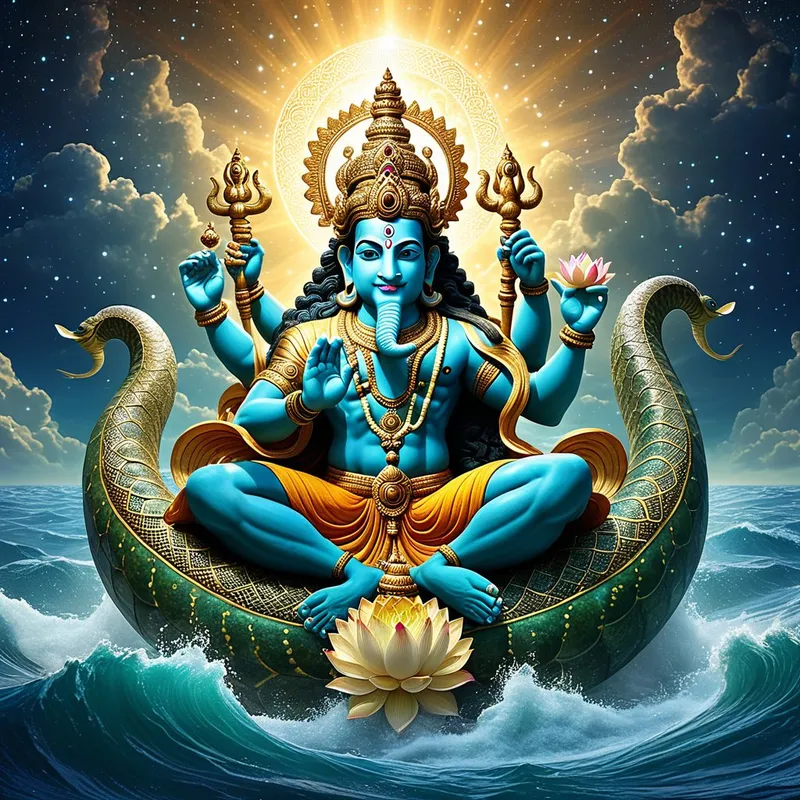
From the infinite, silent depths of the Brahman, a pulse stirs. It is not a movement, but an intention. In the celestial abode of Kshirasagara, upon the coiled bed of the endless serpent Ananta Shesha, the Preserver opens his eyes. He is Vishnu, whose breath is the rhythm of the cosmos. He hears the world's anguish. He feels the fraying of the cosmic fabric. A resolve, ancient and inevitable, crystallizes within him. He will descend. He will take a form born of the world's own substance, to mend what is torn, to right what has capsized.
And so, the descents begin—not as a sudden storm, but as a slow, deliberate unfolding of divine strategy across the fathomless ages.
First, in the time of the great deluge, he is Matsya, a glittering scale in the rising waters, growing vast to guide the ark of life, a horn tied to the mountain peak, pulling all that is sacred through the drowning dark. Then, as the churned oceans heave, he is Kurma, a living mountain of shell, the immovable pivot upon which the gods and demons churn the ocean for the nectar of immortality, his patience the foundation of all effort.
When the demon Hiranyaksha drags the earth to the bottom of the cosmic sea, he is Varaha, a titan of tusks and earth-scent, who dives into the abyssal mud, lifts the goddess Bhudevi on his snout, and restores her to her rightful place in the heavens. Confronting the tyrant Hiranyakashipu, who forbade the worship of Vishnu, he is Narasimha, bursting from a stone pillar at twilight—neither man nor beast, yet both—to deliver a terrible, righteous justice upon the threshold of courtyard and home, where no law applied.
He descends as Vamana, a humble Brahmin boy, to humble the demon king Bali, who ruled the three worlds. With three steps, the dwarf covers earth, heaven, and, placing his foot upon Bali's head, claims the netherworld, restoring cosmic sovereignty through cunning and sacred contract. When the warrior class, the Kshatriyas, become drunk on power and oppress the earth, he is Parashurama, the Brahmin with the fiery axe, a cyclone of wrath who cleanses the world twenty-one times over, a necessary purge written in blood.
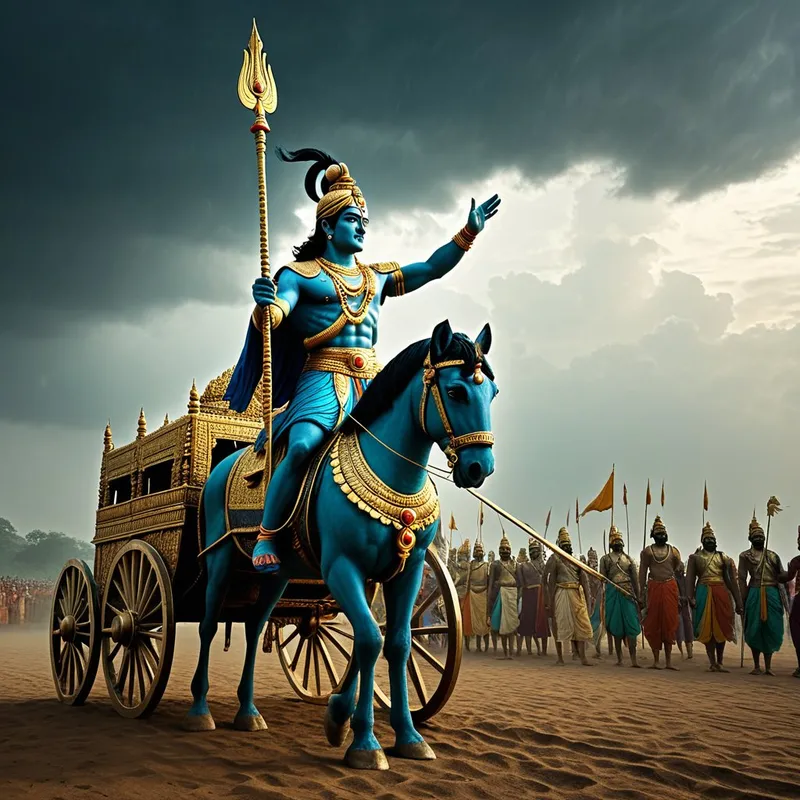
Then, in an age of perfect kings, he is Rama, the prince of Ayodhya. His life is a poem of duty, his exile a forest of trials, his battle against the demon Ravana an epic of retrieving stolen light—his wife Sita. He establishes a kingdom where Ramarajya is not just a tale, but a lived reality. As the dark age, the Kali Yuga, thickens, he becomes Krishna, the cowherd, the prince, the flute-player whose song unravels the soul. On the battlefield of Kurukshetra, he does not lift a weapon, but delivers the Bhagavad Gita, a discourse that illuminates the path of action, devotion, and knowledge amidst the ultimate moral crisis.
The wheel turns. The final descent is yet to come. He will be Kalki, a warrior on a white horse, a blazing sword in hand, arriving at the end of time to dissolve the present cycle, to cut away the rotten roots of the age, and to sow the silent seeds for a new dawn of creation. The tale is never finished; it is a spiral, a promise etched into the bones of time itself.
Cultural Origins & Context
The myth of the Dashavatara is not a single, fixed scripture but a living theological and narrative concept that evolved over millennia within the vast tapestry of Vaishnavism. Its earliest seeds are found in the Vedas, but its full flowering occurs in the Puranas—encyclopedic texts like the Bhagavata Purana and the Vishnu Purana—composed roughly between the 3rd and 10th centuries CE.
These stories were the province of the Suta or the traveling Bhagavata, who would recite them in temple courtyards and village squares. The telling was not mere entertainment; it was Sravana, a form of worship and a vehicle for upadesha. The sequence itself is a masterful synthesis, integrating indigenous tribal totems (the fish, boar), Vedic deities, and epic heroes into a unified cosmology centered on Vishnu. Its societal function was profound: it provided a sacred history that explained the cycles of time (the Yugas), validated social and cosmic order (Dharma), and offered a tangible theology of a compassionate, intervening divinity accessible to all, from the philosopher to the farmer.
Symbolic Architecture
At its core, the Dashavatara is a grand symbolic map of consciousness evolving through time and crisis. It is not a linear history, but a spiral of divine pedagogy.
The avatar does not come to reward the good, but to restore the conditions in which goodness can once again be chosen.
The sequence mirrors both cosmic and biological evolution—from aquatic life (Matsya) to amphibian (Kurma), to land mammal (Varaha), to the hybrid man-beast (Narasimha), and finally to the full human form and beyond. This is a profound allegory for the evolution of the soul or the awakening of consciousness from primal, instinctual states toward self-aware humanity and, ultimately, transcendent wisdom.
Psychologically, each avatar represents an archetypal response to a specific kind of adharma (disorder). Matsya is the preserving of wisdom (the Vedas) in the flood of unconsciousness. Narasimha is the eruption of the repressed, shadow self (the "beast") to confront a rigid, inflated ego (Hiranyakashipu) that denies its own divine core. Krishna represents the integration of the psyche—the playful child, the passionate lover, the shrewd statesman, the supreme philosopher—who guides the conflicted human ego (Arjuna) through its inner civil war.
The Dreamer's Resonance
When the pattern of the Dashavatara stirs in the modern unconscious, it often manifests not as a literal dream of ten gods, but as a profound somatic and narrative sequence of transformation. One may dream of a series of drastic changes—a flood, a descent into deep mud, a confrontation with a beastly figure at a threshold, a moment of taking a seemingly small but decisive step (Vamana's three strides), or receiving crucial advice from a serene, authoritative figure in a moment of crisis (Krishna's chariot).
These dreams signal that the psyche is undergoing a major re-ordering. The "demons" are internal: overwhelming emotions (the flood), entrenched complexes that weigh down one's vitality (the earth in the ocean), rigid, inflated beliefs that forbid growth (Hiranyakashipu's law), or moral paralysis in the face of life's battles (Arjuna's dilemma). The dream sequence suggests the Self is activating different, often surprising, aspects of the personality to meet these challenges—from primal survival instinct to cunning intelligence to compassionate wisdom. It is the psyche's own assurance that it contains an innate, archetypal "preserver" capable of navigating any descent.
Alchemical Translation
The alchemical journey of the Dashavatara is the process of individuation writ large. It models the psychic transmutation required to move from a state of being acted upon by chaos to becoming an agent of conscious order within one's own life.
The early avatars represent the necessary engagement with the prima materia—the base matter of the psyche. We must first save our nascent consciousness (Matsya), then develop the patience to be the foundation for our own difficult work (Kurma), and have the strength to lift our grounded, embodied self (Bhudevi) out of the murky depths of neglect or trauma (Varaha). The middle avatars—Narasimha, Vamana, Parashurama—symbolize the crucible of confrontation with the personal shadow and societal conditioning, using paradox, humility, and sometimes necessary, fierce discrimination to establish inner sovereignty.
The final avatars are not about fighting demons, but about mastering the kingdom of the self and preparing for its transcendence.
Rama establishes the inner Ramarajya, a conscious ego aligned with duty and integrity. Krishna represents the stage where the individual, having integrated many parts, can act in the world from a place of detached wisdom and boundless compassion, guiding others. Kalki is the final, liberating dissolution—not of the world, but of the identified ego-structure that has served its purpose. It is the moment when the individual, fully realized, can let go of the very form of their individuality to merge back into the source, completing the great cycle of descent and return. Thus, the myth becomes a personal mandala, charting the soul's journey from fragmented existence to wholeness, and ultimately, to its own sublime dissolution into the infinite.
Associated Symbols
Explore related symbols from the CaleaDream lexicon: