Dark Night of the Soul Myth Meaning & Symbolism
A mystic's journey through profound spiritual emptiness, where the absence of God becomes the ultimate path to a deeper, unmediated union with the divine.
The Tale of Dark Night of the Soul
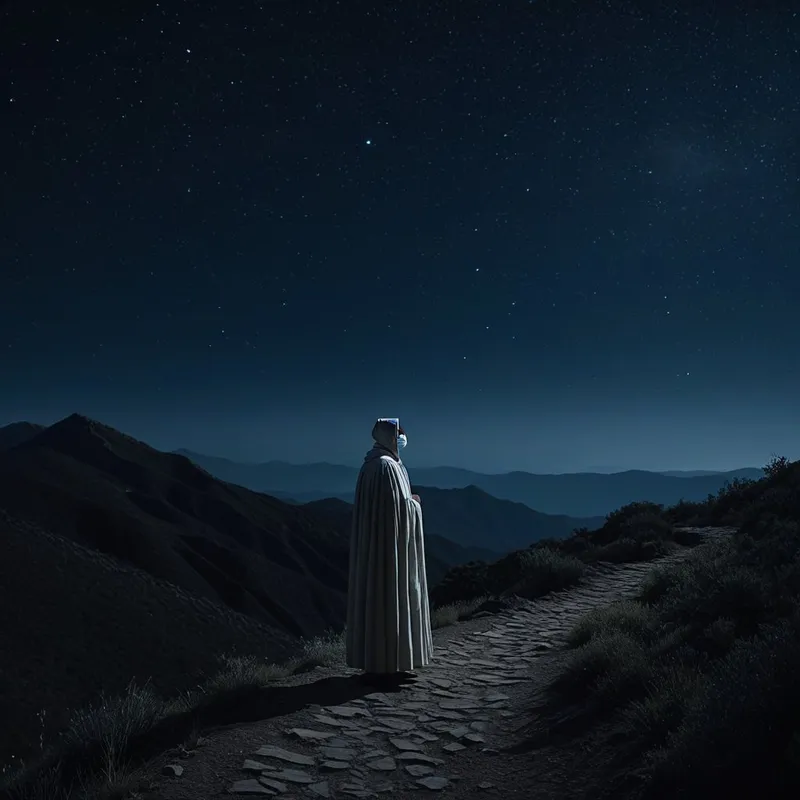
Listen. There is a story not of light, but of a deeper, more terrible brilliance. It is the story of a traveler who did not journey across lands, but inward, into a desert of the spirit.
Once, there was a seeker who knew the sweetness of the divine. He—or she—dwelt in a garden of the soul, where prayer was honey and contemplation was a warm sun. The presence of the Beloved was a constant song, a gentle hand upon the shoulder. The seeker followed the rituals, climbed the ladder of virtues, and felt the ascent was sure.
But then, the seasons of the soul turned. The sun did not merely set; it vanished. The familiar garden walls dissolved into a formless, starless night. The sweet song of prayer became a dry whisper that echoed into a void and returned unanswered. Where once there was warmth, now there was a chilling absence, a silence so profound it roared in the ears. The seeker reached out, but the Beloved’s hand was withdrawn. The scriptures felt like dead letters; the rituals, empty gestures performed in a vacuum. This was no ordinary sadness, no simple doubt. This was a famine of the spirit, a acedia that seeped into the bones.
The night deepened. Every memory of light felt like a cruel taunt. The seeker was stripped—of consolation, of understanding, of the very feeling of faith. He wandered in this interior wilderness, a ghost to himself. Yet, driven by a will not his own, a faint, desperate loyalty, he did not turn back. He kept the watch. He spoke the words into the silence. He offered his emptiness as his only prayer.
And in the deepest watch of that long night, when the soul had been scoured clean of every image, every comforting thought of the divine, a transformation occurred. The seeker realized he was not seeking a presence that was absent, but an absence that was itself a new kind of presence. The void was not empty; it was full of a purifying fire. The silence was not a rejection, but an invitation to a union beyond words, beyond feelings, beyond the self’s own understanding. The night itself became the guide. The darkness was not the opposite of the Beloved, but His most intimate embrace—a love so pure it had to destroy all the soul’s imperfect ideas of love to make room for itself. The dawn that broke then was not of day, but of a spirit reborn in the very heart of the night.
Cultural Origins & Context
This is not a myth of the collective, but of the interior frontier. Its primary scribe was San Juan de la Cruz (St. John of the Cross), who wrote the seminal poem “Noche Oscura” and its accompanying commentaries in the late 16th century. Imprisoned in a tiny cell by his own religious order for attempting reform, he experienced this spiritual crisis firsthand. His poetry, dense with symbolism from the Song of Solomon, gave form to the ineffable.
The myth emerged from the heart of the Catholic Counter-Reformation and the Spanish Mystical Renaissance, a time when the inner life of the spirit was explored with unprecedented psychological depth. It was passed down not as a folk tale, but as a secret map for initiates—monks, nuns, and devout laypersons—engaged in contemplative prayer. Its societal function was paradoxical: it normalized and sanctified the experience of spiritual despair, framing it not as a failure of faith or a demonic attack, but as a necessary, purgative stage on the path to mystical marriage with God. It provided a language for the unspeakable, turning a potential crisis of belief into a recognized stage of divine pedagogy.
Symbolic Architecture
The myth’s power lies in its radical inversion of spiritual expectation. It dismantles the ego’s relationship with the divine.
The Dark Night is not God’s abandonment, but God’s most severe mercy. It is the demolition of the house of the self so that a temple can be built in its place.
The Night symbolizes the active purification of the senses and the spirit. It is the unknowing, the via negativa, where all familiar landmarks are removed. The Soul here is not a static entity but the totality of the human person—intellect, memory, will, and senses—being led passively through a process it cannot control or comprehend. The Beloved is the Divine, who operates as both the cause of the darkness and its secret goal.
Psychologically, the myth represents the death of the persona—the socially and religiously constructed self that believes it “has” a relationship with the transcendent. This persona, built on feelings of devotion, intellectual understandings, and spiritual consolations, must be dissolved. The ensuing despair and sense of meaninglessness are the birth pangs of the authentic Self, which relates to the numinous not through borrowed concepts, but through a direct, unmediated encounter that transcends the ego’s grasp.
The Dreamer's Resonance
When this myth stirs in the modern dreamer, it rarely appears with religious iconography. Instead, it manifests as a profound pattern of existential disorientation. One may dream of being lost in a vast, featureless landscape—a gray plain, an endless ocean, or a labyrinthine building where all rooms are identical and empty. The dream ego searches frantically for an exit, a guide, or a loved one, but finds only echoes and shadows.
Somatically, this process correlates with feelings of pervasive fatigue, a heaviness of spirit, or a sense of being “stuck” or “frozen” despite outward motion. Psychologically, it mirrors a crisis of meaning, where old identities—the successful professional, the devoted partner, the seeker of wisdom—suddenly feel like ill-fitting costumes. The dreamer is undergoing what Jung called the nigerdo, the blackening, the initial stage of the alchemical process where the base material of the psyche is broken down. The conscious mind experiences this as depression, burnout, or a profound creative block, but the unconscious is initiating a necessary dissolution. The dream is the psyche’s way of saying, “The path you knew is gone. You must endure the wilderness until a new orientation is born from within it.”
Alchemical Translation
The Dark Night is the ultimate alchemical opus for the psyche. It models the complete cycle of psychic transmutation, or individuation.
The first stage is Calcination: the burning away of the ego’s attachments to its spiritual achievements and self-concepts. The “sweetness” of initial insight or purpose is reduced to ash. This is the painful entry into the night. Next is Dissolution: the fluid, chaotic state where the structures of the personality seem to melt into the void. The seeker feels formless and without anchor.
The core alchemy occurs in the solve et coagula—dissolve and coagulate. The soul must be rendered into its prima materia, its essential, undifferentiated state, before the new gold can form.
The long, passive endurance of the night is the Coagulation—but not back into the old shape. It is the slow, imperceptible formation of the lapis philosophorum, the philosopher’s stone. In psychological terms, this is the emergence of the Self as the central, organizing principle of the psyche, which can hold the tension of opposites (light/dark, presence/absence, meaning/despair). The triumph is not an ecstatic vision, but a quiet, unshakable integration. The modern individual undergoes this not necessarily for union with God, but for union with their own deepest, most authentic nature. The “Beloved” becomes the wholeness of the Self. One emerges from the Dark Night not with more answers, but with a greater capacity to live the questions, grounded in a reality that has been tested in the fire of absolute negation.
Associated Symbols
Explore related symbols from the CaleaDream lexicon: