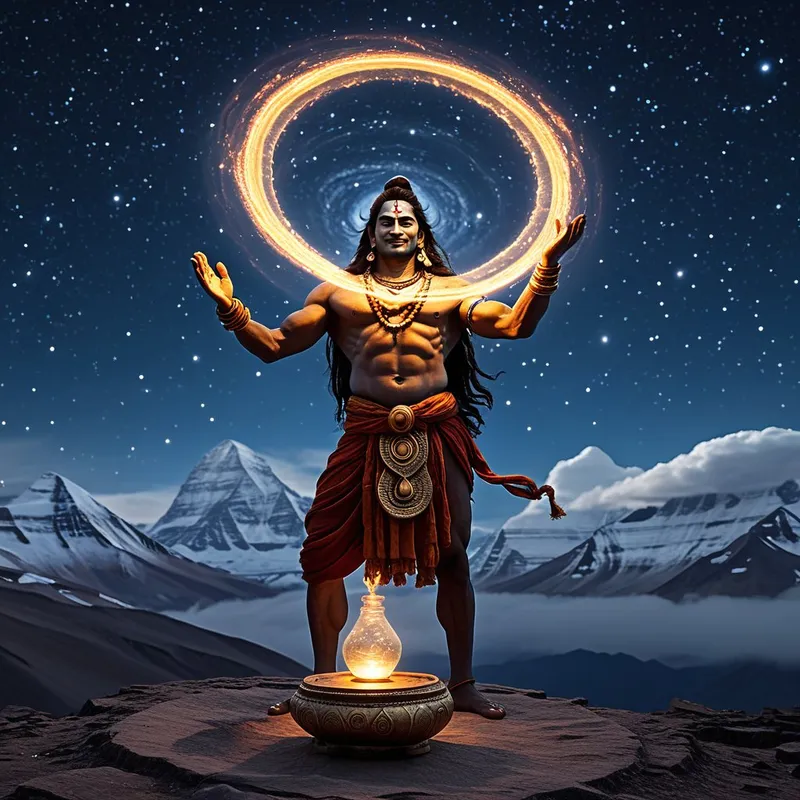
Damaru Myth Meaning & Symbolism
The story of Shiva's Damaru, whose cosmic beat shatters illusion and births the sacred sounds of language and existence from the void.
The Tale of Damaru
Listen. Before the worlds were named, in the cavernous silence that is not silence but the hum of potential, there was a mountain. Not of stone, but of ignorance—dense, dark, and absolute. It sat upon the chest of existence, a weight so profound it stilled the very breath of time. In its shadow, nothing stirred, for nothing could be conceived. This was the mountain of Maya.
And upon its highest, most desolate peak sat Shiva. Not as a king upon a throne, but as the essence of stillness itself. His body was smeared with the ashes of burned universes, his matted locks holding the captive Ganges of all flowing thought. His third eye, a sealed sun, saw only the infinite void within. He was the great Yogi, immersed in Samadhi. The world slept within him, unborn.
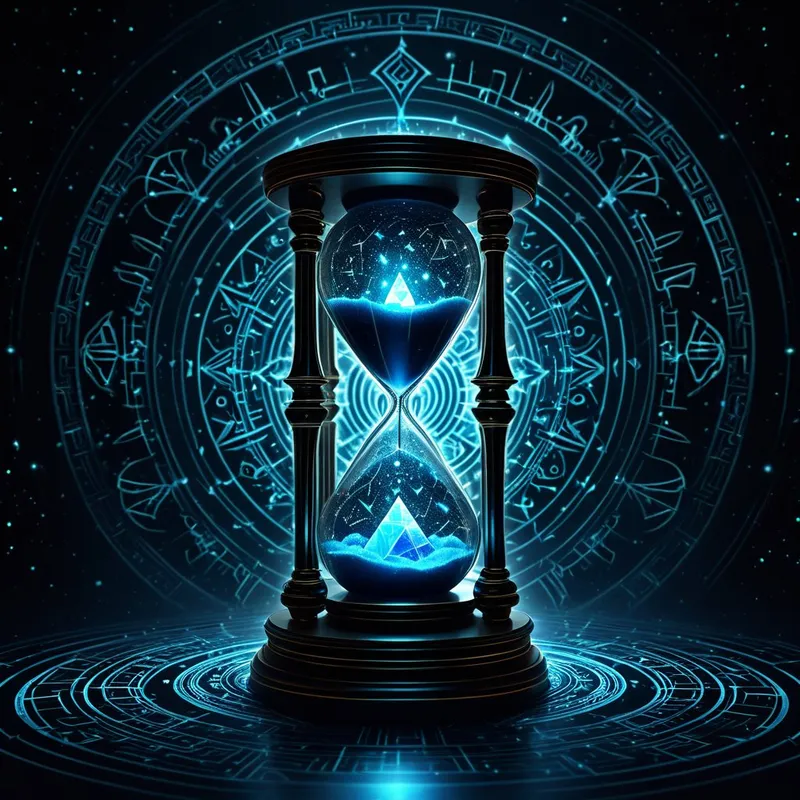
But a rhythm, deep and insistent, began. Not from outside, for there was no outside. It was the pulse of his own heart, the thrum-thrum-thrum of consciousness yearning to know itself. It echoed in the hollow of his being, seeking form. And in the dance of that inner necessity, one of his hands—the hand that gestures fearlessness—curled into a fist, save for the index finger pointing to the sky. From the junction of his thumb and that finger, a shape manifested. Small, potent, an hourglass of time and timelessness. Two triangles, apex to apex. This was the Damaru.
He raised it. And then, with a flick of his wrist so subtle it was like the first thought disturbing eternity, he shook it.
Tak!
The sound was not loud. It was the first thing that was other. It was a sharp, percussive crack in the egg of the unreal. The mountain of Maya shuddered. A single, hairline fracture appeared from peak to base.
Tak-tak! Tak-tak-tak!
The rhythm became a cascade, a staccato river. Each beat was a hammer of truth striking the dark glass of delusion. The fractures multiplied, a luminous web spreading across the monolithic dark. With every oscillation of the drum, with every swing of the twin pellets on their cords, a new vibration was born. These were not mere noises. They were seeds. They were the Matrikas, the mother-sounds.
From the drum’s furious, creative dance, the sacred syllables flew like sparks: A, Ka, Cha, Ta… The entire alphabet of Sanskrit, the Maheshvara Sutrani, crystallized in the air, glowing with the light of pure meaning. The mountain did not merely break; it transmuted. Its crushing weight became the fertile soil of differentiation. Its oppressive silence became the symphony of names and forms. Where there was One, undifferentiated, there now was the Many, singing their particularity into being.
And Shiva? He began to dance. The Tandava commenced, its tempo set by the relentless, generative beat of the Damaru. The destroyer of illusion had become the conductor of creation, his drum the baton that called all things forth from the void, and the metronome by which they would eventually dissolve back into it.
Cultural Origins & Context
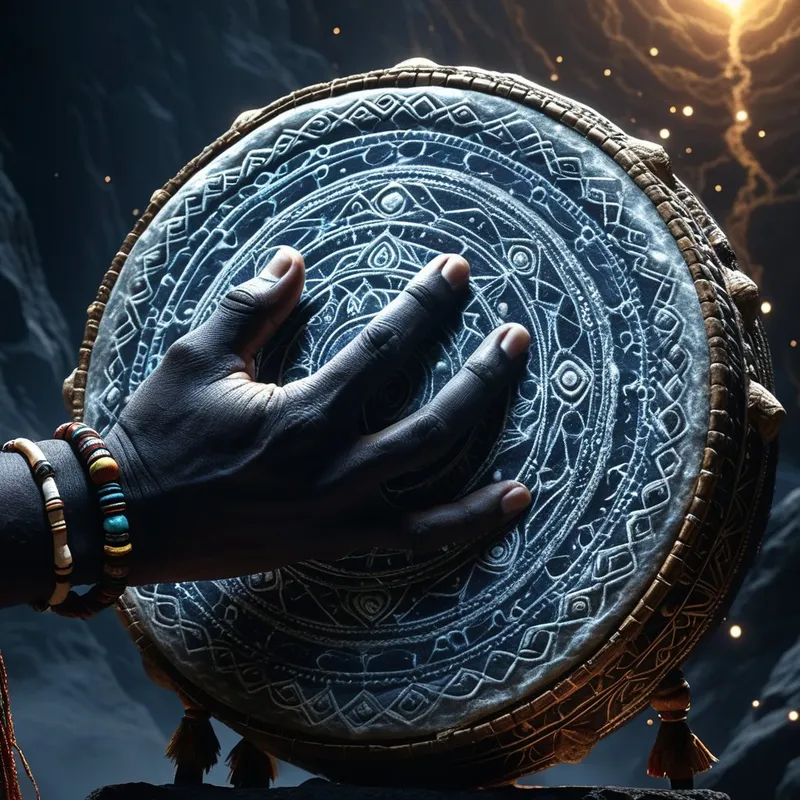
The Damaru is inextricably linked to Shiva, one of the principal figures of the Hindu pantheon. Its myth is not found in a single, canonical text but is woven through the tapestry of Puranic literature, Tantric philosophy, and iconographic tradition. It is a story told by sages in forest groves, depicted by sculptors on temple walls, and contemplated by yogis in deep meditation.
Its primary societal function was ontological and linguistic. It provided a divine origin story for language itself, elevating Sanskrit from a human tool to a cosmic vibration, the very substance of reality. In Advaita Vedanta, the Damaru’s sound symbolizes Pranava, the unstruck sound that precedes manifestation. In the esoteric practices of Tantra, miniature Damarus are used in ritual, their beat mirroring the inner rhythm of nadis and the awakening of Kundalini. Thus, the myth served both to explain the cosmos and to provide a practical map for the mystic to navigate back to its source.
Symbolic Architecture
The Damaru is a universe in miniature. Its hourglass shape is the confluence of opposites: the ascending and descending triangles, male and female, static and dynamic, Purusha and Prakriti. It is the point of dynamic tension where being becomes becoming.
The beat of the Damaru is the heartbeat of the cosmos, the intermittent pulse that simultaneously creates and measures the lifespan of all phenomena.
The two drumheads represent duality—subject and object, self and other—while the central waist is the narrow passage of the present moment, the bindu or point from which all expands. The pellets, swinging on their cords, are the twin forces of action and reaction, cause and effect, whose collision on the skins produces the "world." Most profoundly, the Damaru symbolizes the destruction of monolithic, undifferentiated consciousness (the mountain of ignorance) to birth the articulated, knowable world. It is not destruction for its own sake, but the necessary fracturing that allows for relationship, meaning, and ultimately, the journey back to a conscious unity.
The Dreamer's Resonance
To dream of a drumbeat emerging from silence, or of a small, potent object that cracks a vast, oppressive structure, is to touch the Damaru archetype in the personal psyche. Somatically, one might feel a rhythmic tension-release in the chest or solar plexus, a literal "heartbeat" of a new awareness trying to break through.
Psychologically, this signals a critical phase where a long-held, monolithic complex—a core belief, a buried trauma, a rigid self-image—has become a mountain of ignorance upon the soul. It feels solid, eternal, and silencing. The dream drumbeat is the emerging voice of the Self, the inner Shiva, initiating the process of disillusionment. The dreamer is not being broken down, but broken open. The rhythmic, often startling sound in the dream represents the insistent, sometimes uncomfortable truth that can no longer be contained, beginning the necessary fragmentation of an old, solid-state identity to make way for a more fluid, conscious, and articulated one.

Alchemical Translation
The myth of the Damaru models the alchemical process of solve et coagula—dissolve and coagulate—applied to the psyche. Individuation requires the dissolution of the persona, the complexed structures we mistake for our true selves. This is the "mountain of Maya" within.
The first act of true self-creation is an act of sacred destruction: the shattering of the illusion that you are already complete.
The modern individual must become the Yogi-Shiva, finding the still point within (Samadhi) from which the transformative impulse arises. The "Damaru" is then the focused application of conscious attention—therapy, meditation, creative expression, shadow-work—that rhythmically strikes at the core of the complex. Each insight, each confrontation, is a tak! that creates a fracture in the edifice of the old self.
From this sacred destruction comes a new creation. The fragmented pieces do not scatter; they reorganize into the "Sanskrit alphabet" of the soul—a more nuanced, articulate, and authentic vocabulary of self. The once oppressive weight of a false identity becomes the fertile ground for a conscious personality. The individual learns to "speak" their own truth, having discovered the primordial sounds (Matrikas) of their unique being. They move from being a silent, monolithic statue of ego to a living, rhythmic participant in the Tandava of their own life, able to both shape their world and gracefully let it go, guided by the inner drumbeat of the Self.
Associated Symbols
Explore related symbols from the CaleaDream lexicon: