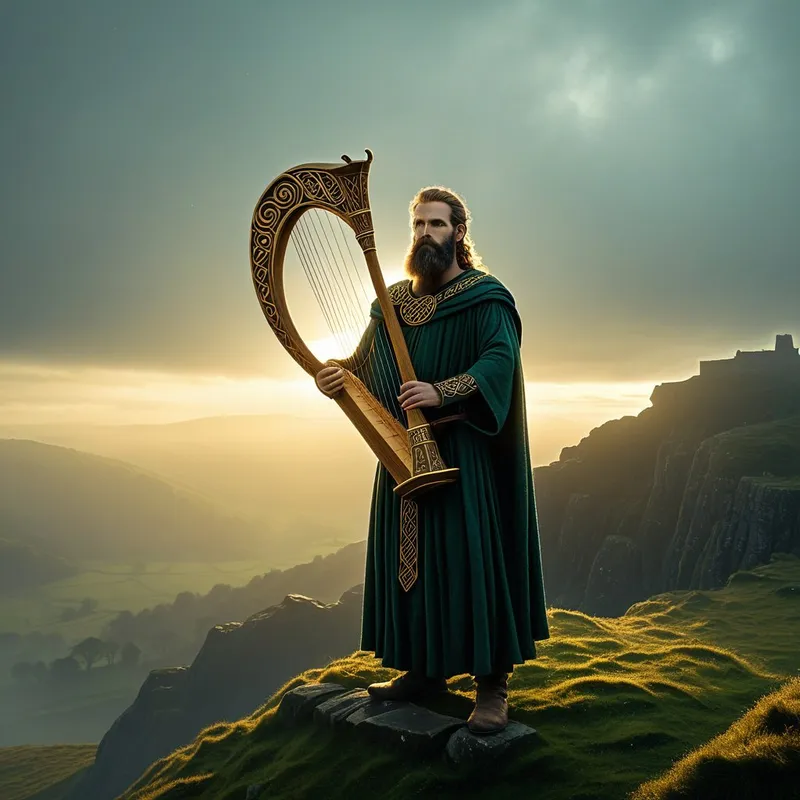
Dagda's Harp Myth Meaning & Symbolism
The Dagda retrieves his stolen magical harp, using its three strains of music to command the seasons, emotions, and will of his enemies.
The Tale of Dagda's Harp
Listen now, and let the fire’s glow become the hearth of a ráth. The air grows thick with the scent of damp earth and woodsmoke. The great war was over. The Fomorians, those misshapen lords of chaos and blight, had been driven back to the cold, grey edges of the world by the shining host of the Tuatha Dé Danann. Yet, in their retreat, they committed a theft that struck at the very heart of the victors. They stole the Harp of the Dagda.
This was no ordinary instrument. Carved from ancient, living oak and strung with the hair of a queen, it was called Uaithne. It was the Dagda’s soul-companion, the tuner of the world’s rhythm. With it missing, a silent dread crept into the Hall of Mead. Joy was muted. The seasons themselves seemed to hold their breath, uncertain.
So the Dagda, with his son Aengus Óg and the fierce warrior Lugh Lámhfhada, journeyed to the very stronghold of the enemy. They came to a grim fortress of black stone, Brug na Bóinne, where the Fomorians feasted in hollow triumph. Through magic and stealth, they entered the great hall.
There, upon the wall, hung Uaithne. The Fomorians, bloated and cruel, had dared not play it, for its magic answered to none but its true master. The Dagda stood in the doorway, and he called out. Not with a shout of war, but with a deep, resonant chant. He called to his harp by its secret, soul-names.
And the harp answered.
With a sound like a sigh of the world itself, it flew from the wall, killing nine Fomorian guards as it passed, and came to rest in the Dagda’s waiting hands. The hall fell into a stunned silence. The Fomorian king, Bres, snarled a command to seize them.
Then, the Dagda’s fingers touched the strings.
He played the first strain: Goltraí. A weeping melody poured forth, and every Fomorian in the hall was overcome with a bottomless, wailing grief. They dropped their weapons and wept like lost children for all the misery they had ever caused.
He played the second strain: Geantraí. The music shifted, becoming bright and bubbling as a spring stream. The Fomorians’ tears turned to helpless, roaring laughter. They clutched their sides, rolling on the floor, utterly disarmed by uncontrollable mirth.
Finally, he played the third strain: Suantraí. This was a melody as soft as twilight, as deep as the earth’s rest. One by one, the Fomorians slumped to the ground, falling into a profound and dreamless sleep. The Dagda, Aengus, and Lugh walked freely among the slumbering giants, took what was theirs, and departed.
And as they returned to the light, the Dagda played a final chord—a chord of pure sovereignty. The land, which had held its breath, exhaled. The seasons remembered their order. Harmony was restored, not by the sword alone, but by the command of the true note.
Cultural Origins & Context
This myth comes to us from the medieval Irish textual tradition, primarily preserved in the Lebor na hUidre and later manuscripts like the Book of Leinster. It is part of the Cath Maige Tuired cycle, which narrates the epic struggle between order and chaos, embodied by the Tuatha Dé Danann and the Fomorians.
The story would have been the domain of the filid, the poet-seers. For them, it was not mere entertainment but a sacred narrative encoding cosmic principles. In a society where the king’s righteousness was believed to directly affect the fertility of the land, the Dagda’s harp was a potent symbol of legitimate rule. Its theft represented the ultimate disorder—a rupture in the contract between the ruler and the cosmos. Its recovery and the subsequent enchantment of the enemies demonstrated that true power lies not in brutal force, but in the authoritative wisdom to command the very fabric of emotion, time, and consciousness.
Symbolic Architecture
The harp, Uaithne, is the central symbol—an instrument of world-tuning. It represents the integrated Self, the cohesive center of the psyche that can orchestrate disparate internal forces.
The three strains—Goltraí, Geantraí, Suantraí—are not merely songs; they are the primordial frequencies of human experience: the catharsis of grief, the liberation of joy, and the peace of dissolution.
The theft by the Fomorians symbolizes a state of psychic fragmentation, where our core talents, our essential voice (our "harp"), is captured by the chaotic, shadowy complexes of the unconscious—by our inner "Fomorians" of unresolved trauma, addiction, or negative self-image. These complexes cannot use our gift; they can only hoard it, leaving the inner kingdom barren.
The Dagda’s journey is the ego’s courageous foray into the shadow-lands to reclaim what was lost. His calling of the harp by its true names is an act of profound self-recognition and invocation. The harp’s violent flight to him shows that when the Self is truly called, it moves with a force that can dismantle the defensive structures (the "nine guards") of the complex.
The Dreamer's Resonance
When this myth stirs in the modern unconscious, it often manifests in dreams of searching for a lost, precious object of personal power or creativity in a confusing or hostile environment. One might dream of a forgotten musical instrument in a basement, a locked chest containing a personal talisman, or a voice that cannot be used.
The somatic experience is one of constriction in the chest or throat—a literal feeling of being unable to "sound one’s note." Psychologically, the dreamer is in a state where their authentic expression has been silenced or hijacked. This could be by external circumstances (a oppressive job, a draining relationship) or, more deeply, by an internalized critic or a depressive complex (the inner Fomorian). The dream is a map pointing toward the necessity of a "journey to the stronghold"—a conscious engagement with the very place where one feels one’s power is held captive.
Alchemical Translation
The process modeled here is the alchemy of reclamation and integration, a core phase of individuation. The "base metal" is the state of being robbed of one’s essence. The "transmutation" occurs through a threefold operation:
First, one must Goltraí: honestly confront and sound the note of sorrow. This is the conscious grieving for what was lost, the pain of inauthenticity, the tears that soften the hardened earth of the psyche.
Second, one must Geantraí: reclaim the capacity for unbridled joy and pleasure, often the first thing sacrificed to a complex. This is not frivolity, but the defiant laughter that breaks the spell of self-seriousness and oppression.
Third, one must Suantraí: learn the art of restful dissolution. This is the conscious surrender, the trustful sleep that allows the frantic ego to step aside, letting the deeper, orchestrating Self (the Dagda) take the harp and play the chord of sovereignty.
The ultimate goal is not to destroy the Fomorians, but to render them harmless through understanding—to put the chaotic forces of the psyche to sleep, not by suppression, but by the overwhelming authority of one’s true, integrated voice.
For the modern individual, the myth teaches that healing and power come not from fighting the shadow with its own weapons of rage and control, but from retrieving and masterfully playing the unique instrument of the Self. When we do, we don’t just defeat our enemies; we command the seasons of our soul, moving from the stolen winter of despair to the sovereign harmony of an authentic life.
Associated Symbols
Explore related symbols from the CaleaDream lexicon: