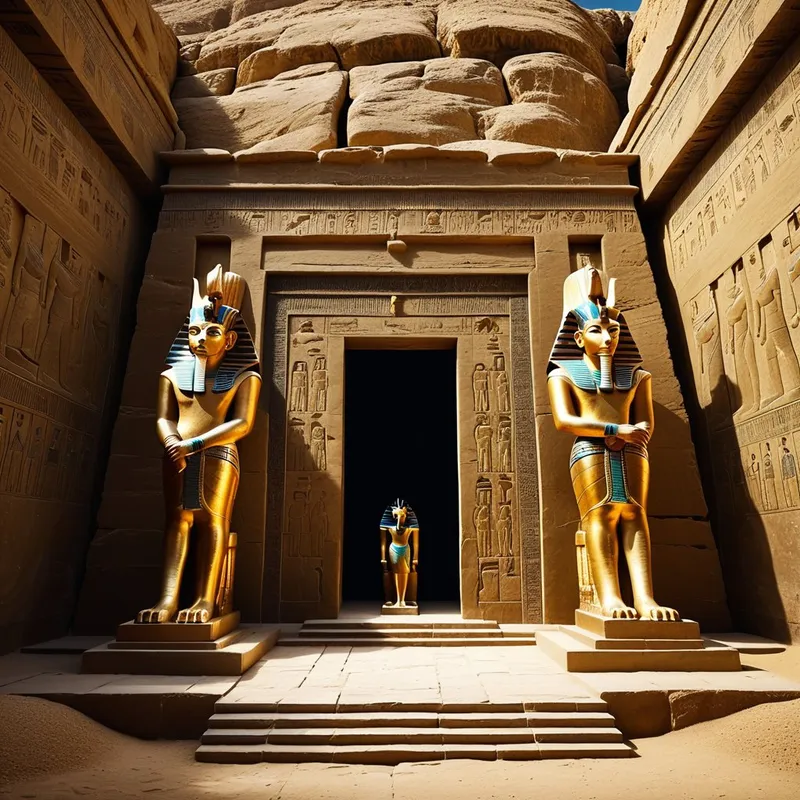
Curse of Tutankhamun Myth Meaning & Symbolism
A modern legend of a sacred tomb's violation and the subsequent misfortunes that befell its discoverers, echoing ancient fears of divine retribution.
The Tale of the Curse of Tutankhamun
Listen, and hear a tale not carved on ancient temple walls, but whispered in the dry, electric air of the modern age. It begins not in the time of pharaohs, but in the dust-choked stillness of a November morning in 1922. In the Valley of the Kings, the sun was a hammer on stone. For years, the pick had struck and the shovel had turned, seeking a king lost to history—Tutankhamun.
The man with the quest was Howard Carter, his patience worn thin as papyrus. His patron, Lord Carnarvon, was ready to abandon the dream. But then, a step. A stair, cut into the bedrock, leading down into the heart of the mountain. The air that seeped from the sealed doorway was not of earth, but of time itself—warm, stale, heavy with the scent of resin and eternity.
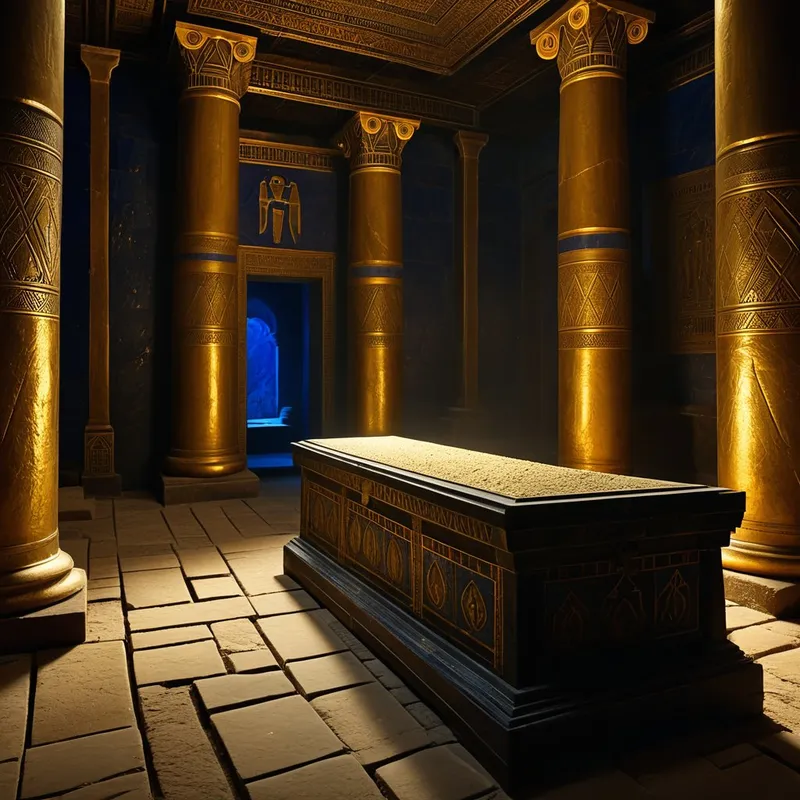
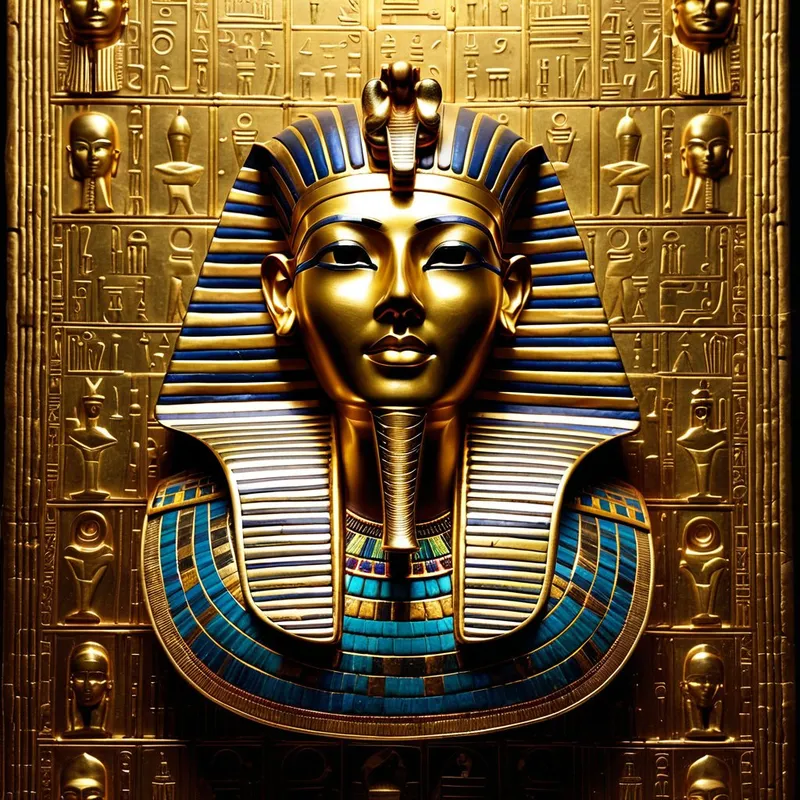
With trembling hands, Carter made a small breach in the upper left corner of the door. He held a candle to the opening. “Can you see anything?” Carnarvon asked, his voice tight. Carter could only whisper, his words swallowed by the darkness, “Yes, wonderful things.” Gold. Everywhere, the glint of gold. Gilded chariots, alabaster vessels, statues with eyes of obsidian, a throne inlaid with glass and gemstones. It was a cavern of silent, waiting splendor, a kingdom preserved in amber darkness. And at its heart, sealed within four shrines of gilded wood, lay the stone sarcophagus of the boy king himself, his face forever young beneath the cold, beautiful weight of a solid gold mask.
But as the world marveled at the treasures, a different story began to unfold. It started with a sting. In Cairo, Carnarvon was bitten by a mosquito. The bite became infected. Fever took him. And at the precise moment of his death, back in England, the lights of Cairo reportedly flickered and died. His dog, Susie, at his ancestral home, let out a howl and dropped dead.
This was but the first thread in a tapestry of dread. Others who had entered the tomb met strange fates. A financier was found dead in his club. A radiologist who X-rayed the mummy died of a mysterious illness. A member of the excavation team died suddenly of heart failure. A visitor to the tomb fell into a coma. The newspapers, hungry for sensation, gave it a name: The Curse of the Pharaoh. They spoke of spores in the tomb, of ancient poisons, but the people heard a older truth: the sacred had been violated. The peace of the Ka had been disturbed. The guardians of the Duat—Anubis, Serqet—had exacted their price. The door to the afterlife had been opened from the wrong side, and something had looked back.
Cultural Origins & Context
Unlike the myths of Ra or Osiris, the Curse of Tutankhamun is a distinctly modern legend, born at the collision of 20th-century archaeology and ancient Egyptian cosmology. Its origins are not in priestly ritual but in newspaper headlines, yet it draws its profound power from a deep, authentic cultural wellspring.
For the ancient Egyptians, the tomb was not a mere grave; it was the Per-Djet, the “House of Eternity,” a sacred machine designed to protect the Ka and ensure safe passage to the Duat. Inscriptions in older tombs did contain warnings, not of mystical curses, but of practical and spiritual consequences for violators—threats of prosecution by the pharaoh’s court or of having their offerings to the gods rejected. The underlying principle was Maat—cosmic order, truth, and justice. To desecrate a tomb was to commit an act of profound Isfet (chaos), disrupting the delicate balance between the living and the dead.
The “curse” narrative found fertile ground in the Western imagination, which was already primed by Gothic literature and a fascination with the “Orient.” It functioned as a folkloric correction, a psychic immune response from the collective unconscious. Where science saw an archaeological site, the myth-making mind saw a sanctum. The culture that created the tomb, through a kind of psychic osmosis, imposed its deepest values upon those who breached it. The story was passed down not by elders, but by journalists and gossips, becoming a cautionary tale for the modern age about the price of unmasking secrets and plundering the past without reverence.
Symbolic Architecture
At its core, the myth is not about supernatural vengeance, but about the inevitable return of the repressed. The sealed tomb is the ultimate symbol of the unconscious—a carefully constructed, opulently decorated vault containing the preserved essence of a forgotten self (the boy-king). The archaeologists represent the rational, conscious ego, driven by curiosity, ambition, and possession (“wonderful things”).
The curse is the shadow’s answer to the ego’s intrusion. It is the law of psychic equilibrium asserting itself.
The “curse” manifests as a series of seemingly coincidental misfortunes. Symbolically, these are the symptoms of a profound disorientation that occurs when a sealed complex of psychic material—trauma, genius, forgotten history, ancestral memory—is violently exposed to the light of day without proper ritual or integration. The treasures are the latent potentials and ancient wisdom; the ensuing misfortune is the dis-ease that comes from possessing them without understanding their context or cost. The gold mask is the brilliant persona, the face shown to the world, but behind it lies the vulnerable, mummified reality.
The key deities implied are not active avengers but personified principles. Anubis is the guardian of thresholds, the weigher of hearts. His presence signifies that a moral and psychic accounting is due. Serqet, scorpion goddess, represents the sudden, piercing toxicity of unintegrated shadow content.
The Dreamer's Resonance
When this myth pattern erupts in the modern dreamscape, it signals a profound encounter with the personal “tomb.” The dreamer may find themselves in a labyrinthine basement, a locked attic, or a forgotten room in their own house that is suddenly full of ancient, valuable, or terrifying artifacts. They may discover a sealed box or a hidden diary.
The somatic feeling is one of awe mixed with dread, a racing heart in a stifling silence. Psychologically, this is the process of numinous intrusion—the ego stumbling upon a complex within the unconscious that is both sacred and dangerous. The “curse” in the dream might manifest as a string of bad luck in the dream narrative, a pursuing shadow figure, or a feeling of being contaminated or haunted after the discovery.
This dream is an initiation into shadow-work. The treasures found are the repressed talents, memories, or energies (the “gold”). The ensuing disturbance is the psyche’s demand that these contents not be merely looted for ego-inflation (“I found something wonderful in myself!”) but be respectfully excavated, examined, and integrated into the whole self. The dream is a warning against spiritual materialism—the desire to possess inner wisdom without undergoing the transformative process it requires.
Alchemical Translation
The alchemical journey modeled here is the Nigredo—the blackening, the initial confrontation with the prima materia in its raw, chaotic, and potentially toxic state. Carter’s moment at the tomb door is the moment of solutio (dissolution), where the known world of the ego is dissolved by contact with the overwhelming unknown.
The curse is the first, necessary stage of transmutation. It is the old self falling ill so that a new consciousness can be born.
For the modern individual, the “Valley of the Kings” is the depth of one’s own personal and ancestral history. The “excavation” is any deep psychological or spiritual quest—therapy, meditation, artistic creation, or any journey into memory. The “curse” is the inevitable crisis that follows initial discovery: old wounds reopening, chaotic emotions surfacing, life structures destabilizing. This is not a punishment, but the operation of a natural law. You cannot disturb the resting place of a buried king (a dominant complex, a core trauma, a supreme talent) and expect life to continue as normal.
The alchemical goal is not to avoid the curse, but to move through it with awareness, to transform the “misfortune” into the mortificatio (death of the old attitude) that precedes albedo (whitening, purification). Integration occurs when we stop being “archaeologists” looting our own souls for shiny insights and become “priests of Anubis,” performing the careful, respectful work of reconstituting what we have found. We must learn the language of the artifacts—our symptoms, dreams, and disturbances—and return them to their sacred function within the temple of the self. Only then does the gold of the mask become the gold of the philosopher’s stone, and the guardian of the tomb become the protector of the reborn soul.
Associated Symbols
Explore related symbols from the CaleaDream lexicon: