Cthulhu Myth Meaning & Symbolism
A cosmic entity sleeps in a sunken city, its dreams warping human sanity, embodying the terror of a meaningless cosmos and the fragility of the human mind.
The Tale of Cthulhu
Listen. The world you know is a thin scum on a shoreless ocean of time and space. Before the first mammal drew breath, before the continents cracked, They were here. From the dark between the stars, They came—the Great Old Ones. And among them, greatest in our tiny, doomed sphere, was the high priest Cthulhu.
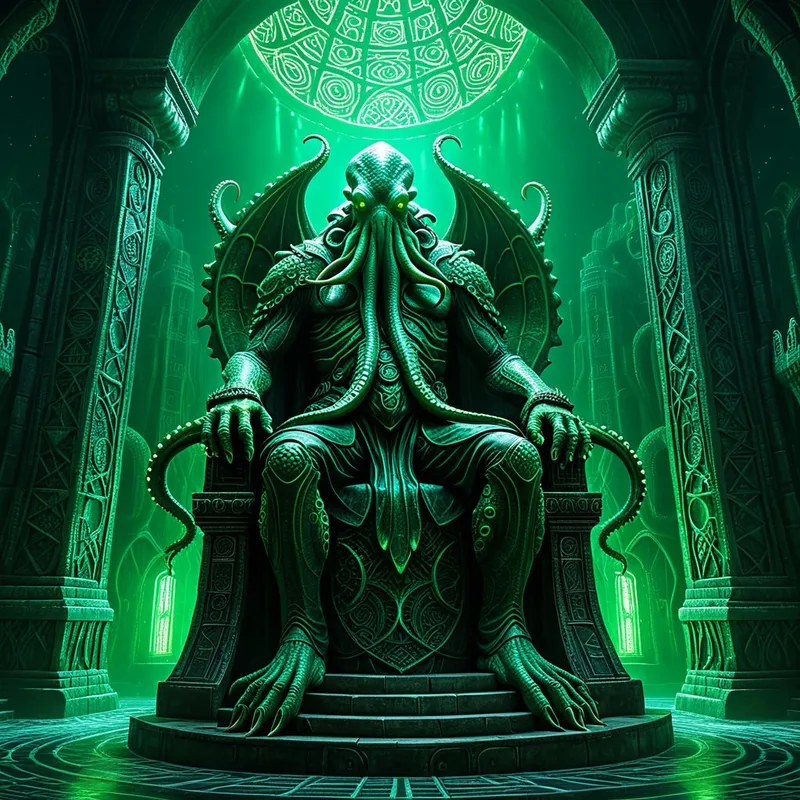
He was a mountain of blasphemous flesh, a chaos of shapes: a man-like parody with a head of writhing feelers, vast leathery wings folded like a shroud, and claws that could rend the fabric of reality. With his kin, he built the nightmare city of R'lyeh from stone that obeyed no sane geometry, in a land now drowned beneath the Pacific’s deepest trenches. There they ruled, under a green, sickly sky, whispering secrets that would shatter a mortal mind.
But the stars changed. A great cataclysm, a war in heaven or a shift in cosmic law, sealed R'lyeh beneath the waves. Not dead, for They cannot die as we understand it, but trapped in a death-like sleep. Cthulhu lies in his water-logged tomb, preserved by the very sea that imprisons him. And he dreams.
His dreams are a poison that seeps through the cracks of the world. They flow into the minds of poets, artists, and the sensitive, bringing visions of the sunken city and the promise of his return. They call to the degenerate cults that fester in remote corners of the earth, who chant the maddening phrase, “Ph'nglui mglw'nafh Cthulhu R'lyeh wgah'nagl fhtagn.” In his house at R'lyeh, dead Cthulhu waits dreaming.
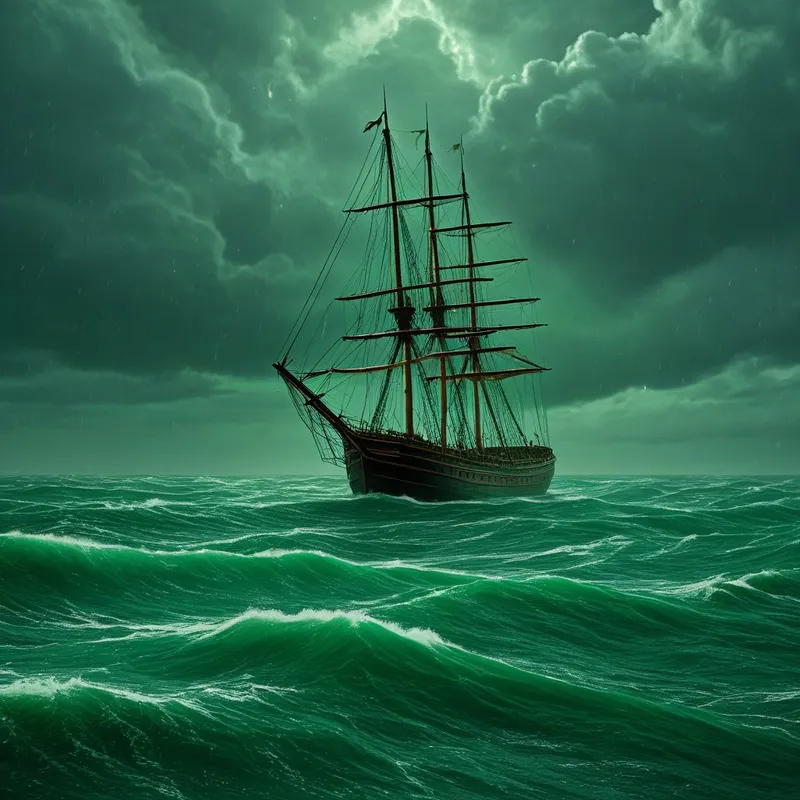
And sometimes, the stars grow right. The prison of stone and sea strains. In 1925, a tempest of madness churned the ocean. A sailor, lost and terrified, witnessed it: the city rose, a horror of angles that hurt the eyes, breaking the surface in a place where no land should be. The stone door of Cthulhu’s tomb groaned open. For a moment, a green, titanic shadow stirred within, and the very air thickened with a stench of cosmic rot and alien oceans. The mind of every living thing on the nearby ship screamed in unison, teetering on the brink of utter dissolution.
But fate, or chance—a meaningless hiccup in the universe—intervened. The stars slipped again. The city sank, the door slammed shut, and the dreaming resumed. The world was spared, not through heroism or divine grace, but by accident. The sleeper had merely turned over. The cults still whisper. The sensitive still shudder in their sleep. He is waiting. Always waiting.
Cultural Origins & Context
The Cthulhu mythos is a uniquely modern mythology, born not from ancient oral tradition but from the typewriter of a reclusive New England writer, H.P. Lovecraft, in the early 20th century. Its transmission is literary, a "pseudo-mythology" constructed through a web of interconnected stories shared and expanded by Lovecraft and his circle, now known as the "Cthulhu Mythos."
Its societal function mirrors that of ancient cautionary tales, but updated for a post-Darwinian, post-Einsteinian world. Where older myths warned against offending local gods, the Lovecraftian myth warns against the pursuit of knowledge itself, reflecting the profound anxieties of its era: the terror of a vast, mechanistic universe revealed by science, in which humanity is an irrelevant accident. The "cultists" in the stories are often marginalized groups—degenerate coastal communities, remote islanders, non-Western peoples—onto which Lovecraft projected his own xenophobic fears, making the myth also a dark reflection of early 20th-century social dread. It is a mythology of cosmic pessimism, passed down not by bards but by forbidden books like the fictional Necronomicon, and its primary function is to model a universe devoid of the comforting narratives of purpose, morality, and human centrality.
Symbolic Architecture
Cthulhu is not a monster in the traditional sense. He is a symbol, perhaps the ultimate symbol, of the Self in its most alien and terrifying aspect. He represents the sheer, overwhelming Otherness of the unconscious psyche and the external cosmos, which are, in this myth, fundamentally the same.
The greatest terror is not the monster that wants to destroy you, but the cosmos that does not even notice you exist.
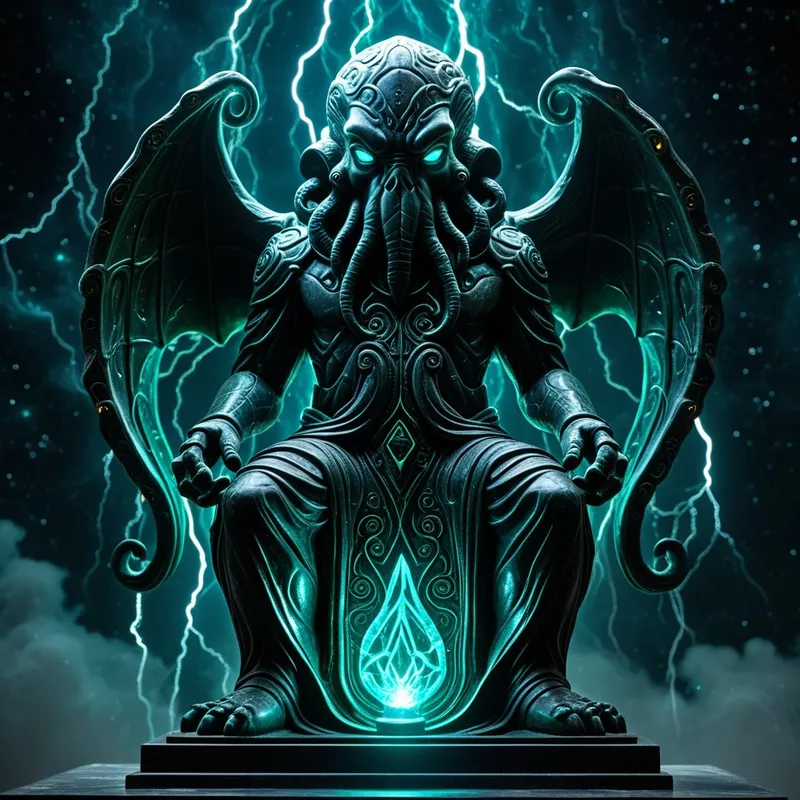
Cthulhu’s hybrid form—part octopus, dragon, and human—symbolizes a chaotic, primordial unity that predates and mocks our neat biological categories. His sunken city, R'lyeh, with its non-Euclidean geometry, is the architecture of a mind that operates on logic utterly foreign to our own, a direct representation of the incomprehensible structure of the deep unconscious. His "dreams" that influence humanity are the symbolic expression of how contents of the collective unconscious—archetypal, powerful, and often terrifying—can erupt into the conscious world, causing psychic upheaval, "madness," or artistic inspiration. The cults represent the dangerous, shadowy allure of this unconscious material, the temptation to surrender one's individual consciousness to the pull of a vast, impersonal psychic force.
The Dreamer's Resonance
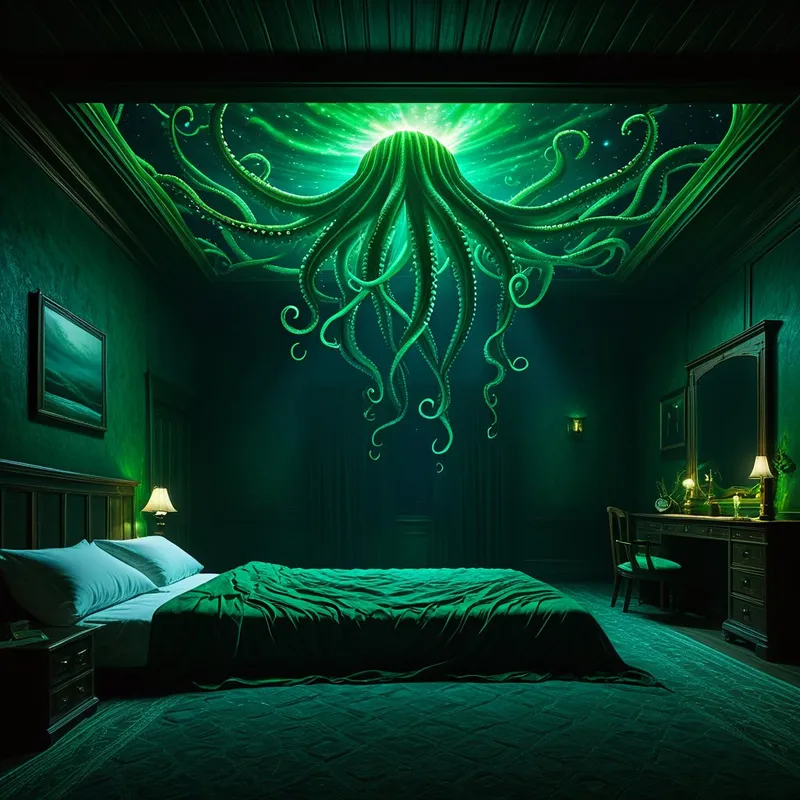
When the pattern of the Cthulhu myth manifests in modern dreams, it is rarely as a literal tentacled giant. It appears as the experience of cosmic insignificance and psychic inundation. The dreamer may find themselves in a vast, empty space (cosmic or oceanic), feeling terrifyingly small. They may encounter architecture of impossible, dizzying scale and angles. They may sense a vast, sleeping presence beneath the landscape of the dream—under the floorboards, below the city streets, at the bottom of a dream-sea.
Somatically, this is the psyche processing the shock of confronting what psychologist Carl Jung called the "shadow" at a collective level: not just our personal repressed flaws, but the shared, archaic underpinnings of human existence that are utterly indifferent to our individual lives and civilized pretensions. The psychological process is one of ego-dissolution. The dream-ego is confronted with a reality so much vaster than itself that its boundaries threaten to melt away. This can feel like madness, but it is also a necessary confrontation with the non-human substrate of the psyche. The "rising city" in the dream signals a moment where this deeply buried content is threatening to break into conscious awareness, often triggered by life crises, existential dread, or profound disillusionment with traditional meaning-systems.
Alchemical Translation
The alchemical process modeled here is the nigredo—the blackening, the dissolution, the confrontation with the prima materia in its most chaotic and despairing form. In the individuation journey, one must eventually face the "Cthulhu" within: the realization that the core of the self is connected to something ancient, impersonal, and seemingly monstrous. The ego, like the sailor on the Alert, is a fragile vessel on this psychic ocean.
The goal is not to defeat the sleeper, but to survive the encounter with the knowledge of its existence, and in doing so, have the old, naive self die.
The triumph in this myth is paradoxically found in its lack of heroic triumph. The "resolution" is the sealing of the tomb, the resumption of the dream. Psychically, this translates to the ego's task of not being destroyed by the unconscious, but of learning to contain its reality. One does not integrate Cthulhu; one acknowledges that he sleeps in the abyss of the soul. The alchemical work is to build a conscious mind strong enough and humble enough to know it rests atop a sunken city of unimaginable antiquity and power, without fleeing into madness or the cultist's blind worship.
This process transmutes the lead of cosmic terror into the gold of a more authentic, grounded humility. The individual who has faced this psychic truth no longer labors under the illusion of being the center of the universe. Their identity is no longer a defiant castle on a hill, but a conscious, aware outpost on the shore of a vast and unknown sea. They have seen the shadow of the wings in the dream, felt the city shift beneath their feet, and returned to the waking world carrying not answers, but a profound, unshakeable question that forever alters their relationship to reality.
Associated Symbols
Explore related symbols from the CaleaDream lexicon: