Crown of Britain Myth Meaning & Symbolism
A myth of a king forged not by bloodline but by sacred ordeal, uniting his soul with the spirit of the land to become its true sovereign.
The Tale of Crown of Britain
Listen. The wind that moans through the stones of Camelot carries an older song. It sings of a time before banners, before Round Tables, when the land itself was awake and watching. It sings of the Crown of Britain.
This was no crown of gold, hammered by smiths. It was a living truth, a covenant written in the bedrock and the rushing streams. The land, Logres, was a queen without a consort, wild and sorrowful. Her hills were her shoulders, slumped; her rivers were her tears, flowing to a joyless sea. She waited, not for a conqueror, but for a king whose heart could beat in time with her own deep, slow pulse.
Into this waiting stillness came a youth, not yet Arthur, bearing only a question and a sword pulled from a stone—a feat of strength, but not of sovereignty. The wizard Merlin, whose eyes held the grey of mountain mist, led him to a place that was no place: a grove of ancient oak at the world’s navel. “Here,” Merlin whispered, his voice like rustling leaves, “you will not be given a crown. You will be asked a question by the land. Your answer will forge it.”
As the moon climbed, the grove changed. The oaks became silent judges. The wind died. From the earth rose a presence, vast and feminine—the spirit of the land. She did not speak with a mouth, but her voice echoed in Arthur’s bones: “What do you offer?”
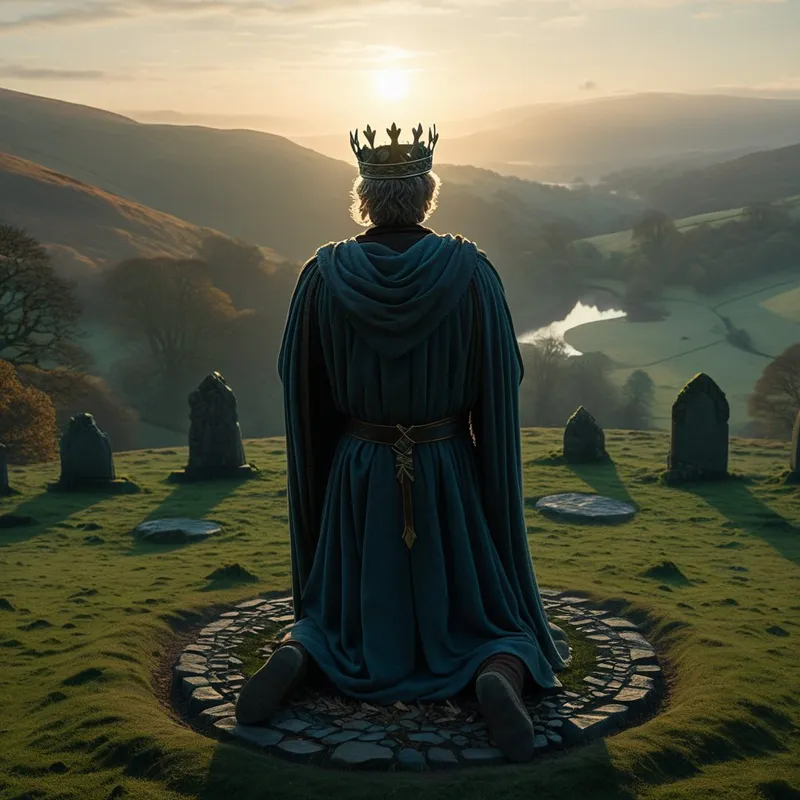
He offered his sword. The earth swallowed it without a sound. He offered his future glory. The oaks sighed in disdain. Desperate, feeling the immense loneliness of the land seep into his soul, he understood. He knelt, pressing his palms to the cold soil. “I offer my self,” he said, his voice cracking. “My joy shall be your sunlight, my sorrow your rain. My peace your meadows, my strife your storms. I am not your master. I am your husband. My life for your life.”
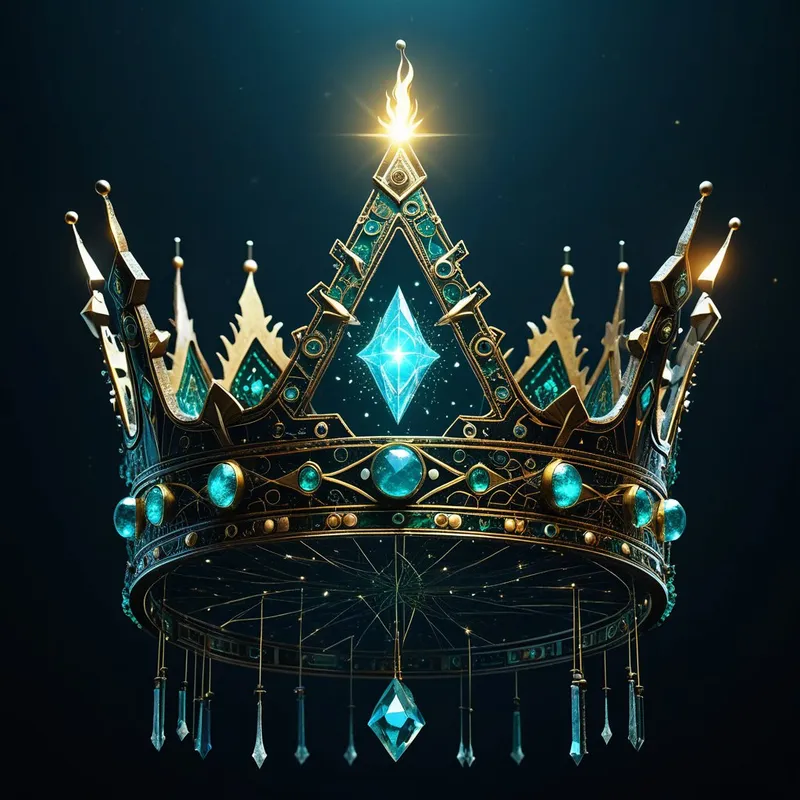
Silence, deeper than before. Then, a tremor. Not of fear, but of recognition. From the soil where his hands lay, roots of light spiraled upward, weaving around his brow. From the stars above, threads of cold, clear certainty descended. They met upon his head, knitting together not gold, but an essence—a circlet of responsibility made visible. It was heavy, heavier than any metal, for it held the weight of every stone, the flow of every river, the breath of every creature in the isle. The Crown of Britain was not placed; it was grown. And in that moment, Arthur was no longer just a man. He was the land’s chosen soul, and the land became his living body.
Cultural Origins & Context
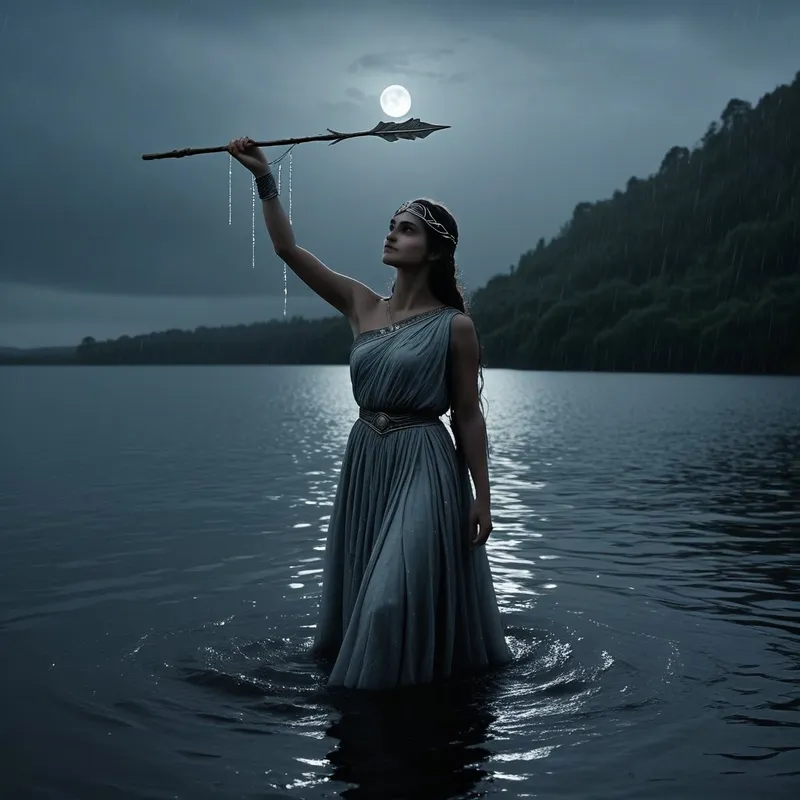
The concept of the Crown of Britain as a sacred, animistic covenant predates the chivalric romances of the High Middle Ages. Its roots sink into the pre-Christian, Celtic soil of the British Isles, where kingship was not merely a political office but a sacerdotal function. The king was seen as the tánaiste ríg—the earthly spouse of the sovereignty goddess, often manifest as the land itself. His fitness to rule was proven through symbolic marriage, ensuring fertility, peace, and prosperity.
In the Arthurian corpus, this ancient mythic stratum was preserved and transformed by Welsh bards and later, French romancers. It is rarely a single, explicit tale but a pervasive undercurrent. It echoes in the Sword in the Stone contest, which tests worthiness, not just strength. It resonates in the recurring motif of the Grail, which is tied to the health of the land—the Fisher King’s wound mirroring a national malaise. The myth was passed down not as history, but as a deep cultural truth about legitimate power. Its societal function was to define true sovereignty as service, symbiosis, and sacred duty, in stark contrast to the tyrannical rule of usurpers or the hollow rule of mere inheritance.
Symbolic Architecture
Psychologically, the Crown of Britain represents the ultimate integration of the individual with the greater whole—the ego’s conscious alignment with the Self, Jung’s archetype of totality. The land is the unconscious, the vast, patterned, and living psyche in which the conscious mind is embedded.
The true crown is not a symbol of dominance over the external world, but of conscious responsibility for the internal one. It is the ego agreeing to steward the entire kingdom of the soul.
Arthur’s offerings—sword (power), glory (egoic achievement)—are rejected because they are possessions of the persona. The land demands not what he has, but what he is. His final offering, the marriage of his life to the life of the land, symbolizes the ego’s surrender to its role as the focal point of the Self. The crown’s unbearable weight is the weight of consciousness itself—the acute awareness of one’s impact, one’s connections, and one’s duty to the totality of one’s being. The myth warns that sovereignty without this sacred union creates a Wasteland; rule becomes exploitation, and the king becomes a tyrant over his own soul.
The Dreamer's Resonance
When this myth stirs in modern dreams, it often manifests as profound somatic pressure. One may dream of their head being weighed down, of having a heavy helmet or stone diadem placed upon them. Alternatively, the dream landscape itself may become interactive and demanding—a house that is also a forest, a city that breathes. The dreamer might be tasked with healing a sick animal that is the size of a county, or mending a crack in the earth that runs through their living room.
These dreams signal a critical phase in psychological development: the call to sovereignty. The psyche is demanding that the conscious mind (the dreamer) step up and accept responsibility for the entire inner domain. It is often experienced during life transitions where one’s identity and role are being redefined—taking on leadership, becoming a parent, or embarking on a deep journey of self-integration. The pressure is the feeling of the nascent crown forming, the ego struggling to bear the new, greater weight of a more conscious life. Resistance to this process can produce dreams of being chased through this living landscape, or of the crown as a burning, painful ring of fire.

Alchemical Translation
The alchemical process mirrored in the myth is the Coniunctio, the sacred marriage. This is not a literal union but the fusion of opposites into a new, transcendent substance. In the psyche, the opposites are the conscious mind (the king) and the unconscious (the land).
The ordeal in the grove is the nigredo, the blackening or dissolution. Arthur’s failed offerings represent the shedding of outdated identities and values. His kneeling and ultimate vow is the albedo, the whitening—a purification and humbling of the ego, making it receptive. The weaving of the crown from star-stuff and root-light is the rubedo, the reddening, where the new, integrated consciousness is born and fixed.
Individuation is the forging of the inner crown. It is the process by which we stop seeing our depths as foreign territory to be conquered, and instead recognize them as the sacred ground of our own being, to which we pledge our service.
For the modern individual, the “Crown of Britain” work involves asking the land of our own soul its question. What do we offer? We must move beyond offering our achievements (the sword) or our social persona (the glory). We must offer our vulnerable, authentic presence—the commitment to feel our own sorrows as rains, our joys as sunlight, to take responsibility for the fertility or barrenness of our inner world. The crown that forms is not a trophy, but a yoke. It is the conscious burden of wholeness, the weight and the glory of becoming a true ruler of one’s own life, in sacred partnership with the vast, ancient, and living Self.
Associated Symbols
Explore related symbols from the CaleaDream lexicon: