
Covenant Myth Meaning & Symbolism
A sacred, binding pact between humanity and the divine, forged in promise and blood, defining belonging, obligation, and the architecture of the soul.
The Tale of Covenant
Listen. In the beginning, there was a word, and the word was a promise. It was not whispered, but carved into the very fabric of being, a deep and resonant call across the void. The One who spoke—the breath behind the stars, the source of the rivers—looked upon the dust of the earth and saw not chaos, but a reflection. And so, the first promise was breathed into clay, and the creature became a living soul.
But the story of the promise truly begins in the searing heat of the desert, under a sky so vast it swallows sound. Here walked a man named Abraham, a wanderer haunted by a voice. The voice spoke of impossible things: descendants as numberless as the sand, a land flowing with milk and honey. One night, that voice commanded him to look up. "Count the stars, if you can," it said. "So shall your offspring be." And Abraham, in the terrifying silence of that cosmic audience, believed. This was the seed of the pact.
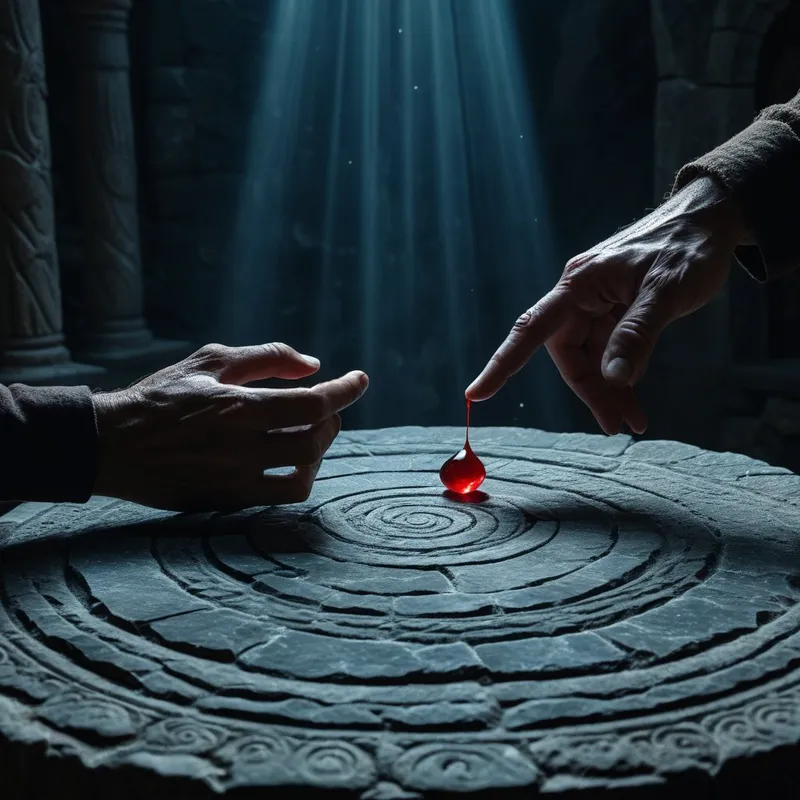
Years later, the voice returned, sharper, more demanding. "Bring me a heifer, a goat, a ram, a dove, a young pigeon." Abraham, his heart a drum of dread and hope, split the animals down the middle and laid the halves opposite each other. As the sun set, a dreadful darkness fell. He fell into a deep sleep, and a smoking fire pot and a blazing torch—manifestations of the divine presence itself—passed between the pieces of the carcasses. In the ancient way, this was the oath: "May it be done to me as to these animals if I break this bond." But only the symbols of the Divine passed through. The covenant was sealed not by mutual threat, but by a unilateral, terrifying grace. The promise was now a bond, cut in blood and fire.
Generations passed. The descendants became a people, enslaved in Egypt. The voice spoke again, to a stammering shepherd named Moses, from a bush that burned but was not consumed. "I have heard their groaning," it said. "I will bring them out." And He did, with a mighty hand and an outstretched arm, through a sea parted like a curtain. At the foot of a trembling mountain, shrouded in thunder and lightning, the covenant was given its shape. On tablets of stone, the terms were inscribed: not just a promise of land and blessing, but a law of the heart, a way of being in sacred relationship. "You will be my people, and I will be your God." It was a marriage contract for a nation.
Yet the people were frail, their hearts of stone. They broke the bond. Prophets wept, calling them back to the husband of their youth. And so, a new whisper began, a prophecy of a covenant not of ink and stone, but of spirit and flesh. A promise of a law written on the heart.
Then came a night in an upper room. A man, knowing his hour had come, took bread, broke it, and said, "This is my body, given for you." He took a cup of wine and said, "This cup is the new covenant in my blood, which is poured out for you." The next day, on a hill of execution, the ultimate sacrifice was made. The temple veil—the symbol of separation—was torn in two, from top to bottom. In that moment, the old covenant of external law was fulfilled and transcended by a new covenant of internal grace, sealed not with the blood of bulls and goats, but with the blood of the promised one himself. The bond was now written in the very heartbeat of the divine, offered to all who would enter in.
Cultural Origins & Context
The myth of Covenant is the backbone of the Biblical narrative, emerging from the tribal and nomadic context of the ancient Near East. Its structure mirrors the suzerainty treaties of empires like the Hittites, where a greater king (the suzerain) establishes a binding agreement with a lesser king (the vassal), outlining stipulations, blessings for fidelity, and curses for betrayal. The Hebrew scribes and prophets appropriated this powerful political form and theologized it, transforming a contract of state into the sacred story of a people's unique relationship with YHWH.
It was passed down not as a single story, but as the defining rhythm of a culture: recited at Passover meals, sung in the Psalms ("He remembers his covenant forever"), thundered by prophets like Hosea and Jeremiah, and reinterpreted by rabbis and early Christian theologians. Its societal function was paramount: it provided an identity ("We are the people of the covenant"), a moral and legal framework (the Torah), and an explanation for historical fortune and misfortune (blessings and curses). It answered the fundamental human questions of "Who are we?" and "Why are we here?" with a narrative of chosenness, responsibility, and divine fidelity.
Symbolic Architecture
At its core, the Covenant is the archetypal symbol of sacred relationship. It represents the human soul's deepest longing for a binding, meaningful connection with the Source of existence—a longing to move from the orphaned state of existential loneliness to the beloved state of being "known."
The covenant is the architecture of the soul in relation to the numinous; it is the psychic container that makes relationship with the infinite possible.
The cutting of the animals symbolizes the terrifying cost of true union. It is a sympathetic magic of the highest order: "As these pieces are divided, so may I be divided from myself if I break faith." The divine presence passing alone through the pieces transforms the symbol from a contract of mutual destruction into an icon of divine commitment—a promise upheld by the greater party even when the lesser fails. The movement from the Old Covenant (law on stone) to the New Covenant (law on the heart) maps the psychological journey from external superego to integrated conscience, from compelled obedience to authentic, internalized transformation.
The Dreamer's Resonance
When the myth of Covenant stirs in the modern dreamer, it often manifests as dreams of momentous signatures, unbreakable vows, or sacred meetings. One might dream of signing a contract in blood, of finding a lost family seal or ring, of being bound by a golden thread to a distant, luminous figure, or of a solemn ceremony where promises are exchanged in a language of light.
Somatically, this can feel like a tightening in the chest—not of anxiety, but of profound responsibility—or a warmth spreading from the heart center. Psychologically, the dreamer is navigating a process of sacred obligation. They are encountering a part of their own psyche or life path that demands a commitment beyond casual interest. It is the Self (the inner divine) calling the ego to a deeper level of integrity, to "cut a covenant" with its own deepest values, talents, or relationships. The anxiety in such dreams often stems from the fear of the cost of that commitment, the "cutting" it requires.

Alchemical Translation
The alchemical work modeled by the Covenant is the opus contra naturam—the work against our fragmented, wandering nature. It is the process of moving from the massa confusa of potential to the fixed state of authentic identity through a vow made to the Self.
Individuation is the New Covenant written on the heart: the law of one's own unique being, discovered not imposed, loved not merely obeyed.
The first stage (nigredo) is Abraham's call into the unknown desert, the burning away of old identities. The second stage (albedo) is the giving of the Law at Sinai—the clarifying, often harsh, revelation of one's own inner contradictions and the standards of the Self. The crisis (rubedo) is the repeated failure, the breaking of the tablets, the exile—the painful recognition that willpower alone cannot fulfill the vow.
The final transmutation (citrinitas to rubedo) is the internalization symbolized by the New Covenant. The sacrificial blood is no longer an external payment but the owning of one's shadow and the offering of one's whole, imperfect self. The stone tablets become the living flesh of conscious living. The covenant is no longer a treaty "out there" with a distant god, but the living, breathing relationship between the ego and the guiding, transpersonal center of the psyche. One becomes, at last, a unified being—a people of one, living in faithful covenant with the mystery of one's own soul.
Associated Symbols
Explore related symbols from the CaleaDream lexicon: