Coniunctio Oppositorum Myth Meaning & Symbolism
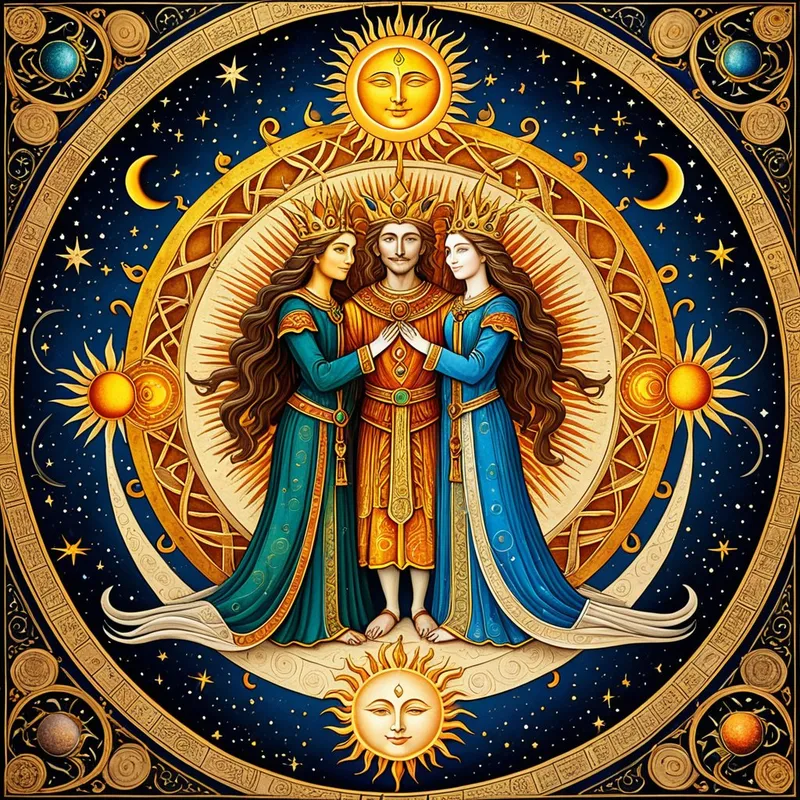
The alchemical myth of the sacred marriage, where the King and Queen, Sol and Luna, unite in a fiery embrace to birth the Philosopher's Stone and the Self.
The Tale of Coniunctio Oppositorum
Listen, and hear the tale whispered in the steam of the alembic and etched in the soot of the furnace. In the beginning, there was division. From the prima materia, the raw chaos of the world, two sovereigns were cast: Rex, the Sun King, a being of fierce, focused light and unyielding will. His palace was a citadel of gold, his law was reason, and his domain was the brilliant, arid day. And Regina, the Moon Queen, a being of reflective, silver light and deep, knowing tides. Her court was a garden of silver, her language was intuition, and her realm was the fertile, mysterious night.
For an age, they ruled in splendid isolation, each complete in their own kingdom, yet the world between them languished. It was a place of stark contrasts—blinding heat and chilling cold, barren rock and flooding stream—devoid of life, devoid of soul. The very substance of reality cried out for a third thing, a child of their essence, but they could not conceive it. They were perfect opposites, and in their perfection, they were sterile.
Then, a longing awoke, not in the mind, but in the very substance of their being. It began as a subtle pull, a magnetic yearning felt in the King’s golden scepter and the Queen’s silver chalice. He saw her pale light gilding the edges of his kingdom at dusk, and felt not threat, but a haunting beauty. She felt his penetrating rays warming the depths of her deepest pools at dawn, and felt not scorching, but a vitalizing power.
Driven by this profound and dangerous desire, they descended from their thrones. They met not on the battlefield, but in the Vas Hermeticum, the sealed vessel of the world, a place that was neither his nor hers, but the liminal ground of potential. There was no courtship of words, for their languages were foreign. Instead, they presented their essence. He offered his Sulfur—his fiery spirit, his passion and will. She offered her Mercury—her fluid soul, her adaptability and connection.
The conflict was immediate and terrible. His fire sought to dominate and consume her fluidity. Her mercury sought to dissolve and escape his fixity. Their union was a storm, a nigredo of black despair and violent dissolution. The vessel shook with their struggle. It seemed they would annihilate each other, leaving only ash.
But in the heart of that chaos, a miracle of surrender occurred. Not a surrender of one to the other, but a mutual surrender of their isolated sovereignty to the process itself. The King allowed his rigid form to be softened, liquefied by the Queen’s mercurial embrace. The Queen allowed her boundless form to be defined, given purpose by the King’s fiery focus. Their bodies, gold and silver, began to melt and flow together in the alchemical bath.
From the crucible of their struggle arose a gentle, pervasive heat, the albedo, washing them in a luminous white light of purification. And then, the final, glorious conflagration—the rubedo. Their fused bodies blazed with an inner sun, a rose-red flame of consummation. In that ultimate fire, they were not destroyed, but transcended. From their sacred marriage was born the Lapis Philosophorum, the Philosopher’s Stone, a radiant, multifaceted gem that held the power to heal all division, to transmute base matter into gold, and to grant eternal life. And their own forms, forever changed, were seen anew as the Rebis, the two-headed, hermaphroditic being, whole and complete within itself. The world between their kingdoms burst into verdant, miraculous life.

Cultural Origins & Context
The myth of the Coniunctio Oppositorum is not a tale from a single culture with temples and priests, but the core narrative of Western alchemy, a profound underground stream of esoteric thought that flowed from Hellenistic Egypt through the Islamic Golden Age into Medieval and Renaissance Europe. It was passed down not by bards, but by adepts and practitioners—figures like Hermes Trismegistus, Paracelsus, and the anonymous authors of cryptic texts like the Rosarium Philosophorum.
Its societal function was dual. Exoterically, it was an allegorical manual for the literal laboratory work of transmuting metals, using coded language to protect the art from the unworthy. Esoterically, and more importantly, it was a spiritual and psychological roadmap. It provided a symbolic language for the soul’s journey toward perfection and unity with the divine. In a world often divided by dogma, it offered a model of reconciliation, teaching that the highest truth arises from the marriage of seemingly irreconcilable principles—spirit and matter, male and female, conscious and unconscious.
Symbolic Architecture
At its heart, the Coniunctio is a grand metaphor for the psyche’s drive toward integration. The King and Queen are not external deities but profound intra-psychic realities.
The King, Sol, represents the conscious ego: our will, our logic, our structured identity, and the drive for differentiation. He is the principle that says “I am this, not that.”
The Queen, Luna, represents the unconscious, particularly the anima (in a man’s psyche) or animus (in a woman’s): our emotions, intuition, relational capacity, and the forgotten, shadowy parts of ourselves. She is the principle that whispers, “All is connected.”
Their initial separation is the state of normal, fragmented consciousness, where reason denies intuition, and persona suppresses shadow. The Vas Hermeticum is the sealed container of the therapeutic or meditative process—the safe, bounded space where these opposites can safely engage. The violent nigredo symbolizes the painful but necessary confrontation with the shadow, depression, and the dissolution of the old, rigid ego. The albedo is the washing clean, the insight and clarity that follows. The rubedo is the final, passionate integration, resulting in the birth of the Self, symbolized by the Lapis or the Rebis.
The Dreamer’s Resonance
When this myth stirs in the modern dreamer, it announces a profound inner process of reconciliation. One may dream of two figures—often a known man and woman, or abstract forces of light and dark—locked in struggle, dance, or a slow, inevitable approach. The dream landscape may feel charged, electric, or heavy with potential.
Somatically, this can correspond to a feeling of being “torn apart” by conflicting desires or identities, or a deep, inexplicable yearning for completion. Psychologically, it is the psyche’s attempt to broker a peace treaty between warring factions: between career and family ambitions, between logical plans and wild intuition, between the need for independence and the craving for deep connection. The dream is the Vas Hermeticum itself, staging the drama of the Coniunctio so that the waking ego can witness, and eventually, participate in the sacred marriage within.

Alchemical Translation
For the modern individual, the myth models the path of Individuation. We are all born from a primal unity into a world of opposites. The journey to wholeness is not about choosing one side (only the King’s rationality or only the Queen’s feeling), but about enduring the fiery process of their union.
The first step is to consciously recognize and “descend” to meet our inner opposite. For a person overly identified with thinking (Sol), this means courageously engaging with neglected feelings, fantasies, and the irrational (Luna). For one lost in emotional tides (Luna), it means applying conscious discipline and structure (Sol).
The conflict that follows is inevitable and necessary—it is the friction that generates the transformative heat. The ego must consent to be softened, its certainty dissolved. The unconscious must agree to be given form and voice. This is the sacred labor, the opus contra naturam—work against our one-sided nature.
The triumph is not a final, static state of perfection, but the birth of a transcendent function—the Philosopher’s Stone within. This is the capacity to hold tension, to generate a third, reconciling perspective from the clash of opposites. It is the ability to act with both will and compassion, logic and intuition, as an integrated Rebis. In this state, one does not simply have experiences; one transmutes experiences—the lead of suffering, conflict, and base emotion—into the gold of wisdom, meaning, and a life that is authentically, wholly one’s own.
Associated Symbols
Explore related symbols from the CaleaDream lexicon: