Circulatio Myth Meaning & Symbolism
The alchemical process of Circulatio describes the soul's sacred, cyclical journey through dissolution and coagulation, death and rebirth, to achieve the Philosopher's Stone.
The Tale of Circulatio
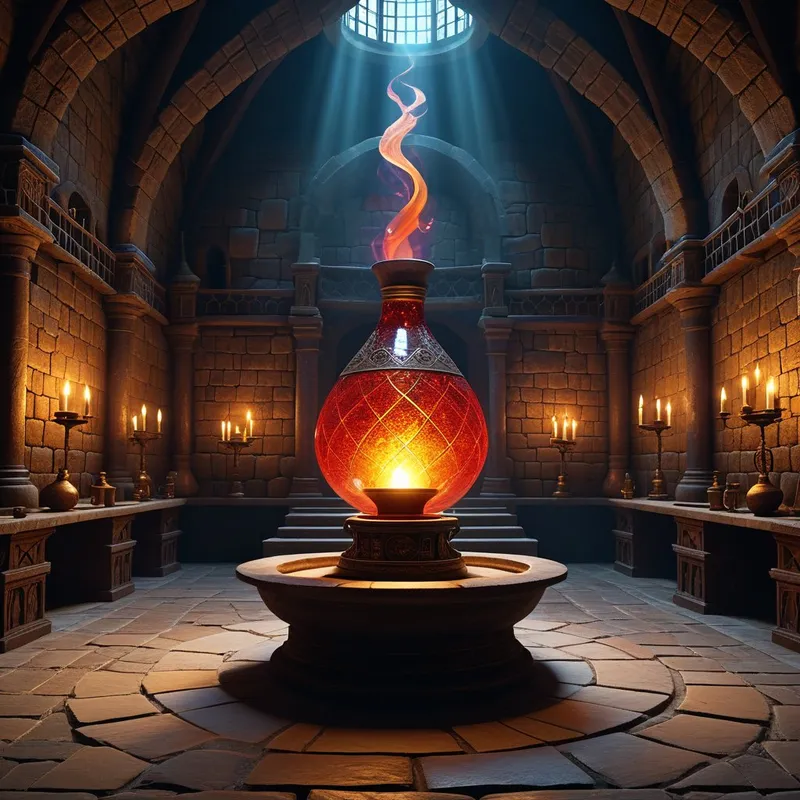
Listen, and hear the tale not of a hero, but of a motion. It is the story whispered by the fire in the athanor, sung by the bubbles in the glass womb of the alembic. In the beginning, there is not chaos, but separation. The King, Solar and Fiery, sits upon a throne of dry, red earth. The Queen, Lunar and Moist, dwells in a silver sea. They gaze across a gulf of air, knowing each other, yet unable to touch. They are the fixed, the proud, the isolated.
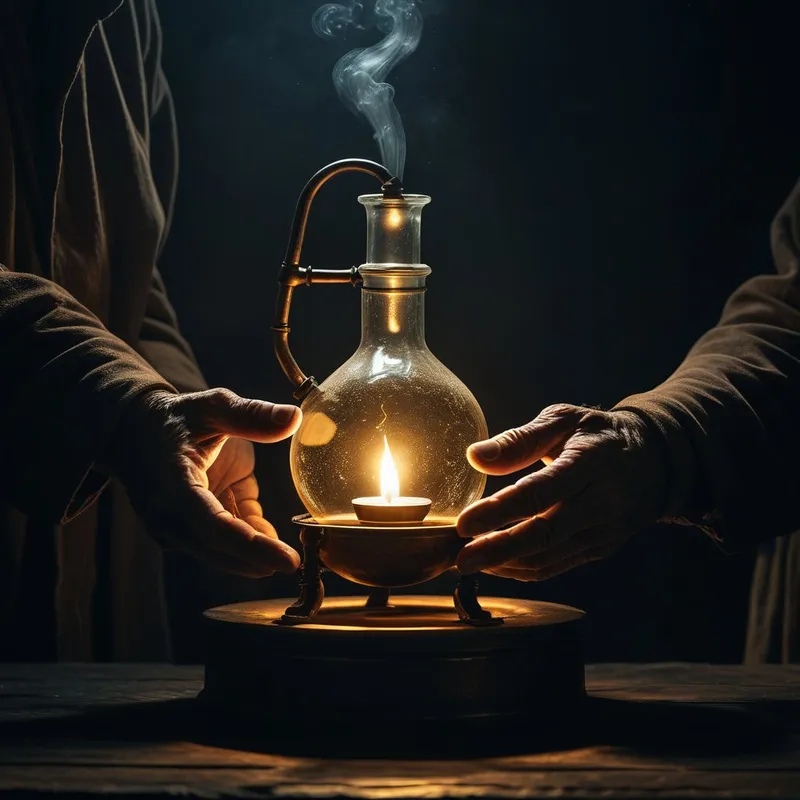
But the Great Work demands union. The alchemist, servant of the mystery, becomes the midwife of motion. Into the sealed vessel—the vas Hermeticum—they are placed. The fire is applied, not a raging blaze, but the patient, persistent heat of longing. The King begins to sweat his royal essence, a crimson tear. The Queen weeps a silvery dew. They do not rush to embrace. Instead, they ascend.
A mist rises, a sigh of steam carrying the soul of the King. It travels up the neck of the vessel, a spirit in exile, leaving its corporeal body below. In the cool dome, it condenses—a death, a precipitation. It falls as a gentle rain, a baptism, upon the waiting body of the Queen below. She receives him, and in that mingling, she too is stirred to her own ascent. Her moist spirit volatilizes, rising to meet the descending influence of the King’s next breath.
And so it begins: the Circulatio. Ascension and descent. Volatilization and fixation. Spirit and body, male and female, sulfur and mercury, endlessly chasing one another in a sacred, rising spiral within the sealed sphere of the self. They are no longer King and Queen, but two dancers in a single, circulating breath. The liquid in the vessel clouds, clears, changes hue—from the black of Nigredo to the peacock’s tail of iridescent promise, to the purest white of Albedo.
This is not a battle, but a courtship conducted through cycles of death and rebirth. Each ascent is a dissolution of the known self; each descent, a coagulation of new understanding. The fire never ceases. The motion never stills. It is the wheel that turns the mill of the stars, the pulse that beats in the heart of the world. And from this tireless, patient circulation—not from a single, violent conquest—a new substance is born. It gathers drop by precious drop in the receiver, a liquid that holds light, a body that is all spirit: the first promise of the Philosopher’s Stone. The tale ends not with a shout, but with the silent, eternal hum of the wheel in motion.
Cultural Origins & Context
The mythos of Circulatio is not found in a single epic poem but is encoded in the practical manuals and cryptic emblems of European laboratory alchemy, spanning from the Hellenistic period through the Renaissance. It was a core operational principle, a physical process observed in the distillation and reflux of materials. Yet, for the adept, it was always more than chemistry. It was the visible sign of an invisible, psychic law.
This knowledge was transmitted through a fragmented, secretive lineage. It passed from master to apprentice in locked laboratories, whispered alongside instructions for managing the furnace. It was embedded in the intricate illustrations of texts like the Mutus Liber (The Silent Book), where images of angels circling on ladders or birds flying up and down told the story without words. Its societal function was dual: for the exoteric world, it promised the transmutation of base metal; for the esoteric initiate, it mapped the only reliable path to inner transmutation—a path not of linear ascent, but of cyclical refinement.
Symbolic Architecture
At its heart, Circulatio is the supreme symbol of process over product, of journey over destination. It represents the dynamic tension of opposites—conscious and unconscious, spirit and matter, thought and feeling—not in static balance, but in vital, reciprocal exchange.
The soul is not purified by a single fire, but by the courage to evaporate and condense a thousand times.
The sealed vessel is the total psyche, the bounded space of the individual life where this work must occur. The fire is the heat of attention, of conflict, of Eros—the energy that forces movement. The circulating substances are the contents of the psyche itself. To "volatilize the fixed" is to take what is rigid, dogmatic, or concretized in our identity (the King) and render it fluid, open to insight and change. To "fix the volatile" is to take what is fleeting, chaotic, or unconscious (the Queen) and give it form, integrate it into conscious structure.
This endless cycle models the core of psychological growth: an insight (ascent/volatilization) must be brought down and applied, made real in one's life (descent/fixation). That lived experience then produces a new, deeper question or tension, which demands another ascent into reflection or the unconscious. Progress is spiral, not linear.
The Dreamer's Resonance
When the pattern of Circulatio stirs in the modern dreamer, it signals a profound somatic and psychological process of integration. The dreamer may find themselves on an endless staircase, climbing only to arrive back at the beginning, yet somehow changed. They may dream of elevators that go up and down between the same two floors, or of breathing in a substance that turns into light upon exhaling.
Somatically, this can correlate with feelings of being "in process"—not stuck, but actively cycling. It may manifest as a recurring theme in therapy where the same issue is revisited, but each time from a slightly higher vantage point. There is a quality of active patience. The anxiety of linear time ("I should be fixed by now") dissolves into the rhythm of the cycle. The dreamer is not dreaming of a breakthrough, but of the practice that makes breakthrough possible. It is the psyche's way of validating the necessity of repetition, of showing that the work of self-knowledge is never done, but deepens with each turn of the wheel.

Alchemical Translation
For the modern individual seeking psychic wholeness or individuation, Circulatio is the master model. Our culture worships the linear narrative: the heroic journey out, the decisive victory, the arrival at a permanent state of enlightenment or success. Alchemy, and this myth, propose a radical alternative: the goal is achieved through devout commitment to the cycle itself.
The Stone is not found at the end of the work; it is secreted in the sweat of the process.
The "base metal" of our neuroses, complexes, and fragmented self-image is not transformed by a single act of will or insight. It is transformed by the relentless, gentle application of the inner fire—conscious attention—which forces our fixed attitudes to "sweat" and become fluid, and our volatile emotions to "condense" and become comprehensible. We must allow our thoughts (sulfur) to be dissolved by our feelings (mercury), and our feelings to be structured by our thoughts, in an endless dialogue.
This is the transmutation: from identifying with the static King or Queen on their separate thrones, to identifying with the motion that unites them. The Self that emerges is not a new, fixed entity, but the very capacity for this circulation—a psyche that can fluidly move between opposites, digest experience, and continually recreate itself. The Philosopher's Stone, then, is the realization that you are not the content of the vessel, but the sacred, circulating process within it. The gold is in the going.
Associated Symbols
Explore related symbols from the CaleaDream lexicon: