Chi Rho Myth Meaning & Symbolism
The tale of an emperor's vision, a celestial monogram, and the moment a world religion was forged in the crucible of power and faith.
The Tale of Chi Rho
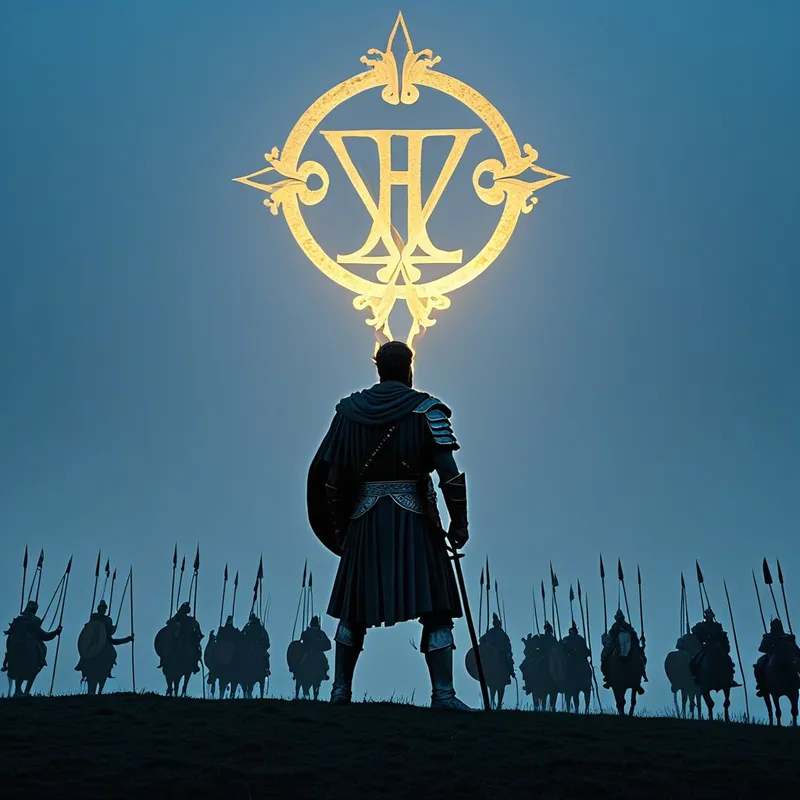
The world held its breath on the eve of a battle that would decide the fate of an empire. The air over the Milvian Bridge was thick with the scent of damp earth and cold iron. Constantine, a man whose shoulders bore the weight of legions and the whispers of rival emperors, stood in his tent. Sleep was a traitor that night, replaced by a churning tide of strategy and dread. He stepped out into the deepening twilight, his gaze lifting from the earthbound concerns of men to the vault of heaven.
And there, as the last light bled from the west, the sky tore open.
It was not a star, nor a comet, but a searing script of light. A symbol burned against the fabric of the night—a Chi crossed by a Rho, the first two letters of Christos. It was not drawn in gentle lines but forged in celestial fire, a monogram of divine authority. And wrapped around it, in letters of flame that seared themselves into his soul, were the words: In Hoc Signo Vinces.
The vision passed, leaving the imprint of light on his sight and a profound silence in his spirit. But the night was not done. In the realm of dreams, where gods and generals converse, Christos himself appeared. He bore the same radiant sign and commanded the shaken emperor: "Make this the safeguard of your army."
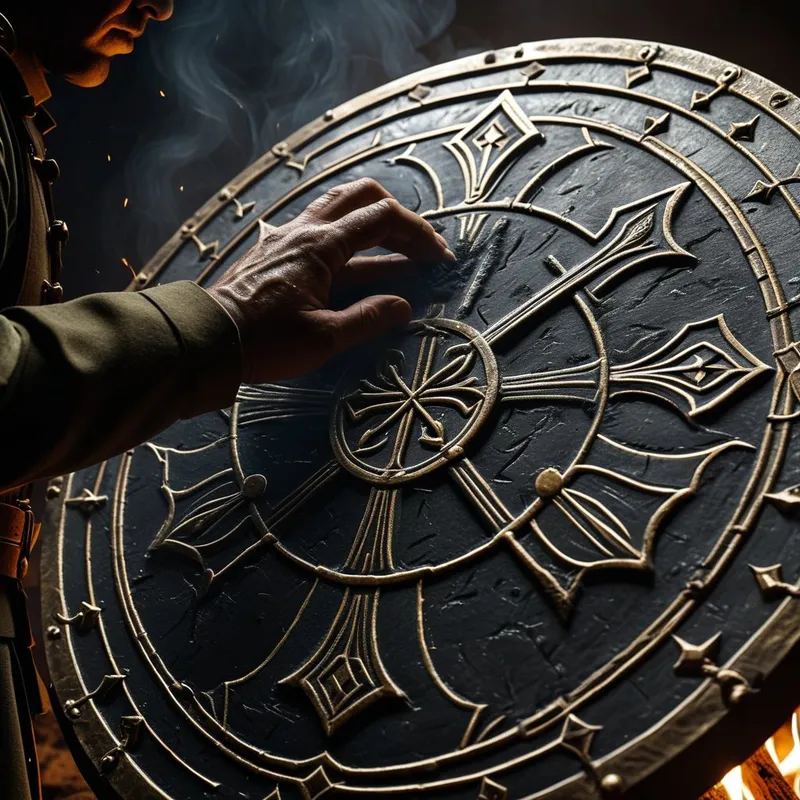
Dawn came, not with clarity, but with a command born of awe. Constantine summoned his artisans. He described the vision—the intersecting lines, the looped appendage. From memory and divine mandate, the symbol was rendered. It was painted on the shields of his legionaries, transforming tools of war into sacred talismans. It was raised high on the labarum, a new standard for a new age.
When the armies clashed at the Milvian Bridge, the soldiers of Constantine did not fight merely for an emperor. They advanced under a sign from heaven. The battle was fierce, the Tiber ran thick, but the tide turned. His rival’s forces broke and scattered. In that victory, won under a cryptic sign, an empire began its slow, monumental pivot. The symbol that appeared in a moment of personal desperation became the emblem of a cosmic revolution, etching itself not just on shields, but on the very cornerstone of history.
Cultural Origins & Context
This is not a myth from the misty dawn of time, but a historical report refracted through the lens of faith. The primary accounts come from Eusebius of Caesarea, who claims to have heard the tale from the emperor’s own lips. It is a foundation myth for the Christianization of the Roman state, occurring in the early 4th century CE.
Its societal function was profound and twofold. For the early Christian church, a persecuted and often clandestine body, it was the ultimate validation: the Logos of God intervening directly in secular history to crown its champion. It transformed their narrative from one of martyrdom to one of manifest destiny. For the Roman state and its military, it provided a powerful new sacral legitimacy. The old gods of the Capitoline Hill were being supplemented, and then supplanted, by a god who guaranteed victory in battle. The myth was passed down not by bards around a fire, but by bishops in basilicas and chroniclers in scriptoria, becoming the sacred backstory for the alliance of Cross and Crown that would define Western civilization for centuries.
Symbolic Architecture
At its core, the Chi Rho is a symbol of revelation in crisis. It appears not in a temple, but on a battlefield; not to a saint at prayer, but to a general in anguish. It represents the irruption of the numinous into the realm of desperate human action.
The intersection of the Chi is the crossroads of fate, where human will meets divine imperative. The Rho, curling from that junction, is the unfolding consequence, the new path born from that collision.
Psychologically, the Chi (X) is the unknown variable, the chaotic element of a life at a breaking point. The Rho (P) is the pneuma, the spirit or breath, that emerges to give that chaos a new direction and name. Constantine, as the mythic figure, embodies the archetype of the Ruler at his most vulnerable, whose personal crisis becomes the crucible for a collective transformation. The symbol itself is a monogram—a condensation of a vast, complex theology (Christology) into a single, potent, portable mark. It is the divine made legible, power made into a signifier that can be carried into the fray.
The Dreamer's Resonance
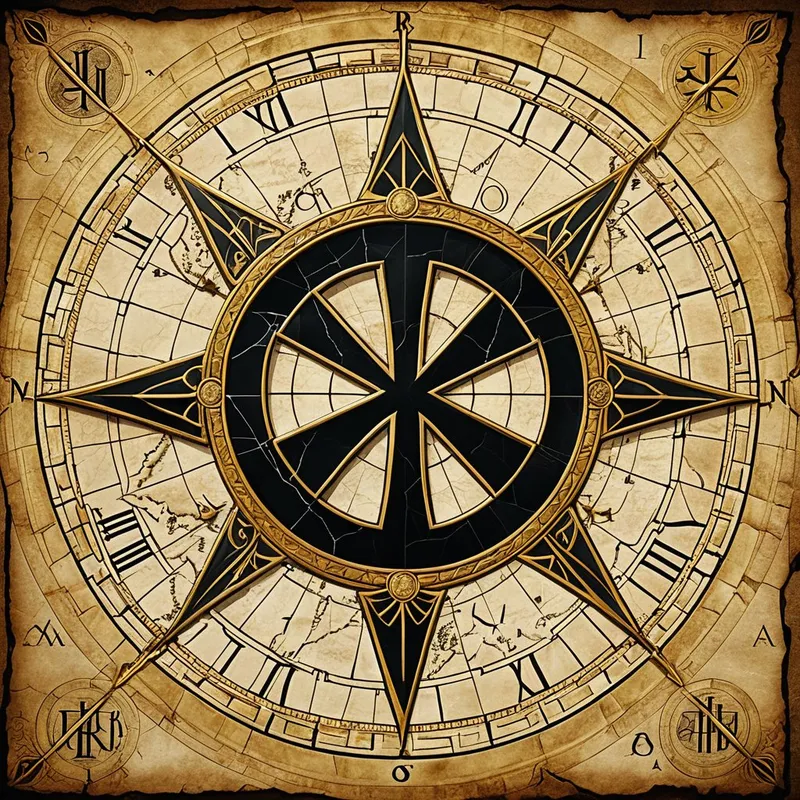
When this mythic pattern surfaces in modern dreams, it rarely appears as a historical pageant. Instead, one might dream of a strange, compelling symbol—a glowing logo, an enigmatic graffiti tag, a brand on an animal—that appears at a moment of intense pressure or decision. The dreamer often feels a mix of awe, obligation, and confusion: "What does this mean, and what must I do with it?"
This is the psyche signaling a critical juncture in the process of individuation. The "battlefield" is an internal conflict—perhaps a moral dilemma, a career crossroads, or a crisis of identity. The appearing symbol represents a new, synthesizing principle from the Self, the psyche’s central organizing authority. It is an intuitive, non-rational answer to a rationally unsolvable problem. The somatic feeling is often one of a "piercing" insight or a weight of destiny. The dreamer is being shown their personal labarum, the emblem around which they must now reorganize their psychic "army" of talents, drives, and values to engage their world.
Alchemical Translation
The alchemical process mirrored here is not the gentle refinement of silver, but the violent, transformative nigredo followed by the illuminating albedo. Constantine’s pre-vision anxiety is the nigredo—the dark night of the soul, the confusion and dissolution of old certainties (the old pagan gods failing to provide solace or assurance).
The vision is the albedo, the divine lightning strike that whitens and clarifies. The celestial symbol is the Lapis Philosophorum revealed not in a flask, but in the sky, offering not gold, but a new ordering principle.
For the modern individual, this myth models the psychic transmutation required when one’s existing worldview—our personal "empire"—is under siege. The alchemical instruction is: In your moment of deepest conflict, attend to the revelatory symbol. It may not come from a god, but from the depths of the unconscious: a recurring image, a sudden phrase, a dream icon. The "conquest" (Vinces) is not over others, but over the inner chaos. One must then have the courage of Constantine: to inscribe that symbol on the shield of your consciousness, to raise it as the standard for your actions, and to march forward under its authority. This act binds the transcendent insight (the vision) to the immanent reality (the battle), completing the alchemy. The base metal of a desperate situation is transmuted into the gold of a purposeful, re-oriented life, founded on a revelation personally received and courageously enacted.
Associated Symbols
Explore related symbols from the CaleaDream lexicon: