Chōchin-obake Myth Meaning & Symbolism
A tale of a humble paper lantern, cast aside, that awakens with a vengeful spirit—a myth of discarded objects and the shadows they inherit.
The Tale of Chōchin-obake
Listen, and let the night wind carry this whisper from the old world. It begins not in a grand palace or a sacred grove, but in the quiet, forgotten corners of a merchant’s house in the Edo twilight. For a hundred years, a simple [chōchin](/myths/chchin “Myth from Japanese culture.”/) hung by the gate. It knew the sigh of evening, the laughter of returning children, the solemn bow of guests. It drank the smoke of countless oil lamps until its paper skin grew brittle and stained with the patina of decades.
Then, one autumn, it was taken down. Not with ceremony, but with a servant’s brisk efficiency. A new lantern, bright and white, took its place. The old one was cast into a shadowed storeroom, atop a pile of other discards—a cracked chawan, a torn scroll. There, in the dust and silence, time worked upon it differently. No longer measuring the rhythm of human days, it began to measure the slow beat of its own resentment. The memory of light became a phantom pain. The stains on its paper looked more and more like a face. A single rip near its base began to resemble a gaping mouth.
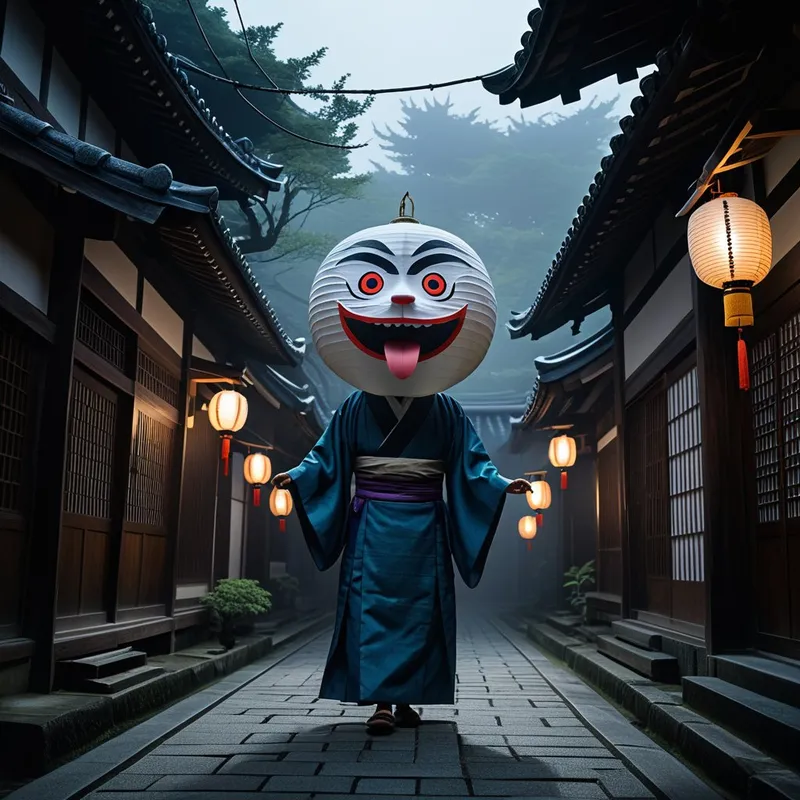
On the hundredth night of its abandonment, during a storm that rattled the wooden shutters, the memory of flame awoke within its core. Not a real flame, but the ghost of one. A cold, phosphorescent light began to pulse in the storeroom’s gloom. The lantern shuddered. Its paper body, once slack, grew taut. The rip widened into a leering grin, and from the blackness above it, a single, luminous eye slid open, blinking with ancient malice. [The bamboo](/myths/the-bamboo “Myth from Taoist culture.”/) frame creaked, and from the mouth-like tear, a long, red, forked tongue unfurled, tasting the air of neglect.
It was no longer a chōchin. It was a Chōchin-obake.
With a soft, papery rustle, it lifted from the pile. It drifted through the house not as a solid [thing](/myths/thing “Myth from Norse culture.”/), but as a thought of vengeance made visible. It sought the living, not to harm them with violence, but to terrify them with the truth of their disregard. It would appear at the edge of a sleeping maid’s vision, its eye staring, its tongue lolling, before vanishing with a puff of cold air. It would bob mockingly outside a window, mimicking its former useful self, now a grotesque parody of guidance. Its power was not in strength, but in persistence—the persistence of a memory that refuses to be erased, of a service that demands acknowledgment even in its monstrous new form.
Cultural Origins & Context
The Chōchin-obake belongs to the vast and vibrant category of yōkai. Unlike deities (kami) or tragic ghosts ([yūrei](/myths/yrei “Myth from Japanese culture.”/)), yōkai often emerge from the animistic heart of Japanese folk belief, which holds that all things—rocks, tools, household objects—can acquire a spirit (tamashii) after long use or through intense experience.
This myth flourished in the Edo period, a time of relative peace and urban culture. It was a story told not by priests in temples, but by common people in homes and taverns. It served as a playful, yet profound, piece of folk pedagogy. In a society that valued frugality, respect for tools, and the careful maintenance of household items, the Chōchin-obake was a cautionary tale. It personified the consequence of wastefulness and disrespect for the objects that shared one’s daily life. The story functioned as a social reminder: care for your possessions, or they may develop a life—and a grudge—of their own.
Symbolic Architecture
At its core, the Chō[chin](/symbols/chin “Symbol: The chin in dreams can represent assertiveness, communication, and personal identity.”/)-obake is a masterful [symbol](/symbols/symbol “Symbol: A symbol can represent an idea, concept, or belief, serving as a powerful tool for communication and understanding.”/) of the [shadow](/symbols/shadow “Symbol: The ‘shadow’ embodies the unconscious, repressed aspects of the self and often represents fears or hidden emotions.”/) of utility. An object created for a single [purpose](/symbols/purpose “Symbol: Purpose signifies direction, meaning, and intention in life, often reflecting personal ambitions and core values.”/)—to give light—is stripped of that function and cast into the darkness. Yet, its essence does not vanish; it inverts. The light it once projected [outward](/symbols/outward “Symbol: Movement or orientation away from the self or center; expansion, expression, or externalization of inner states into the world.”/) turns [inward](/symbols/inward “Symbol: A journey toward self-awareness, introspection, and the exploration of one’s inner world, thoughts, and unconscious mind.”/), becoming a cold, self-aware glow. The service it provided becomes a demand for recognition.
The most profound hauntings are not of places, but of purposes left unfulfilled.
Psychologically, it represents the [fate](/symbols/fate “Symbol: Fate represents the belief in predetermined outcomes, suggesting that some aspects of life are beyond human control.”/) of aspects of [the self](/myths/the-self “Myth from Jungian culture.”/) that are used for a time and then discarded when no longer convenient. The diligent [worker](/symbols/worker “Symbol: The symbol ‘Worker’ represents effort, productivity, and the role of individuals within a broader societal framework.”/) cast aside after years of service, the creative [passion](/symbols/passion “Symbol: Intense emotional or physical desire, often linked to love, creativity, or purpose. Represents life force and deep engagement.”/) shelved for practicality, the [vulnerability](/symbols/vulnerability “Symbol: A state of emotional or physical exposure, often involving risk of harm, that reveals authentic self beneath protective layers.”/) hidden away to present a hardened face—these are all psychic “lanterns” thrown into the storeroom. There, they do not die. They fester. They mutate. The once-useful trait, neglected, can return not as a skill but as a neurosis, not as warmth but as a chilling [resentment](/symbols/resentment “Symbol: A deep-seated emotional bitterness from perceived unfairness or injury, often festering silently and poisoning relationships.”/) that flickers at the periphery of [consciousness](/symbols/consciousness “Symbol: Consciousness represents the state of awareness and perception, encompassing thoughts, feelings, and experiences.”/).
The single giant eye symbolizes a distorted, obsessive consciousness—a [perception](/symbols/perception “Symbol: The process of becoming aware of something through the senses. In dreams, it often represents how one interprets reality or internal states.”/) narrowed to a single point of grievance. The lolling [tongue](/symbols/tongue “Symbol: Represents communication, self-expression, and the power of words.”/) speaks a [language](/symbols/language “Symbol: Language symbolizes communication, understanding, and the complexities of expressing thoughts and emotions.”/) of raw, unsocialized [appetite](/symbols/appetite “Symbol: Represents desire, need, and consumption in physical, emotional, or spiritual realms. Often signals unmet needs or excessive cravings.”/), the [hunger](/symbols/hunger “Symbol: A primal bodily sensation symbolizing unmet needs, desires, or emotional voids. It represents craving for fulfillment beyond physical nourishment.”/) of something that has been denied its place at the [table](/symbols/table “Symbol: Tables in dreams often symbolize stability, social interactions, and a platform for discussions, negotiations, or decisions in our waking life.”/) of the [psyche](/myths/psyche “Myth from Greek culture.”/).
The Dreamer’s Resonance
To dream of a Chōchin-obake is to encounter a specific flavor of the personal shadow. It is not [the shadow](/myths/the-shadow “Myth from Jungian culture.”/) of repressed evil, but of repressed utility and connection. The dreamer may be undergoing a somatic process of feeling “used up” and discarded, or a psychological reckoning with their own tendency to discard parts of their history or personality.
The lantern’s silent, staring pursuit in a dream suggests a part of the self that will not be ignored any longer. Its non-violent but deeply unsettling presence indicates that the issue is not one of mortal threat, but of integrity. The psyche is signaling that a contract has been broken—an internal agreement to honor one’s own journey, one’s own “worn-out” but experienced parts. The cold light it emits is the illumination of this neglected truth, a light that feels uncomfortable because it exposes what we’d rather leave in the dark: our own ingratitude toward ourselves.

Alchemical Translation
The individuation process modeled by this myth is not one of slaying a [dragon](/myths/dragon “Myth from Chinese culture.”/), but of re-integrating a tool. The [triumph](/myths/triumph “Myth from Roman culture.”/) is not destruction, but re-contextualization. The Chōchin-obake does not need to be exorcised; it needs to be seen and its story heard.
The alchemical fire is not for destruction, but for transmutation; even resentment can be fuel for a more conscious light.
The modern individual facing their own “lantern spirit” must first venture into the psychic storeroom—the forgotten memories, abandoned projects, and outgrown identities. They must confront the grotesque form not with fear, but with curiosity. What useful light did this part of me once provide? What service did it render before I deemed it obsolete? The giant eye must be met with the dreamer’s own compassionate gaze. The lolling tongue must be allowed to voice its complaint.
The transmutation occurs when the individual acknowledges the spirit’s origin and honors its past service. This is the psychic equivalent of repairing the lantern, not to hang it by the gate again, but to place it in a shrine of personal history. Its light changes from the cold glow of grievance to the warm glow of witnessed memory. The monstrous form relaxes; the single eye closes, and the essence of the object—its durability, its history of illumination—is absorbed back into the self. It becomes not a haunting, but a heritage. The energy once bound in resentment is freed, becoming available not as a terror in the night, but as a grounded sense of continuity and self-respect. The orphaned part of the soul is adopted back into the family of the self.
Associated Symbols
Explore related symbols from the CaleaDream lexicon: