
Chōchin Myth Meaning & Symbolism
A myth of a lantern spirit, born from human longing, illuminating the path between worlds and the shadowy depths of the human heart.
The Tale of Chōchin
Listen, and let the veil between worlds grow thin. In the time when shadows had weight and silence had a voice, there existed a lantern not of oil and flame, but of longing. It was not crafted by a carpenter, but by the collective sigh of a thousand lonely travelers on forgotten mountain paths.
In the deep valleys where the mist clung like a ghost to the cedars, and the only sound was the whisper of the kami in the stones, people would hang simple paper lanterns—Chōchin—at crossroads and beside bridges. These were not mere lights to see by, but offerings. Prayers made visible. A plea to the darkness: "Do not swallow us whole. Show us the way."
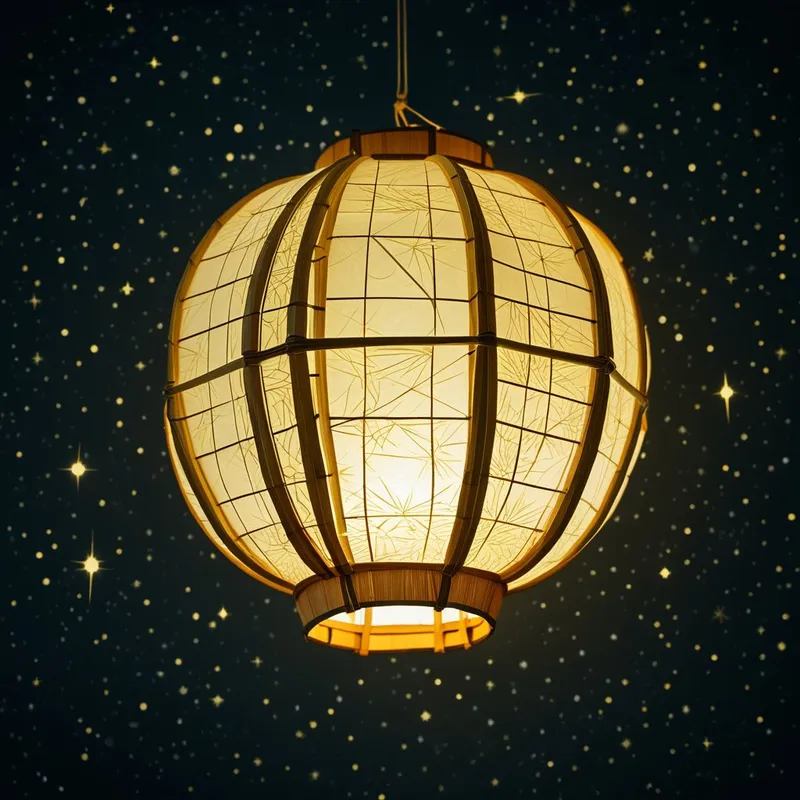
And the darkness listened. It drank the light, but it also drank the fear, the hope, the whispered names of loved ones left behind. Season upon season, prayer upon prayer, the essence of these human offerings soaked into the paper and the bamboo frame. One night, under a moon veiled by cloud, a lantern at a particularly lonesome pass did not just hold light. It became light. A soft, sentient glow pulsed within it. The paper skin, marked with the grime of rain and soot, now seemed to breathe. A presence, gentle and profoundly sad, inhabited the vessel. This was the Chōchin-obake, though it was no mere yōkai of mischief. It was a child of human need.
It did not speak, for its language was illumination. To the lost soul stumbling in the pre-dawn gloom, it would brighten, casting its warm circle further down the true path. To the arrogant brigand, it would dim to a mere ember, leaving him to the consequences of his own darkness. It witnessed all: the joyous reunions, the final partings, the secret sins confessed only to the night. Its light was a silent witness, absorbing every story until its paper heart felt heavy with the weight of a thousand journeys.
Its conflict was its nature. It was bound to its post, a sentinel of the threshold, forever showing the way but never able to take a step itself. It yearned for the destinations it revealed, for the warmth of a hearth it could only glimpse from afar. The rising action was the slow accumulation of this cosmic loneliness, a melancholic resonance that hummed in its light. The resolution was never an escape, but a transformation of purpose. It realized its confinement was its power. By remaining, by holding its place in the void, it became the fixed point by which all movement could be measured. It was the question mark at the crossroads, and its steady light was the only answer it could ever give.

Cultural Origins & Context
The myth of the sentient Chōchin spirit finds its roots not in grand imperial chronicles, but in the rich, earthy loam of minzokugaku and yōkai lore. It belongs to the world of kaidan, tales told not in palaces but in village gatherings, on the engawa on humid summer nights, and by traveling storytellers. These narratives served a dual societal function: to explain the uncanny in the natural world and to codify moral and practical wisdom.
The lantern itself was a ubiquitous object in pre-modern Japan, essential for nocturnal travel, festivals, and rituals. In the Shinto worldview, all objects, or yorishiro, could potentially host a kami. A tool used with great reverence and for a profound purpose—like guiding the living or illuminating the way for the dead during Obon—could accumulate spiritual residue. The Chōchin-obake is a direct expression of this animistic belief. It was passed down as a cautionary tale about respect for everyday objects and as a comfort: you are never truly alone on the road, for the very light you carry holds the memory of all who came before.
Symbolic Architecture
At its core, the Chōchin spirit is a profound symbol of consciousness itself—specifically, the light of awareness confined within a fragile, temporary vessel. The paper lantern is the body and the ego-structure: seemingly solid, defining a shape, yet fragile, permeable, and ultimately disposable. The light within is the animating spirit, the observing self, the ego in its purest function as a bearer of awareness.
The lantern does not create light; it merely houses and directs it. So too, the conscious self does not create awareness but is its temporary, shaped vessel.
The spirit's bondage to its post symbolizes the inherent limitations of individual perspective. We are all, in a sense, fixed to our particular crossroads of history, biology, and culture. Our "light" can only shine from where we stand. The melancholic accumulation of witnessed stories represents the growth of the psyche—the way our consciousness is shaped and burdened by experience, memory, and empathy. The Chōchin-obake is thus the archetype of the Witness, the part of us that observes our life's journey without being able to step off the path.
The Dreamer's Resonance
To dream of a Chōchin spirit is to encounter a moment of profound self-reflection in the collective unconscious. The somatic feeling is often one of quiet awe mixed with a deep, resonant sadness—a "beautiful sorrow." Psychologically, this dream emerges when the individual is at a crossroads, not just in life, but in their inner world.
The glowing lantern in a dream landscape represents a nascent insight, a new level of awareness trying to illuminate a previously dark area of the psyche. Perhaps it's the first conscious recognition of a lifelong pattern, or a glimmer of understanding about an old wound. The dreamer may feel both drawn to the light (the desire for self-knowledge) and uneasy about its source (fear of what that knowledge may reveal). If the lantern is tattered or the light flickers, it speaks to the fragility of this new consciousness and the fear that it may be extinguished by the winds of resistance or old habits. This dream marks the process of illumination before integration—the light is seen, but the dreamer has not yet learned how to carry it forward.

Alchemical Translation
The myth of the Chōchin models the alchemical stage of nigredo transforming into albedo. The initial state is the unlit lantern in the dark: the unconscious, unidentified life. The ignition is the first spark of individuation—the painful, beautiful moment when one realizes, "I am a light in this darkness, but I am also confined."
The spirit's struggle is the core of psychic transmutation. To transform, we must first accept our confinement—the limits of our ego, our biography, our body. The modern individual seeks endless freedom, but the Chōchin teaches that true power comes from conscious limitation. By fully inhabiting our specific post—our unique set of circumstances and perspective—we become a reliable source of orientation, first for ourselves, then for others.
The alchemical gold is not found by abandoning the lantern, but by realizing the lantern and the light were never two separate things.
The final translation is the shift from asking, "Which path should I take?" to embodying the question itself. The individuated Self becomes the living crossroads, the stable point of awareness from which all inner contents—thoughts, emotions, complexes—can be observed and allowed to pass. The melancholic accumulation of experience is transmuted into wisdom. We are no longer just travelers on the road; we become, in our own way, the gentle, enduring light that makes the journey visible. We become, at last, both the vessel and the flame.
Associated Symbols
Explore related symbols from the CaleaDream lexicon: