Chariot of Helios Myth Meaning & Symbolism
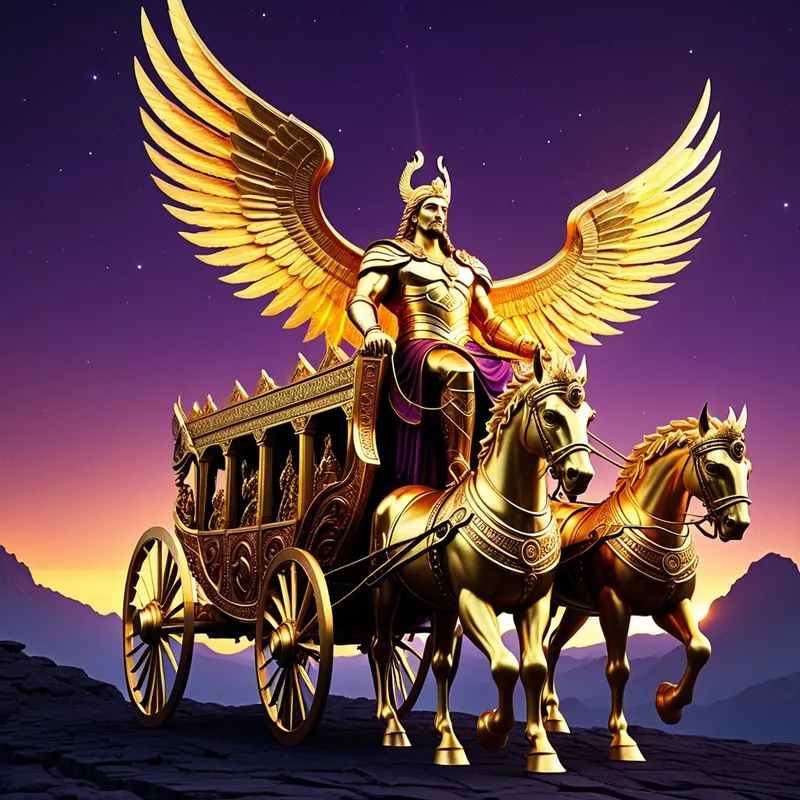
The sun god Helios drives his celestial chariot across the sky daily, a sacred duty whose violation by his son Phaethon brings catastrophic imbalance.
The Tale of Chariot of Helios
Hear now the tale of fire and order, of a path etched in flame across the vault of heaven. Before the first bird sang, in the deep Chaos of beginnings, the divine lot was cast. To Helios, the all-seeing, was given a sacred charge: to harness the very heart of the world.
Each day, in the easternmost land of the Ethiopians, where the sky is stained with rose and gold, the gates of dawn are thrown open. From his gleaming palace, Helios emerges, crowned with a halo of piercing rays. His chariot, wrought of beaten gold and electrum by the god Hephaestus, stands ready, a vessel of unbearable splendor. To it are yoked four immortal steeds: Pyrois, Eous, Aethon, and Phlegon. Their breath is the hot wind of summer; their hooves strike sparks on the clouds.
With a steady, godly hand, Helios takes the reins. A whisper, a command, and they are aloft. The ascent is steep and perilous, a climb up the curve of the sky. The horses strain against the celestial incline, their heat kept in perfect check by their master’s will. At the zenith, the world below is laid bare to his unwavering gaze—no secret, no deed, hidden from the sun. Then begins the long, deliberate descent toward the western ocean, where the Hesperides wait to cool the steaming horses and chariot in the deep, twilight waters. From there, a golden boat carries him back to the east through the dark, subterranean river of Oceanus, to begin again. This was the cosmic law, the unbreakable rhythm upon which life depended.
But into this perfect order, a crack appeared. Phaethon, a mortal youth, was Helios’s son. Tormented by doubts of his divine lineage, he journeyed to his father’s radiant eastern palace. To prove his paternity, he begged a favor: to drive the sun chariot for a single day. Bound by a sacred oath, Helios, with a heart heavy with foreboding, consented. He anointed his son’s face with protective ointment, warning him of the terrible path: “Hold the middle way. Do not soar too high, lest you scorch the halls of heaven. Do not sink too low, lest you set the earth ablaze.”
Phaethon, brimming with pride, mounted the chariot. The moment he seized the reins, the immortal horses knew. This was not the hand of a god. They bolted. The chariot lurched wildly, careening off the celestial track. It soared too high, grazing the constellations, freezing the high heavens. Then it plunged too low, dragging its fiery axle across the plains of Africa, searing them into desert, causing rivers to boil and mountains to melt. The earth cried out in agony. To prevent total annihilation, Zeus had no choice. With a thunderbolt of terrible finality, he struck Phaethon from the chariot. The boy fell like a shooting star, blazing into nothingness over the river Eridanus. The weeping Heliades, his sisters, were transformed into poplar trees, their amber tears becoming electron. Helios, in profound grief, resumed his duty, restoring the sacred, scorched balance of the world.
Cultural Origins & Context
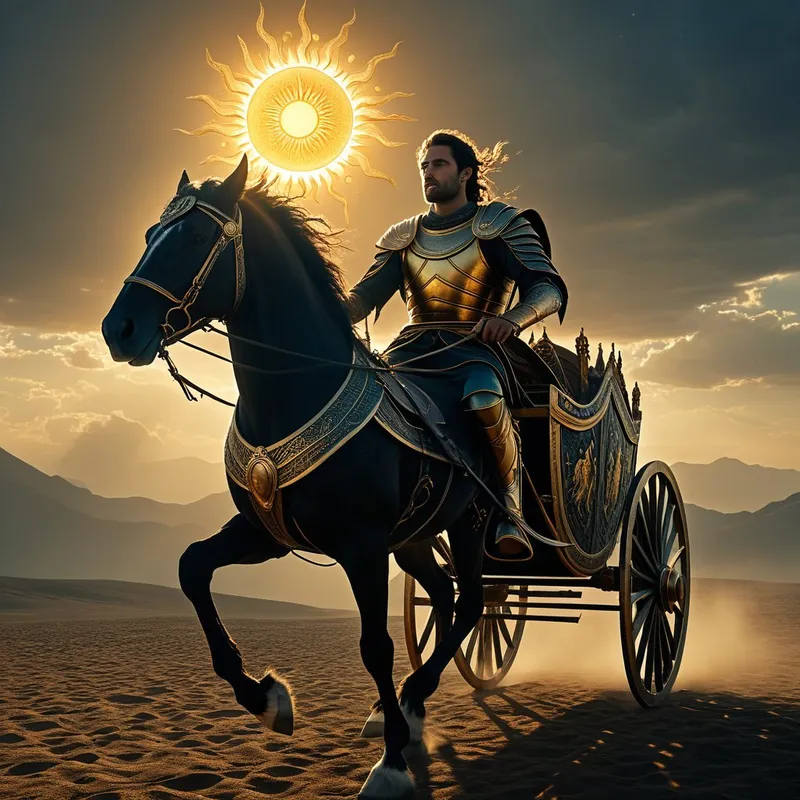
This myth, primarily preserved in Ovid’s Metamorphoses and echoed in earlier Greek fragments, is not merely a story of a boy’s folly. It is a foundational narrative about cosmic responsibility. In the Greek worldview, the sun’s journey was not a natural phenomenon but a divine, conscious act. Helios was a Titan, an older order of divinity representing the raw, potent forces of the cosmos. His daily journey was the ultimate expression of Dike—the right and proper order of things.
The myth served as an aetiology, explaining the origins of the Libyan deserts, the pitch-black skin of the Ethiopians (burnt by the sun’s proximity), and the source of amber. More profoundly, it was a cautionary tale told in symposia and by poets, reinforcing core Hellenic values. It illustrated the catastrophic consequences of hubris—the mortal attempt to perform a god’s function. The chariot was not a vehicle but an office, a sacred trust. The story functioned to delineate boundaries: between the divine and mortal realms, between order and chaos, and between a role earned through eternal nature and one arrogantly assumed through fleeting desire.
Symbolic Architecture
At its core, the Chariot of Helios is a supreme symbol of the integrated Self. Helios represents the conscious ego capable of harnessing and directing immense psychic energy—the libido, the life force, the fiery drive of the instincts (the four horses).
The chariot is the vessel of consciousness; the reins are the will; the path is the destiny. To drive it is to hold the tension of opposites, to mediate between the heights of spirit and the depths of matter.
Phaethon represents the inflated ego, the psyche that has identified with its divine potential (“I am the son of a god!”) without having integrated the strength, wisdom, and discipline required to manage that power. His journey is not a true hero’s journey, but a catastrophic failure of initiation. He seizes the symbol of power (the reins) without embodying the archetype (the Ruler). The result is a psychic conflagration: the unconscious (the horses) runs wild, scorching the inner landscape—burning out ambitions, destroying relationships (the scorched earth), and ultimately leading to the disintegration of the immature ego (Zeus’s thunderbolt).
The Dreamer's Resonance
When this myth stirs in the modern unconscious, it often manifests in dreams of失控 vehicles. To dream of driving a car that accelerates uncontrollably, of brakes failing on a steep hill, or of a plane hurtling toward the ground, is to dream the Phaethon complex. The somatic experience is one of panic, overheating, and helplessness.
Psychologically, this signals a period where an individual has taken on a role, responsibility, or identity that exceeds their current integrative capacity. It is the young executive promoted too fast, now burning out. It is the artist who gains sudden fame and cannot handle the creative “heat.” It is anyone who has “grabbed the reins” of a life that is not authentically theirs, driven by a need to prove their worth (like Phaethon proving his lineage) rather than a genuine calling. The dream is the psyche’s emergency signal: You are off the path. The energy you are wielding is destroying you from the inside out.

Alchemical Translation
The alchemical process modeled here is not of successful transmutation, but of the Calcinatio gone horrifically wrong—a warning of the perils of skipping stages. True individuation requires first submitting to the chariot, not seizing it.
The initiate does not demand to drive; he first learns to clean the stables, to groom the horses, to study the path. He becomes worthy of the reins through service to the archetype.
The myth charts the necessary correction. Phaethon’s incineration is a brutal but essential dissolution of the inflated persona. The modern equivalent is the “burnout” or breakdown that forces a total life reassessment. From this ashes, the work of Helios can begin. This is the slow, disciplined process of building a vessel (the ego-structure) strong enough to contain one’s authentic power. It is the daily practice—the Circulatio—of rising to our responsibilities, holding the middle path between grandiosity and inadequacy, and consistently applying our energy to our true course. We must become the steady charioteer of our own lives, gazing unflinchingly at our reality, accepting the heat of our own nature, and making the long, patient journey from dawn to dusk, day after day. In this, we cease being Phaethon, the boy who stole fire, and become Helios, the one whose nature is fire, perfectly directed along the arc of a meaningful life.
Associated Symbols
Explore related symbols from the CaleaDream lexicon: