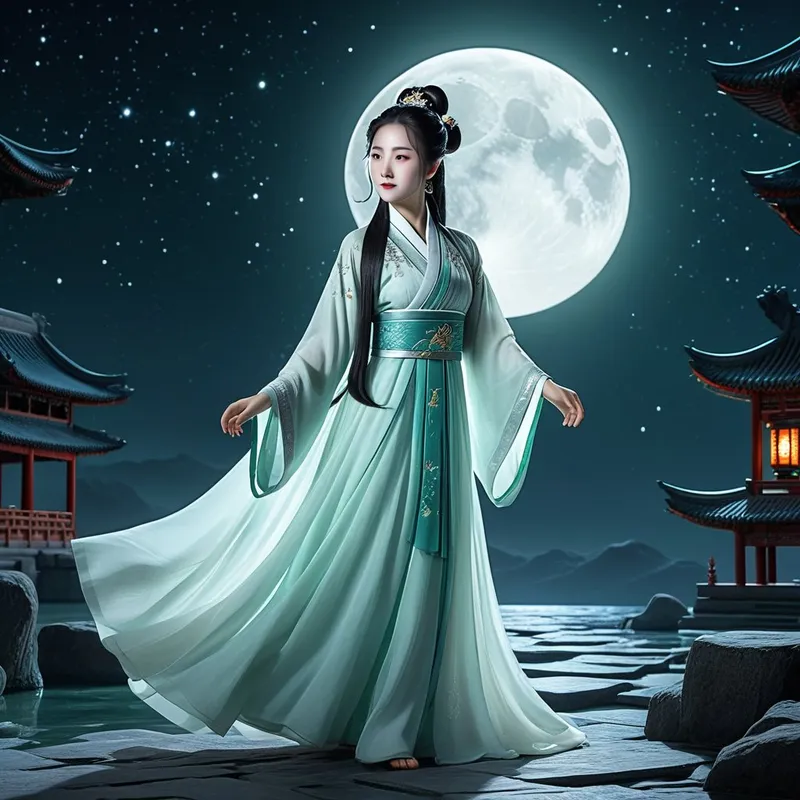
Chang'e Myth Meaning & Symbolism
A tale of a woman who, seeking immortality, consumes the elixir of life and ascends to the moon, becoming a goddess of eternal solitude and luminous reflection.
The Tale of Chang'e
Listen, and hear a story painted in moonlight and regret.
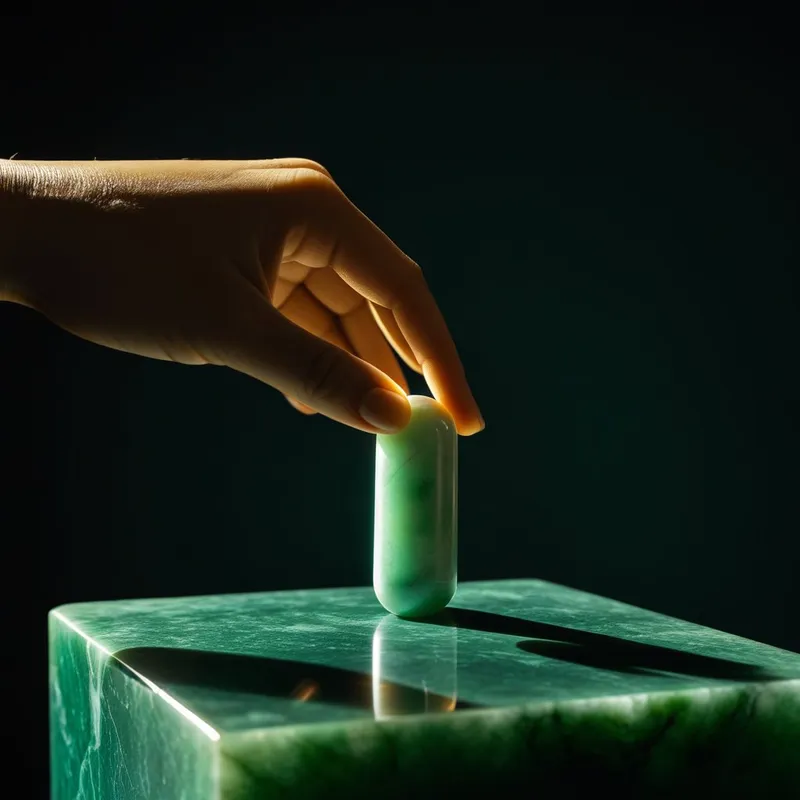
In the time when gods and heroes walked the earth, there lived a peerless archer, Houyi. He was a man of the sun, all action and fiery purpose. For his great deed of shooting down nine of the ten suns that scorched the world, the Xi Wangmu granted him a treasure beyond price: a single pill of the Elixir of Immortality. This was no mere medicine, but a distillation of cosmic essence, a seed of eternity. "Consume it whole," she warned, "and you will ascend to the heavens, leaving this mortal coil behind. But share it between two, and you shall both live forever on earth, in undying peace."
Houyi brought the elixir home to his beloved wife, Chang'e. Her beauty was not of the glaring sun, but of the reflective moon—quiet, deep, and contemplative. They decided to wait for an auspicious day to share the pill, to secure an eternal life together. Houyi placed the radiant pill in a lacquer box and hid it away.
But the weight of such a secret is a gravity all its own. While Houyi hunted, a shadow of unease fell upon their home. A petty thief, or perhaps the whispering envy of a lesser deity, sought the elixir. Chang'e, sensing intrusion, felt a cold panic. The sacred trust was threatened. In that moment of desperate protection, she did the only thing she could think to do. She opened the box, took the pulsing, golden pill, and swallowed it.
The effect was instantaneous and catastrophic. It was not a gentle unfurling, but a violent unmaking. The earth's pull fell away from her. She felt herself becoming light, then thought, then pure essence. Her body, no longer bound by clay, began to float upwards. Out the window she drifted, past the thatched roof, into the vast and starry vault of the night. She reached for home, for Houyi, but her hands passed through the roof tiles as through mist. Up and up she soared, pulled by a destiny now irrevocably chosen.
The heavens did not welcome her as a hero. She ascended not to a palace of celebration, but to the coldest, most solitary place imaginable: the Guanghan Palace on the moon. There, in that silent, crystalline realm of eternal night, her transformation completed. She became the Goddess of the Moon, her mortal life shed like a silken robe. Her only companion was a Jade Rabbit, endlessly pounding herbs in a futile attempt to recreate what was lost. And on clear nights, when the moon is full and bright, you can still see her there—a figure of breathtaking beauty and bottomless loneliness, forever gazing back at the warm, living world she can never rejoin.
Cultural Origins & Context
The myth of Chang'e is ancient, with roots stretching back to the Shijing (Book of Songs) and narratives from the Shan Hai Jing (Classic of Mountains and Seas). It was not a static tale, but a living story shaped by poets, Daoist alchemists, and folk tradition over millennia. During the mid-autumn Zhongqiu Festival, the story is recited and the moon is worshipped, making Chang'e a central figure in a communal ritual of thanksgiving and familial unity—a poignant contrast to her own narrative of isolation.
The myth served multiple societal functions. It explained the celestial mechanics and the moon's luminous, cold nature. For Daoists, it was a cautionary allegory about the perils of seeking immortality without proper spiritual preparation. On a human level, it gave poetic form to the universal experiences of unintended consequence, the weight of choice, and the bittersweet nature of gaining a transcendent state at the cost of earthly connection.
Symbolic Architecture
At its heart, the myth of Chang'e is an archetypal drama of ascent through transgression. It maps the psyche's confrontation with a power too great to be integrated safely into ordinary life.
The Elixir is the ultimate symbol of the Self—the promise of psychic wholeness and completion. But to seize it unprepared is to be shattered by it.
Chang'e is not a villain, but a human catalyst. Her act is one of protection that becomes a transformation. The moon she inhabits is not a prize, but a psychological state: the realm of the conscious ego divorced from the warm, instinctual earth of the body and relationship (represented by Houyi). She becomes pure consciousness, eternal reflection, but at the cost of participation. The Jade Rabbit is the compulsive, unconscious activity that continues after a traumatic psychic shift—the endless, repetitive labor of the psyche trying to mend what cannot be mended, to return to a state before the fateful choice.

The Dreamer's Resonance
When this myth stirs in modern dreams, it often signals a profound process of involuntary individuation. The dreamer may experience:
- Dreams of floating or flying away uncontrollably, representing a feeling of being unmoored from one's life, identity, or relationships due to a recent decision or revelation.
- Images of a beautiful but icy, isolated place, reflecting a state of emotional withdrawal or intellectual enlightenment that feels majestic but lonely.
- Encounters with a radiant, forbidden object or knowledge that, once "consumed," changes everything. This could symbolize a traumatic truth, a spiritual awakening, or a professional success that carries a hidden cost of alienation.
Somatically, this may manifest as a sense of coldness, detachment, or living "in one's head." The individual is undergoing what Chang'e underwent: a necessary but painful differentiation of the self from its former embedded state. They are becoming conscious, which is a kind of ascension, but one that initially feels like exile.

Alchemical Translation
The psychic transmutation modeled here is the sacrifice of the personal for the archetypal. Chang'e's journey is the ultimate dark night of the soul that precedes a new constellation of the personality.
The Guanghan Palace is not a prison, but the necessary vessel for a new kind of consciousness. One must first become the lonely moon before one can learn to illuminate the night.
For the modern individual, the "elixir" might be a hard-won insight, a talent, a truth about one's family, or a spiritual calling that cannot be shared with one's former "tribe." Consuming it means accepting the destiny of that knowledge, even if it separates you. The initial phase is pure orphanhood—cast out from the warm, solar world of collective belonging.
The alchemical work begins after the ascent. It is the long, quiet labor of the Jade Rabbit: the slow, patient integration of this new, lunar consciousness. One must learn to inhabit the solitude, to find meaning in reflection rather than action, and to eventually understand that the light one now sheds—cool, clarifying, and revealing of shadows—is a gift to the world below. The goal is not to return to the sun, but to become a stable, illuminating presence in the psychic cosmos, accepting one's role as the eternal witness, the holder of the reflective, feminine principle in a psyche that has journeyed beyond the simple dichotomies of earth and heaven.
Associated Symbols
Explore related symbols from the CaleaDream lexicon: