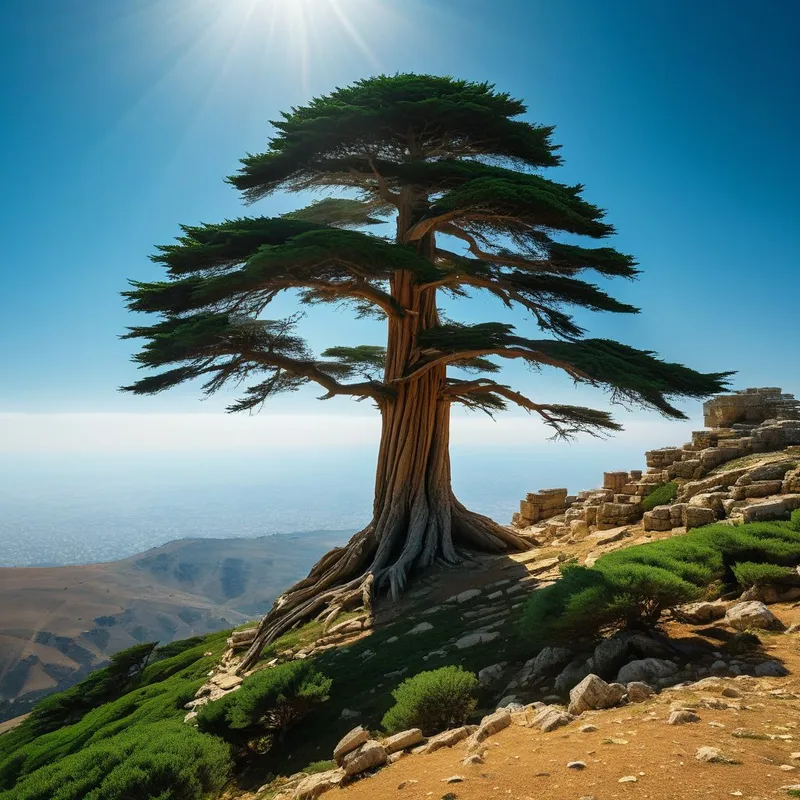
Cedar of Lebanon Myth Meaning & Symbolism
A majestic tree bridging heaven and earth, felled by kings to build temples, embodying divine presence, human hubris, and sacred sacrifice.
The Tale of Cedar of Lebanon
Hear now, of the mountain that touches the belly of heaven, and of the tree that is its crown.
In the high places, where the air is thin and tastes of stone and ice, the Lebanon range holds its back against the sky. And upon its shoulders grow the giants: the Cedars of the Lord. Their trunks are pillars of reddish-gold, wider than the embrace of ten men. Their branches are tiered, like the heavens themselves—a first spreading tier, then a second, then a third, ascending in perfect, green-black clouds of foliage that whisper secrets to the stars. Their scent is the scent of eternity: resinous, clean, piercing the heart. They are the first trees. They remember when the waters receded.
They are the dwelling place of the Ruach, the wind from God that moves between earth and the great deep. Eagles nest in their highest boughs. The rain is summoned by their need.
But a sound rises from the plains below. Not the wind. The sound of ambition. A king, in a city of dust and brick, dreams of a house—not for himself, but for his God. He is Solomon, wisest of men, and his dream is clad in cedar. He sends word to Hiram, King of Tyre: "Command that cedars be cut for me from Lebanon."
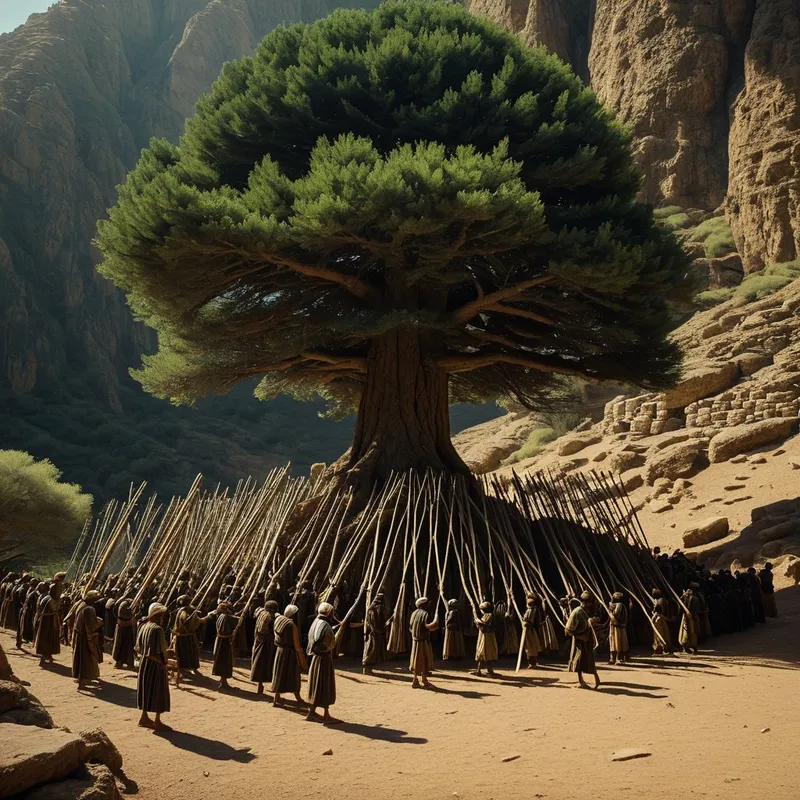
And so, the men come. Ten thousand shifts of men, hewers of stone and fellers of trees. They climb where only goats and spirits tread. They face the giants. The bite of the bronze axe into the ancient bark is a sound that makes the mountain shudder. Chips fly, golden as sunlight. The groan of the tree is deep, a vibration in the rock, a sigh that travels through the roots to its brothers. One month they labor on a single giant, until, with a crack that echoes like thunder in a clear sky, the pillar begins to lean.
It falls slowly, with terrible grace, its branches screaming against the sky as they tear through the canopy of its kin. It crashes to the earth in a cloud of dust and shattered rock, its length spanning a valley. The silence that follows is heavier than the mountain.
Then, the work of transformation. The limbs are stripped. The colossal trunk is measured, shaped, smoothed. Teams of oxen, countless men, drag it on rollers down to the sea. The logs are bound into great rafts, a floating forest, and floated south along the coast to Joppa. From there, they are hauled again, up to the holy mountain in Jerusalem.
In the dust and din of the building site, the scent of Lebanon fills the air. The cedar is raised again—not as a living tree reaching for heaven, but as a carved beam, a paneled wall, an altar overlaid with gold. The house is built. The Holy of Holies is lined with it, from floor to ceiling. The scent of the cedar, the very breath of the mountain, becomes the permanent fragrance of the dwelling place of the Most High. The tree that touched heaven now forms the ceiling of God’s house on earth. It is both a sacrifice and a throne.
Cultural Origins & Context
This is not a single myth from a forgotten tablet, but a resonant theme woven through the sacred texts of ancient Israel. The Cedars of Lebanon appear in the Torah, the Psalms, the Prophets, and the historical books. They were a known, tangible symbol of supreme quality, durability, and majesty. For a people whose landscape was often arid and marked by smaller, gnarled trees like the olive and the sycamore, the cedars of the northern mountains represented an almost mythical ideal of vegetative power.
The primary narrators of this "myth" are the scribal historians and poets of the Judahite tradition. The story of Solomon’s procurement of cedar for the First Temple (detailed in 1 Kings 5-6) is presented as a historical account of statecraft and piety. Its societal function was multifaceted: it legitimized the Jerusalem Temple as a cosmic center (built with the world’s finest materials), celebrated royal wisdom and international diplomacy, and contrasted human achievement with divine sovereignty. The prophets, like Isaiah and Ezekiel, would later use the cedar as a metaphor for pride that is humbled, or for a righteous remnant that God will replant. The myth lived in the tension between its use as a symbol of glorious achievement and as a warning against the hubris that such achievement can breed.
Symbolic Architecture
The Cedar of Lebanon is an axis mundi, a world pillar connecting the three realms: its roots in the underworld of stone and deep earth, its trunk in the human world of ambition and craft, its crown in the divine realm of wind and spirit.
To fell the cedar is to mediate the impossible: to bring the vertical, timeless majesty of the divine into the horizontal, time-bound project of human culture.
It symbolizes divine immanence—God’s presence inhabiting the material world. The tree is natural, yet chosen; it is transformed, yet its essence (its scent, its grain) remains, perfuming the holy space. It also symbolizes kingly hubris and sacred contract. Solomon’s act is one of breathtaking scale and cost. It is an act of devotion, but also of mastery. He masters the mountain, the tree, the sea, and the labor of thousands to serve his vision. The myth does not shy away from this tension; it is the core drama. The tree’s journey from living mountain god to dead, shaped timber in God’s house mirrors the human spiritual journey: the ego (the towering, natural self) must be “felled” and shaped to become a vessel for something transcendent.
Psychologically, the Cedar represents the Self in the Jungian sense—the total, integrated psyche, majestic and central. The king who orders its felling represents the ego attempting to integrate this vast Self into the structure of conscious life (the Temple). It is a perilous, necessary, and sacred operation.
The Dreamer's Resonance
When the Cedar of Lebanon appears in a modern dream, it is rarely a simple tree. It is an event. Dreaming of seeing a majestic, towering cedar often signals contact with a core, foundational aspect of the dreamer’s Self—a feeling of innate nobility, resilience, or deep-rooted wisdom that is being recognized. There is a somatic sense of expansion, of breathing more deeply.
Dreaming of cutting down or seeing a cedar felled is profound shadow-work. It indicates a necessary, often painful, process of deconstruction. A long-standing, towering structure of the personality (an identity, a belief system, a source of pride) is being sacrificed for a larger purpose. The dreamer may feel this as loss, anxiety, or even violation, but the mythic context suggests it is for temple-building. The somatic feeling might be of emptiness, a hollow ache, or the shocking vibration of an impact.
Conversely, dreaming of building or being inside a structure of cedar speaks to integration. The raw, natural power has been successfully translated into a inhabitable inner space—a stable psyche, a sacred inner sanctuary where one can meet the numinous. The scent in the dream is key; it is the memory of the living tree within the crafted house, symbolizing that the essence of the Self survives its transformation.
Alchemical Translation
The alchemical process modeled here is the opus of Individuation, where the prima materia (the raw, natural soul) is transformed into the lapis philosophorum (the sacred, integrated Self).
The Cedar on the Mountain is the prima materia: the unconscious Self in its natural, wild, and glorious state. It is potential, but unintegrated. The conscious ego (Solomon) recognizes its splendor and feels a holy desire to unite with it, to give it a dwelling place in the world of consciousness.
*The Felling is the nigredo:* the blackening, the mortification. This is the crucial, painful stage where the ego confronts the autonomy of the Self. The act of cutting is a necessary violence—the breaking down of old, towering complexes, the humbling of spiritual pride. It is a descent, a “death” of the natural form. Many spiritual crises feel like this: the felling of what once seemed eternal and central.
*The Shaping and Transport is the albedo:* the whitening, the purification. The raw material is worked upon. It is smoothed, measured, and moved from its native realm (the unconscious) to the site of construction (the conscious life). This is the long, laborious work of therapy, reflection, and art—taking insights from the depths and preparing them for use.
*The Raising in the Temple is the rubedo:* the reddening, the glorification. The transformed material becomes the central structure of the inner sanctuary. The ego has not simply stolen the Self’s power; it has built a house for it. The living presence of the tree (the Self) now dwells within the crafted order of the temple (the conscious personality). The two are united. The scent of cedar—the enduring essence—is the proof.
The ultimate alchemical truth of the Cedar is this: the sacred is not destroyed by being used; it is fulfilled. The temple is not a cage for the divine tree, but its ultimate expression in the world of time and matter.
Associated Symbols
Explore related symbols from the CaleaDream lexicon: