Castor and Pollux from Greek m Myth Meaning & Symbolism
The tale of twin brothers, one mortal and one divine, whose profound bond transcends death, creating an eternal constellation of brotherhood and shared fate.
The Tale of Castor and Pollux from Greek m
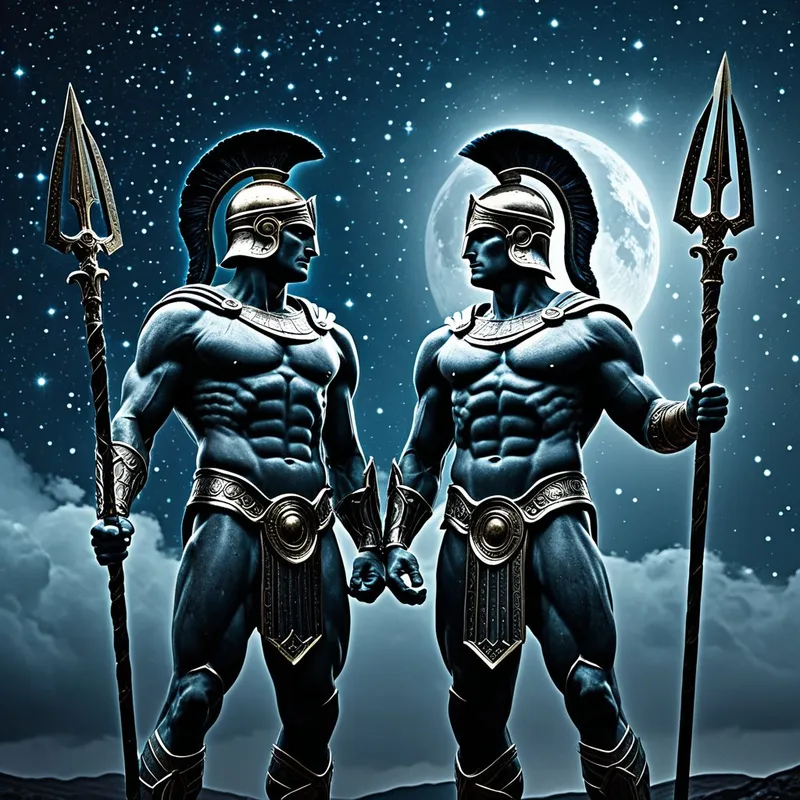
Hear now the song of the Dioscuri, the sons of Zeus, whose tale is written not only in the annals of men but in the very fabric of the night sky. It begins in the royal house of Sparta, where Queen Leda, beloved of the great god Zeus, bore a miraculous brood. From one egg hatched radiant Helen, whose face would launch a thousand ships. From another emerged two boys: Castor and Polydeuces, whom the Romans would call Pollux.
They were two bodies with one soul. Castor, born of Leda’s mortal husband King Tyndareus, was a prince of the earth, a tamer of horses whose hands spoke the language of the bridle. Pollux, the divine seed of Zeus, possessed a strength that flowed from the heavens, a boxer whose fists could fell a bull. Yet no lineage could divide them. Together they sailed with Jason on the Argo, their presence a bulwark against storm and monster. Together they hunted, fought, and ruled, a perfect dyad of mortal skill and immortal vigor.
But fate, the spinner of all threads, cannot abide perfect symmetry. A quarrel arose with their cousins, Idas and Lynceus, over divided cattle. In the heat of the dispute, Idas, fueled by a festering envy, drove his spear deep into Castor’s chest. The mortal twin fell, his lifeblood soaking the Spartan earth he loved. A cry tore from Pollux that was not human—it was the sound of a star being ripped in half. He slew Lynceus in turn, and as Idas raised a tombstone to crush him, Zeus, watching from Olympus, struck the murderer down with a thunderbolt.
Yet this divine vengeance was ash in Pollux’s mouth. He knelt by his brother’s body, the inseparable now cruelly severed. Immortality, his celestial birthright, became a curse—an endless, lonely dawn. He would not accept it. He went to his father, not as a supplicant, but as a force of nature. “Take it back,” he implored Zeus, his voice raw with a grief that shook the foundations of the divine court. “This gift of endless life. Let me die with him, or let him live with me. I will not walk eternity alone.”
In the face of such absolute love, even the king of gods was moved. He offered a choice no other had been given: Pollux could remain immortal on Olympus, or he could share his divinity with Castor. But the cosmos demands balance. They would not both dwell forever in the golden halls. Instead, they would trade places, alternating their existence between the sunlit world of the living and the shadowy realm of Hades. One day in the light, one day in the dark, forever passing the torch of life between them.
And so, Zeus lifted them both, the mortal and the immortal, and set them in the heavens as the constellation Gemini. There they remain, twin stars forever close in the winter sky, a celestial testament to the bond that refused the finality of the grave. They became the protectors of sailors, appearing as the shimmering St. Elmo’s fire on mastheads, guiding those caught between the dual realms of sea and storm, just as they themselves navigate the twin shores of life and death.
Cultural Origins & Context
The myth of the Dioscuri is deeply rooted in the proto-Indo-European tradition of the “Divine Twins,” a foundational archetype found from the Ashvins of the Vedas to legendary founders in European folklore. In the Greek world, their cult was particularly strong in Sparta and Doric regions, where they were venerated not merely as figures of story, but as active, present gods. They were models of the idealized Spartan martial brotherhood (philia), representing the perfect synergy of complementary strengths essential for the hoplite phalanx.
Their worship was practical and immediate. As savior gods (Soteres), they were believed to appear on battlefields, fighting alongside Spartan armies. At sea, the phenomenon of corposant (St. Elmo’s fire) was interpreted as their visible presence, offering protection to vessels. This dual patronage—of the soldier on solid ground and the sailor on the unstable deep—cemented their role as masters of liminal spaces, mediators between safety and peril, order and chaos. Their myth was not just recited by bards; it was enacted in rituals, sworn upon in oaths, and seen in the natural world, making them a living part of the cultural and spiritual landscape.
Symbolic Architecture
At its heart, the myth is a profound exploration of duality and its transcendence. Castor and Pollux represent the fundamental pairs that constitute human experience: mortal and immortal, body and spirit, earth and heaven, temporal and eternal. They are not opposites in conflict, but complementary halves of a greater whole.
The ultimate alchemy is not turning lead to gold, but weaving mortality and divinity into a single, enduring pattern.
Castor, the earthly horseman, symbolizes the embodied self—our skills, our temporal achievements, our vulnerable flesh. Pollux, the divine boxer, represents the indestructible core of being—the spirit, the essential identity that persists. The tragedy is not Castor’s death, but the separation of these two principles. Pollux’s refusal of solitary immortality is the psyche’s rebellion against a fragmented existence. His choice to share his fate initiates the resolution: not the elimination of duality, but its integration. The alternating destiny in Hades and Olympus is a symbolic mandala of wholeness, acknowledging both the cyclical nature of life (light/dark, conscious/unconscious) and the eternal cohesion of the central self.

The Dreamer’s Resonance
When this myth stirs in the modern dreamscape, it often surfaces during experiences of profound loss, partnership crises, or deep internal conflict between two seemingly irreconcilable parts of the self. To dream of twins—especially if one is injured, fading, or ethereal—can signal a somatic recognition of a “split” in one’s identity. Perhaps the practical, achieving self (Castor) feels at odds with or neglected by the aspirational, spiritual self (Pollux).
The dream may manifest as searching for a lost sibling, seeing a double in the mirror who acts independently, or witnessing a celestial event with two stars. The somatic feeling is often one of acute incompleteness, a “phantom limb” pain of the soul. This is the psyche working to heal a rupture, to initiate its own version of Pollux’s plea: it seeks to re-negotiate the relationship between the mortal, conditioned personality and the immortal, essential Self, refusing to let either part be exiled or annihilated.
Alchemical Translation
The individuation process modeled by the Dioscuri is the alchemy of sacred partnership, first within. Our initial state is often one of unconscious identification: we are either “only Castor” (identified solely with our mortal roles and frailties) or “only Pollux” (identified with spiritual ideals in denial of human limits). The “spear of Idas”—a crisis, a failure, a betrayal—“kills” this one-sided identification, forcing a confrontation with our inherent duality.
The crucible of the soul is forged in the refusal to abandon any part of oneself.
Pollux’s descent from Olympus to kneel in the dust is the act of nobilitas—the spirit choosing to engage fully with the wounded, mortal condition. His bargain with Zeus is the transformative act: the conscious agreement to hold both realities in a dynamic, alternating tension. The modern individual undergoing this alchemy learns to dwell alternately in the “Olympus” of their potential and ideals, and the “Hades” of their shadows, limitations, and unconscious material. One does not conquer the other; they share sovereignty. The result is not a static, perfect unity, but a living, breathing constellation—a Self that is a reconciled duality, capable of navigating all realms because it acknowledges it belongs to all of them. We become, like the Gemini stars, fixed points of light born from an eternal, loving exchange between heaven and earth.
Associated Symbols
Explore related symbols from the CaleaDream lexicon: