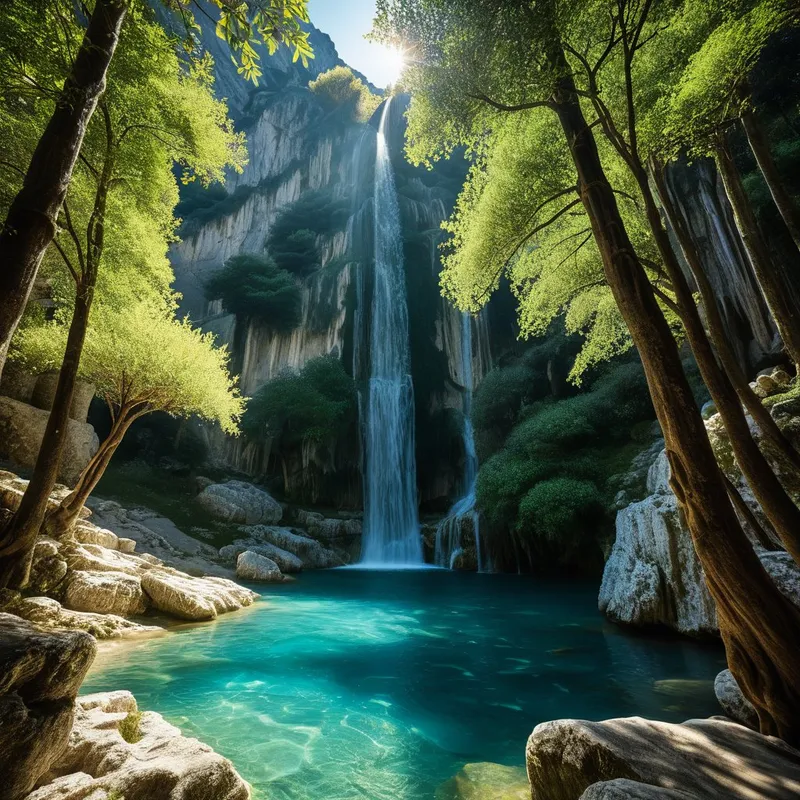
Castalian Spring Myth Meaning & Symbolism
A sacred spring at Delphi, born from a nymph's flight, whose waters purify pilgrims and awaken prophetic, poetic voice in those who dare to drink.
The Tale of Castalian Spring
Hear now the whisper of the rock, the sigh of the mountain. High on the shuddering flanks of Parnassus, where eagles carve prayers into the sky, there was a cleft. Not a wound, but a mouth. And from this mouth, before memory, water sang. It was a cold, clear song, older than the gods who would claim it.
But this is not merely the tale of a spring. It is the tale of a flight, a transformation born of terror and desire.
The nymph Castalia was like the light on a fast-moving stream—beautiful, elusive, forever dancing away from grasp. Her laughter was the sound of pebbles tumbling in a brook. Yet her freedom drew a gaze she did not want: the gaze of Apollo, the Far-Darter, he who sees all. Fresh from slaying the great serpent Python to claim the oracle below, his spirit burned with conquest and passion. He saw Castalia and desired to possess her grace, to add her song to his lyre.
But Castalia knew the price of a god's love. She had seen the fate of others—transformed into trees, into echoes, into stars, forever frozen in the moment of their refusal. She would not be captured. She would not become a trophy in his sacred grove.
So she ran. Not through meadows, but up the sheer bone of the world, towards the very summit where the air grows thin and mortal thoughts fall away. Apollo’s pursuit was not a chase; it was an inevitable tide rising behind her. She could feel the heat of his presence, the golden net of his will closing in. At the precipice, before the great cleft in the mountain’s face, she stopped. Below her lay the sanctuary of his new-won power, the Omphalos. Before her was the god. Behind her was only stone.
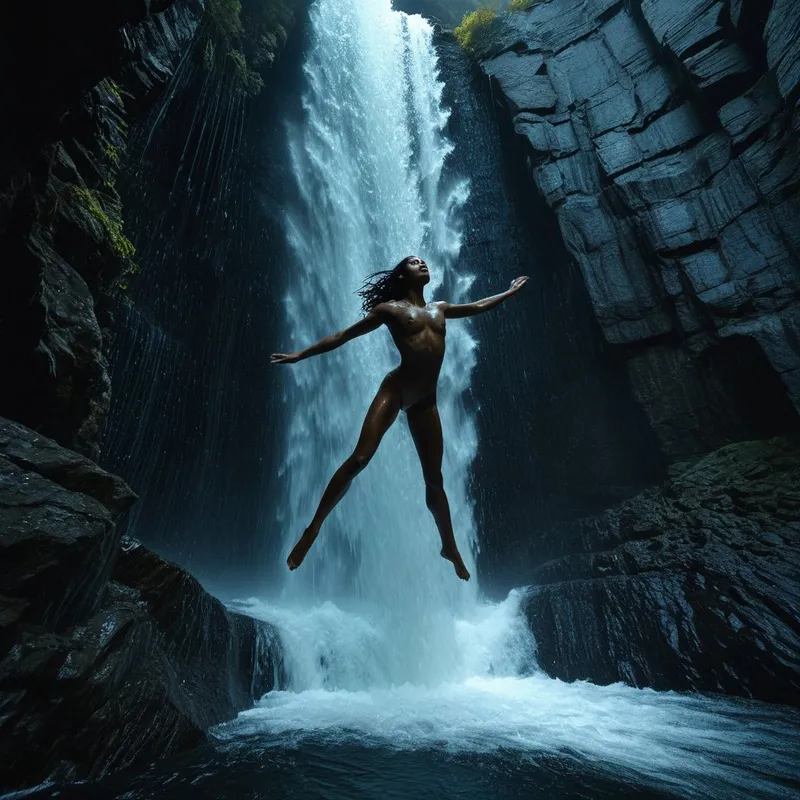
In that suspended breath, she made her choice. Not surrender, but a deeper yielding. She would not be taken. She would give herself—but to the mountain itself, to the deep, silent dark from which all things emerge. With a cry that was neither fear nor despair, but a fierce, final declaration of self, Castalia threw herself into the dark mouth of the cleft.
And the mountain drank her. Not as a death, but as a marriage. Her fleeing form dissolved, not into nothingness, but into essence. Her terror became a chill, refreshing clarity. Her desperate flight became a perpetual, graceful descent. Her silent scream became a ceaseless, murmuring song. Where she vanished, the water began to flow with a new voice—a voice that was both hers and not hers, a voice that remembered the nymph’s flight and promised the god’s gift. The Castalian Spring was born, a monument not to possession, but to a transformation so complete it became a source for all.
Cultural Origins & Context
The Castalian Spring was no mere geographical feature; it was the ritual threshold to the most sacred space in the ancient Greek world: the Sanctuary of Apollo at Delphi. Its myth, likely originating in the local lore of the Phocian region, was woven into the fabric of Delphic practice. The spring’s location was pragmatically and symbolically potent—pilgrims ascending the Hiera Hodos would stop here, physically and spiritually, before entering the god’s precinct.
Its primary societal function was one of radical purification. Priests, priestesses (most famously the Pythia), and supplicants seeking prophecy would wash their hair in its icy waters. This was not a simple cleaning; it was a katharsis, a ritual shedding of the mundane miasma of the outside world to become a vessel fit for divine communication. The spring was the liminal zone where the profane self was scrubbed away, preparing the individual to stand before the Omphalos and hear the god’s often-cryptic truths. The myth provided the aition (the sacred cause) for this practice: the waters themselves were born from a moment of ultimate transition, making them the perfect medium for facilitating another.
Symbolic Architecture
The myth of Castalia is a profound map of psychic transformation. On one level, it is a classic narrative of daphne, where a pursued being escapes a more powerful force through metamorphosis into a natural element. Yet Castalia’s transformation is uniquely reciprocal. She does not simply become an inert object; she becomes a dynamic, sacred source.
The spring is the embodied paradox: the point of absolute surrender becomes the wellspring of perpetual flow.
Castalia represents the untamed, instinctual psyche—the autonomous life of soul (the nymph) that resists being wholly assimilated by the conscious, ordering principle (Apollo, representing light, reason, and cultural order). Her flight is the soul’s retreat from a consciousness that seeks to possess and define it too rigidly. Her leap into the cleft is not a defeat, but a descent into the unconscious itself—the dark, rocky substratum of the personality. The spring that results symbolizes the integration of these opposing forces. The water is the purified emotion and insight that bubbles up when the conscious mind (Apollo) no longer pursues to capture, but instead tends and honors the source that now nourishes its own domain (the oracle).
The water thus becomes the symbol of inspired speech and clarity. It washes away the "dirt" of subjective bias, personal history, and egoic noise, allowing for the clear, if mysterious, voice of a deeper truth—the "god’s voice"—to be heard. It is the medium through which the chaotic, personal experience of the nymph is alchemized into the transpersonal, cultural gift of prophecy and poetry.

The Dreamer's Resonance
To dream of the Castalian Spring is to dream of a profound inner summons to purification and authentic voice. The dream may manifest as finding a hidden fountain in a concrete urban landscape, attempting to drink from a tap that flows with impossibly cold, clear water, or standing before a body of water you know you must enter to proceed.
Somatically, this often correlates with a felt need to "come clean"—a physical sensation of being coated in a grime that is not physical, or a tightness in the throat chakra related to unspoken truths. Psychologically, the dreamer is at a point where old identities, accumulated resentments, or borrowed opinions have become a psychic contamination, blocking access to their own inner oracle. The spring in the dream represents the call to a necessary, often uncomfortable, katharsis. The act of drinking or bathing in it signifies a willingness to undergo this cleansing, to dissolve the outworn self (like Castalia) in order to allow a more authentic expression to flow forth. Resistance in the dream—fear of the water’s cold, pollution of the source—points to a clinging to the very ego-structures that are causing the stagnation.
Alchemical Translation
The journey of Castalia models the alchemical opus of individuation—the process of becoming one’s true, whole self. It begins with the nigredo, the blackening: the oppressive pursuit by the solar consciousness (Apollo) which, in its immature state, seeks to colonize the entire psyche. Castalia’s terror and flight represent the soul’s dark night, its feeling of being hunted by its own potential.
Her leap into the mountain’s cleft is the supreme act of the mortificatio—the symbolic death. This is not a literal suicide, but the ego’s willing surrender of its totalitarian claim. It is the moment in therapy or deep introspection when we stop running from a painful complex or a denied aspect of self and instead, consciously "leap into" it, allowing ourselves to be dissolved by its truth.
The sacred is born not from victory, but from the courageous dissolution of the one who flees.
From this dissolution comes the albedo, the whitening: the emergence of the clear, purifying waters. This is the stage of insight and clarity. The integrated self is no longer the pursued nymph or the possessive god, but the living spring that serves both. For the modern individual, this is the state where one’s raw, instinctual experience (the nymph) is not repressed, but is allowed to flow forth and inform one’s conscious life and creativity (Apollo’s domain). The "oracle" one consults is no longer an external authority, but this inner, cleansed source of truth. One drinks from one’s own depths, and from that water, finds the words—whether in art, in relationship, or in simple, honest living—that are both profoundly personal and universally resonant. The spring, once a place of ritual for ancient pilgrims, becomes the ever-flowing center of the individual’s own sacred geography.
Associated Symbols
Explore related symbols from the CaleaDream lexicon: