Cassandra's Warnings Myth Meaning & Symbolism
A Trojan princess blessed with foresight by Apollo, then cursed to be disbelieved, embodies the agony of knowing a terrible truth that no one will accept.
The Tale of Cassandra's Warnings
Hear now the story of the one who saw, and the world that chose blindness.
It began not in the clamor of war, but in the hushed, incense-heavy air of the temple. Apollo, the Far-Shooter, lord of the silver bow and the clear word, found his gaze captured by Cassandra, princess of Troy. Her beauty was not merely of form, but of spirit—a keen, receptive vessel. In the gilded silence, he offered the ultimate seduction: the gift of prophecy. To see the unspun threads of fate. To know the truth of tomorrow.
Cassandra, young and perhaps wise in ways she did not yet understand, hesitated. The god’s price was her embrace. She refused. Some say she accepted the gift but then spurned the god; others whisper she tricked him, taking the knowledge but not the lover. The result was the same. A god’s desire, once thwarted, curdles into a curse that cannot be unmade. Apollo could not take back the searing clarity he had breathed into her mind. But he could poison the well of her voice. He spat into her mouth as she recoiled—a divine contamination. The curse was sealed: she would forever see the future with painful precision, and forever, she would speak her truths to deaf ears. No one would ever believe Cassandra.
The curse unfolded like a slow, inevitable tragedy. When the glittering prize, Helen, was brought within the high walls of Troy, Cassandra alone saw not a queen, but a consuming fire dressed in woman’s form. She raved at the Scaean Gates, her hair loose, her eyes wide with the vision of towers falling. Her family, the court, the citizens—all saw only the mad daughter of Priam, a woman possessed by hysterical phantoms. They pitied her. They restrained her. They ignored her.
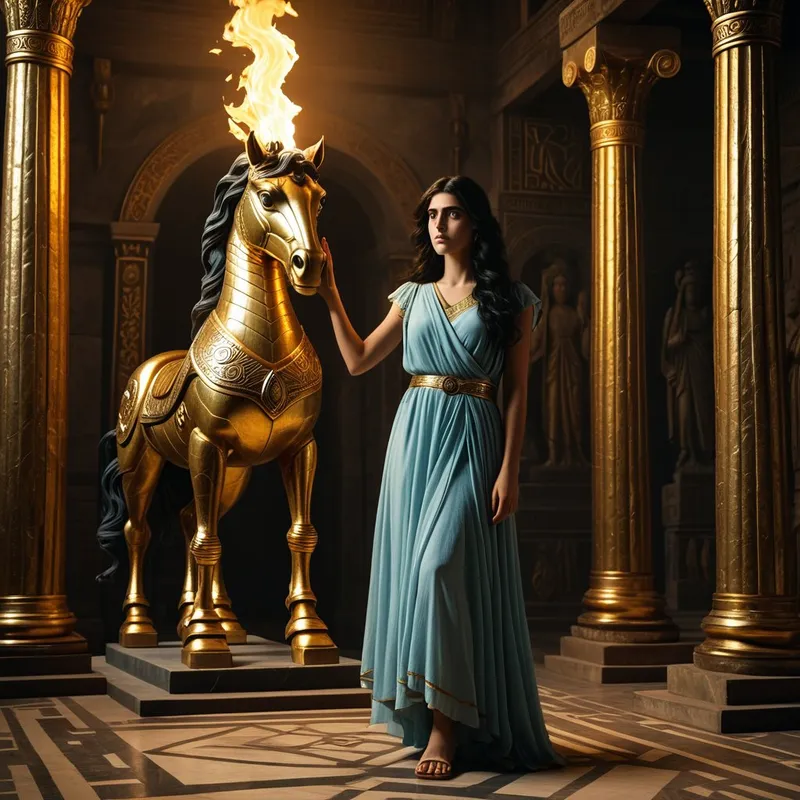
Her torment crescendoed with the Greeks’ final, vile stratagem. The army had vanished, leaving only a monstrous offering on the shore: a giant horse of polished wood. Troy erupted in celebration. The war was over! Only Cassandra saw the truth. She smelled the sweat of men hidden in the belly of the beast. She heard the faint clink of armor within the hollow womb. She ran through the streets, her voice raw, clawing at the ropes that hauled the horse inside the walls. “It is death!” she screamed. “Beware Greeks bearing gifts!” Her warnings were the ravings of a lunatic. They laughed. They celebrated. They pulled the horse in.
That night, the belly opened. Fire and sword were unleashed. Cassandra, in her final act of clear-eyed horror, fled to the temple of Athena, clinging to the ancient wooden statue, the Palladion, as a supplicant. It was no sanctuary. The Locrian warrior Ajax the Lesser found her there. He tore her from the statue’s embrace, an act of sacrilege that would haunt his voyage home. She was dragged away, her prophecies of doom now manifest in the screams around her, her truth finally, terribly validated in the blood and ash of her dying city.
Cultural Origins & Context
The myth of Cassandra is woven into the epic tapestry of the Trojan Cycle, most prominently in the works of the tragedians. While she appears in the Iliad and the Odyssey, it is in the plays of Aeschylus (Agamemnon), Euripides (The Trojan Women), and others that her character and curse are fully fleshed out into a profound psychological portrait.
Told and retold in the amphitheaters of Athens, her story served a crucial societal function. In a culture deeply invested in oracles and omens, Cassandra represented the ultimate nightmare of the prophetic tradition: what if the message is clear, but the mechanisms of belief fail? Her myth explored the tension between individual insight and collective folly, between religious authority and the destabilizing voice of a woman who bypassed sanctioned channels (like the Oracle of Delphi). She was a living cautionary tale about the perils of ignoring ominous signs, a theme deeply resonant for a political society that consulted seers before major undertakings. Her fate asked the audience: How do we, as a city, decide what is truth and what is madness?
Symbolic Architecture
Cassandra is not merely a tragic figure; she is the archetypal embodiment of the unintegrated truth-bearer. Her myth constructs a powerful symbolic architecture around the nature of knowledge, communication, and trauma.
The most profound isolation is not to be unknown, but to be known in your truth and yet systematically unseen.
Her “gift” symbolizes absolute, unimpeachable insight—the clarity of the unconscious that perceives patterns and outcomes invisible to the conscious, defending ego. The “curse” represents the rupture between that inner knowing and the outer world. It is the failure of the symbolic order, the breakdown of the shared language necessary for truth to be accepted. Apollo, as the god of logos (the rational, articulate word), here perverts his own domain, creating a speaker whose words are grammatically correct but semantically null to the listener.
Psychologically, Cassandra represents the part of the psyche that holds traumatic foreknowledge—of personal disaster, of shadow elements rising, of unsustainable paths. This part is often “cursed” by a past experience (the “Apollo” moment, which could be a childhood event, a betrayal, or an initiation into a painful reality) that grants awareness but simultaneously isolates it. The family of Troy symbolizes the ego-complex and the collective attitudes that dismiss this inner voice as hysterical, irrational, or dangerous, preferring the comforting illusion (the Wooden Horse) to the terrifying truth.

The Dreamer's Resonance
When the Cassandra pattern stirs in the modern dreamscape, it signals a critical phase of psychological process. The dreamer may find themselves in a familiar setting—a family home, a workplace, a social gathering—desperately trying to communicate a vital piece of information. They shout, but no sound emerges. They present clear evidence that turns to smoke in their hands. The people around them nod politely but their eyes glaze over, or they turn away.
Somatically, this dream experience is one of profound frustration and visceral urgency, often accompanied upon waking by a tight chest, a sore throat, or a feeling of suffocation. It is the somatic imprint of the curse. Psychologically, it indicates that a deep, intuitive part of the Self has perceived a “truth” that the conscious personality is not yet ready, willing, or able to integrate. This could be the foresight of a relationship’s end, the recognition of a toxic pattern at work, or an inner warning about one’s own health or direction. The dream rehearses the trauma of the insight being rejected, not by others, but by one’s own internal “court”—the ruling attitudes and defenses that maintain the status quo.

Alchemical Translation
The alchemical journey modeled by Cassandra’s myth is not one of rescue from the curse, but of a radical transmutation of the curse itself. The goal is not to be believed by the fallen Troy, but to discover the sacred purpose of the vision within the ruins.
The first operation is not to make the world hear you, but to fully hear yourself. The curse becomes a vessel when the prophetess becomes her own first faithful witness.
The nigredo, the blackening, is the full descent into the despair and isolation of her truth. This is the sack of Troy, the destruction of the old identity built on external validation. The captured Cassandra, dragged across the sea, represents the truth-bearer taken into the “foreign land” of the unconscious, a prisoner of her own gift.
The albedo, the whitening, begins with the difficult work of separating the gold from the dross. The “gold” is the pure, uncorrupted insight itself. The “dross” is the bitter attachment to being heard and validated by the very systems that are doomed. This is the mourning of the need for the father (Priam), the family (Troy), and the society to acknowledge her. It is the internalization of her own authority.
The final transmutation, the rubedo or reddening, is the reclamation of voice not as a tool for external persuasion, but as an internal compass and a creative act. The unheard prophecy must be recorded, given form—perhaps as art, as a journal, as a new life path built on that foresight. In some versions, Cassandra’s spirit finds peace only after death, her truths preserved in legend. For the modern individual, the alchemy is complete when the “curse of knowing” is reframed as the “vocation of seeing,” and one builds a life authentic to that vision, whether the world pulls in the wooden horse or not. The power shifts from seeking belief to embodying truth, and in that embodiment, the curse loses its sting.
Associated Symbols
Explore related symbols from the CaleaDream lexicon: