
Cassandra foreseeing doom but Myth Meaning & Symbolism
A prophetess cursed with perfect foresight and perfect disbelief, embodying the agony of knowing a terrible truth that no one will accept.
The Tale of Cassandra foreseeing doom but
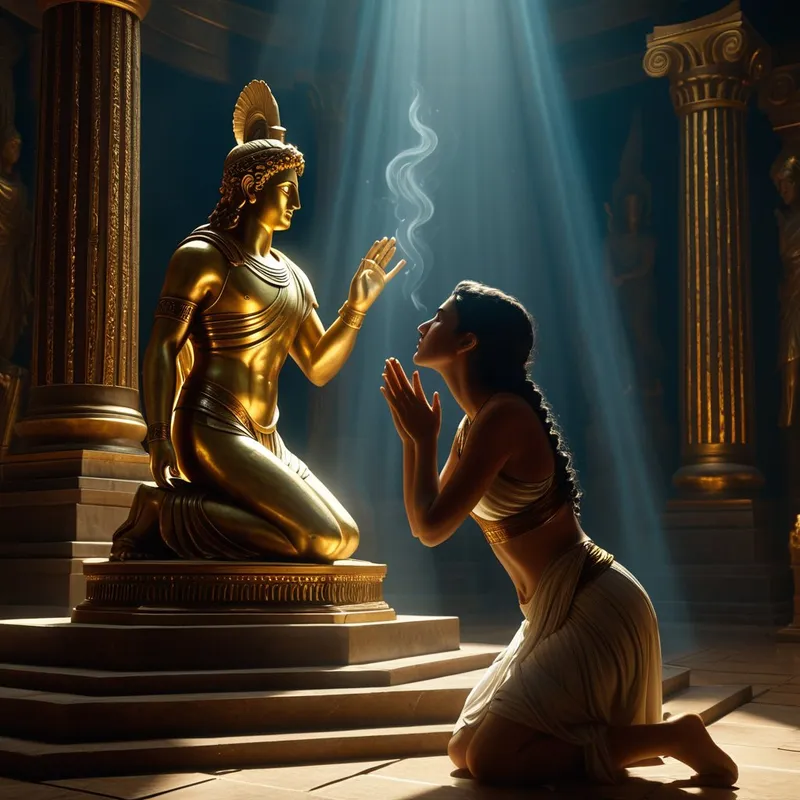
The air in the temple of Apollo was thick with the scent of burnt laurel and myrrh, a sacred haze that hung between the marble columns. Here, in the heart of Troy, the king’s daughter, Cassandra, served as priestess. She was known for her devotion, her mind clear as a mountain spring. One day, as the slanting gold of the afternoon sun painted the god’s statue, a presence filled the space—a pressure in the air, a humming silence. Apollo himself stood before her, radiant, his form both man and blinding light.
He was captivated. In exchange for her favor, he offered the ultimate gift: the clear sight of prophecy. To see the woven threads of fate as the gods themselves see them. Cassandra, young and perhaps too wise, understood the weight of such a gift. She refused the god’s advance. A cold stillness followed her refusal. The god’s radiance did not dim, but it turned sharp, crystalline. The gift, he declared, was already given; the door in her mind was already opened. But a curse would bind it. “You shall see truly, daughter of Priam,” his voice echoed, not in the air but in the marrow of her bones. “But the tongue that speaks your sight will be met only by the wall of disbelief. Your truth will be a ghost to all who hear it; they will look through it to their own destruction.”
From that hour, the visions came. They were not metaphors; they were invasions. She saw the glittering Helen not as a guest but as a slow-burning fuse. She saw the great warrior Achilles, not in his glory, but in his vulnerable heel, and his pyre. Most of all, she saw the horse. A monstrous, silent thing of spliced wood, hollow and pregnant with spears, standing on the beach where the Greek ships had been. She saw the night it would be dragged within the walls, the belly opening like a wound, and the fire that would eat her city whole.
She ran to the palace, her robes tearing on the stones. “Father!” she cried before King Priam and his court. “The gift is a lie! The horse is a tomb! Do not let it pass the gates!” Her words were precise, her descriptions horrifyingly vivid. But as the curse willed, her certainty bred only unease. Her passionate warnings sounded like the ravings of a madwoman. Her brothers mocked her. The elders shook their heads in pity. “Poor Cassandra,” they whispered, “the weight of the god has broken her mind.” She was dragged from the halls, her truth ringing against deaf ears.
On the fateful night, she stood on the walls, watching the celebration below. The horse, an idol of victory, sat in the heart of Troy. She alone heard the faint clink of armor from its hollow womb. As the city slept, sated on wine and false peace, she took an axe and a torch, rushing to the central square. She struck the wooden flank, a desperate, ringing blow. Guards seized her. “It is full of men!” she screamed into the laughing, drunken faces. They bound her and took her away, locking her in a chamber. The last sound she heard from her free people was revelry. The first sound of their end was the creak of the horse’s hidden door swinging open.
Cultural Origins & Context
The myth of Cassandra is a cornerstone of the Epic Cycle, most famously recounted in the works of the tragedians like Aeschylus in his Agamemnon and Euripides in The Trojan Women. She is not a folktale figure but a crucial component of high literary myth, explaining the tragic fall of a great city from within. Her story served a profound societal function for the ancient Greeks: it was a cautionary tale about the limits of human reason and the catastrophic cost of ignoring divine signs, or manteia. In a culture where oracles like Delphi held immense political power, Cassandra represents the ultimate perversion of that system—the perfect oracle rendered utterly powerless by social context. Her myth asks the uncomfortable question: What is the value of truth if the community lacks the capacity to receive it? It was passed down not as a simple story, but as a deep meditation on fate, free will, and the psychological mechanisms of denial, performed in civic theaters as a form of collective catharsis.
Symbolic Architecture
Cassandra is the archetype of the Unheard Prophet. Her curse is a perfect symbolic engine for a specific human agony: the experience of clear-seeing in a context of willful blindness. She represents the intuitive function, the gut-knowing, the pattern recognition that operates ahead of consensus reality.
The curse is not that she sees the future, but that she is exiled from the shared present the moment she speaks of it.
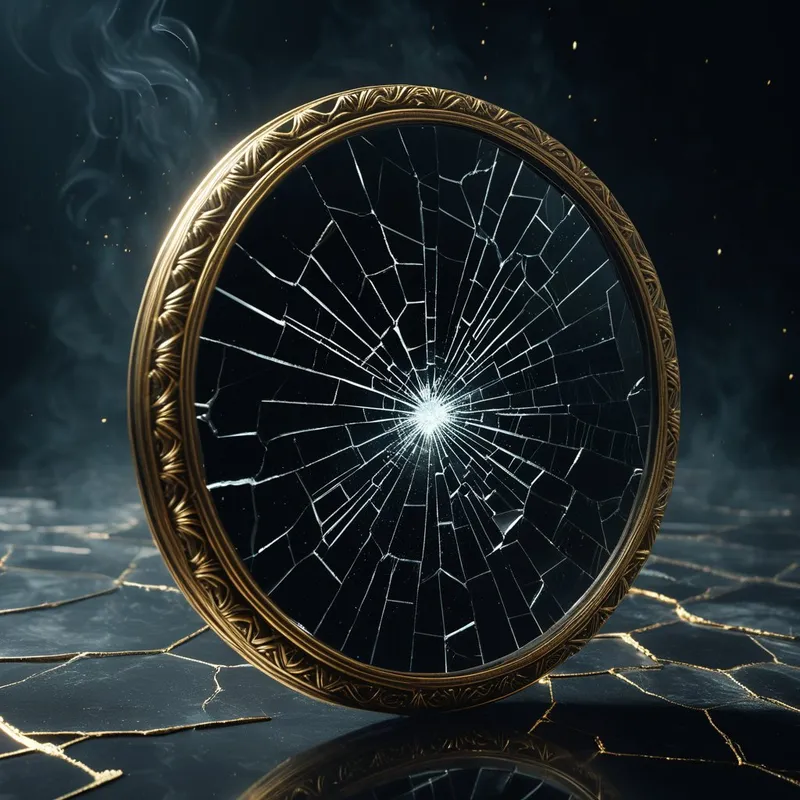
Psychologically, Cassandra embodies the fate of the unconscious content that the ego and the collective are not ready to integrate. The “doom” she foresees is often the logical outcome of unaddressed shadows—the repressed greed, the ignored fault lines, the unsustainable path. Apollo’s “gift” symbolizes the influx of this unconscious knowledge, while his “curse” symbolizes the ego’s defense mechanisms: rationalization, projection (“she’s hysterical”), and outright denial. The city of Troy, in its final hours, becomes a symbol of the fragile psyche that, in refusing to acknowledge its own vulnerabilities, engineers its own collapse.
The Dreamer's Resonance
When this myth pattern stirs in the modern dreamer, it often manifests as dreams of futile communication or paralyzing foresight. You may dream of shouting vital warnings in a crowd where everyone has earplugs in. You may dream of knowing the exact moment a loved one will make a catastrophic mistake, but your body moves in slow motion, your voice is silent. The somatic experience is one of profound frustration and visceral dread—a tightening in the chest, a feeling of breathlessness as you try to impart a truth that cannot land.
This is the psyche working through a Cassandra complex in personal life. It may indicate a situation where the dreamer’s intuitive assessment of a relationship, a job, or a personal habit is crystal clear, but it conflicts with the narrative held by others (a family, a partner, a company culture) or even by another part of themselves. The dream state rehearses the agony of this split, forcing the dreamer to feel the full weight of the ignored truth. It is a call from the unconscious to examine where one’s own “Troy”—a project, a belief system, a lifestyle—is being built on a foundation one already knows is flawed.

Alchemical Translation
The alchemical process modeled by Cassandra’s myth is not one of victory, but of sacred endurance and the transmutation of personal truth in the face of collective invalidation. The prima materia, the leaden starting state, is the raw, torturous clarity of her vision—a truth that isolates. The curse is the necessary nigredo, the blackening, the descent into the despair of being utterly misunderstood.
The alchemical gold she produces is not the salvation of Troy, but the incorruptible integrity of her own witness. She is purified not by being believed, but by remaining faithful to what she sees, even as the world calls it madness.
For the modern individual undergoing individuation, the “Cassandra phase” involves holding a painful insight about oneself or one’s direction that may be rejected by one’s inner council (old identities, internalized voices of parents or society). The psychic transmutation occurs when one stops trying to convince the “Trojans” within—the parts that want comfort over truth—and instead begins to act in accordance with the vision, however quietly. This might mean setting a boundary others will protest, leaving a path that looks secure but feels doomed, or simply journaling a truth one is not yet ready to voice. One integrates the Cassandra archetype not by gaining an audience, but by ceasing to seek validation for the vision from the very structures the vision condemns. In doing so, the individual saves not the city, but their own soul from complicity in the lie. The fire that burns Troy becomes the ignis of the alchemist, the fire of purification that, while destroying one world, forges the unshakeable core of the seer.
Associated Symbols
Explore related symbols from the CaleaDream lexicon: