
Cassandra Myth Meaning & Symbolism
A priestess granted the gift of prophecy by Apollo, then cursed so her true warnings would never be believed, embodying the agony of unheard truth.
The Tale of Cassandra
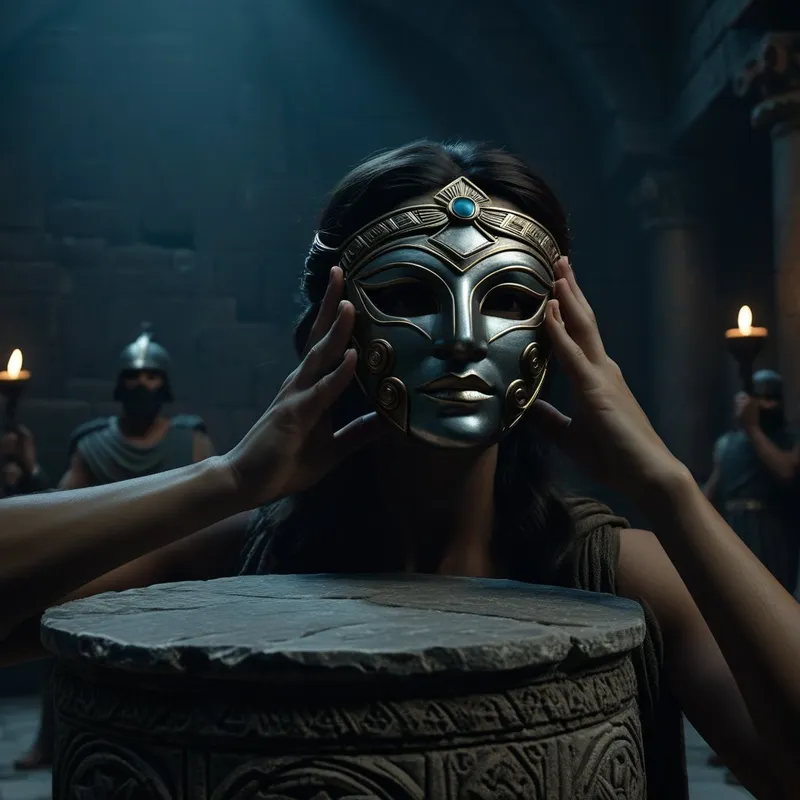
The air in the sanctuary of Apollo was thick with incense and the silence that precedes a storm. Cassandra, daughter of King Priam, knelt not in prayer, but in a state of rapt terror. The god was present. She felt him not as a warmth, but as a pressure, a divine force flooding the channels of her mind. In a moment of cosmic transaction, he offered the gift of clear sight—the unclouded knowledge of what is, what was, and what will be. The young priestess, perhaps in awe, perhaps in cunning, accepted. But when the god moved to claim his promised kiss, she recoiled. The sanctuary chilled. The divine pressure curdled into a curse.
From that moment, Cassandra’s world split in two. She walked in the sunlit world of Troy, its streets bustling, its towers proud. But superimposed upon it was a phantom city, a ghostly double etched in the flames of the future. She saw the great wooden horse, not as a gift but as a womb of death. She saw the shadows of Odysseus and Achilles moving within its belly. She ran through the streets, her hair unbound, her voice raw, pointing at the innocuous-seeming beast. “It carries fire! It carries your doom!” The people stared. Her own family winced. Her words, though true, rang with the dissonance of madness, thanks to Apollo’s spiteful twist. Her truth was impeccable, but its vessel was deemed broken.
When the bronze gates finally groaned shut for the last time, Cassandra sought final sanctuary in the temple of Athena, clinging to the ancient wooden cult statue, the Palladium. Here, the two worlds collapsed into one. The phantom flames became real, painting the temple walls in hellish orange. The Greek warrior Neoptolemus found her there. She looked at him, and in his face, she saw not just a man, but the living instrument of the future she had screamed about for years. Her struggle was not against him, but against the horrific, meticulous accuracy of her own vision coming to pass. As she was dragged from the altar, the weight was not of his hands, but of a prophecy fulfilled, a truth verified in the very moment it became useless. She was condemned to live the nightmare she had foreseen, a passenger in her own life, watching the script unfold with agonizing precision.
Cultural Origins & Context
The figure of Cassandra is woven into the epic tapestry of the Trojan Cycle, most prominently in the works of the tragedians. While fragments of her story appear in the Cypria and other epic poems, it is in the Athenian theater of the 5th century BCE that her character finds its most powerful and haunting expression. Aeschylus gives her a devastating central role in Agamemnon, where she stands on the brink of her own murder, prophesying not only her death but the bloody history of the house of Atreus to unhearing ears.
Her myth functioned as a profound cultural cautionary tale. In a society that revered oracles like those at Delphi, the Cassandra story presented the terrifying inverse of divine communication: the gift without authority, knowledge without the power to effect change. She embodied the existential danger of a truth that cannot be integrated into the social or political body. For the Greek audience, her curse was a narrative device that explored the limits of human reason and the fragility of communal trust. She was the voice of the gods that the polity, in its pride or its ignorance, had chosen to pathologize and exile.
Symbolic Architecture
Cassandra represents the archetype of the unhealed seer—the part of the psyche that perceives painful truths long before the conscious self or the collective is prepared to acknowledge them. Her gift is the function of intuition and foresight, the ability to see patterns and inevitable consequences. Her curse is the alienation that follows when that insight concerns a shadow the community refuses to face.
The curse is not that she sees the future, but that she lives in it while everyone else remains stubbornly, fatally, in the present.
The god Apollo symbolizes the principle of lucid, intellectual consciousness. Cassandra’s rejection of his advances is not merely a personal refusal; it is the intuitive function refusing to be wholly assimilated by, or subservient to, the rational, structured order he represents. The ensuing curse is the revenge of the rational mind upon the intuitive when it feels spurned: it discredits the source. Psychologically, this plays out as the dismissal of gut feelings, hunches, or emotional knowledge by the hyper-rational ego, which brands them as irrational or hysterical.
Her relentless truth-telling, met with disbelief, mirrors the experience of traumatic memory. The traumatic event is a “known” truth that feels unreal and cannot be communicated in a way that makes it feel real to others, trapping the individual in a solitary, inarticulate hell.

The Dreamer's Resonance
When the Cassandra pattern stirs in the modern dreamscape, it often manifests as dreams of futile warning. The dreamer may be shouting at loved ones about an impending disaster—a crumbling wall, an approaching flood—only to have their words come out as whispers, or to be met with blank, smiling indifference. The somatic experience is one of constriction in the throat and chest, a profound pressure to speak coupled with an immobilizing powerlessness.
Such dreams signal that a deep, intuitive part of the psyche is attempting to deliver a critical message to the conscious personality. The “curse” in the dream is the ego’s defense mechanisms—denial, rationalization, minimization—actively working to discredit the message because its content is too threatening to current identity structures, relationships, or life paths. The dreamer is experiencing the internal civil war between a painful truth and the desire for peace, between foresight and the comfort of the status quo. It is the psyche’s way of illustrating the cost of ignoring its own prophetic, self-protective wisdom.

Alchemical Translation
The alchemical journey for one who carries the Cassandra complex is not about gaining the gift—that is already present, often in overwhelming abundance. The work is in transmuting the curse of isolation into the vessel of contained authority. This is the Nigredo to Albedo of the soul.
The first, darkest stage is the full acknowledgment of the wound: “I see truly, and I am not believed.” This must be mourned—the loneliness, the frustration, the rage. The second stage involves a crucial separation: disentangling the truth of the message from the need for it to be received. Cassandra’s torment came from her tethering of her own validity to Troy’s reaction. The alchemical operation is to internalize the oracle. The seeker must become both the prophet and the sacred temple that honors the prophecy.
The transmutation occurs when the voice that cries into the wilderness stops waiting for an echo and learns to appreciate the clarity of the air.
This means recording the visions, honoring the intuitions in private journal or art, and building an inner authority that does not require external validation. It is the development of a container strong enough to hold terrible knowledge without fracturing. Finally, this contained wisdom can begin to inform action in subtle, strategic ways—not through dramatic public warnings, but through aligned choices, boundaried decisions, and the quiet creation of sanctuaries (internal and external) that are resilient to the foreseen storms. The curse of powerless foresight is thus alchemized into the gift of prepared, grounded presence. The seer is no longer a haunted outcast, but a sober steward of the difficult truths that are hers alone to carry, and from which she can now draw a formidable, unshakeable strength.
Associated Symbols
Explore related symbols from the CaleaDream lexicon: