Candlemas Myth Meaning & Symbolism
A mother and child emerge from seclusion into the temple, bearing light, fulfilling ancient law, and marking the fragile threshold between darkness and renewal.
The Tale of Candlemas
Listen. In the deep of winter, when the earth holds its breath beneath a blanket of frost, a story stirs. It begins not with a fanfare, but with a quiet obedience to an ancient rhythm, a law written in blood and spirit.
Forty days had passed since the miracle in the stable. Forty days of a mother’s secret world, a cocoon of milk, straw, and wonder, where the scent of myrrh still clung to tiny hands. For Mary, these were days of seclusion, a sacred quarantine from the bustling world of the temple. But the time was fulfilled. The law called her forth, from the private awe of motherhood into the public eye of faith.
So, with her husband Joseph, a man of silent strength, she made the journey to Jerusalem. In her arms, she carried not just her son, but the offering of the poor: two young turtledoves or pigeons. Their soft cooing was the only sound of protest against the sacrifice to come, a offering for her own purification. But this was no ordinary child, and this would be no ordinary presentation.
They entered the temple—a cavern of stone, smoke, and murmured prayer. The air was thick with the smell of incense and animal sacrifice. They moved toward the altar of offering, two humble figures in the grandeur of Herod’s court. But the story whispers that the temple itself was waiting.
For there was a man in Jerusalem named Simeon. The Spirit was upon him, and it had whispered a promise: he would not see death before he had seen the Lord’s Christ. Driven by that same Spirit, he came into the temple at that very hour.
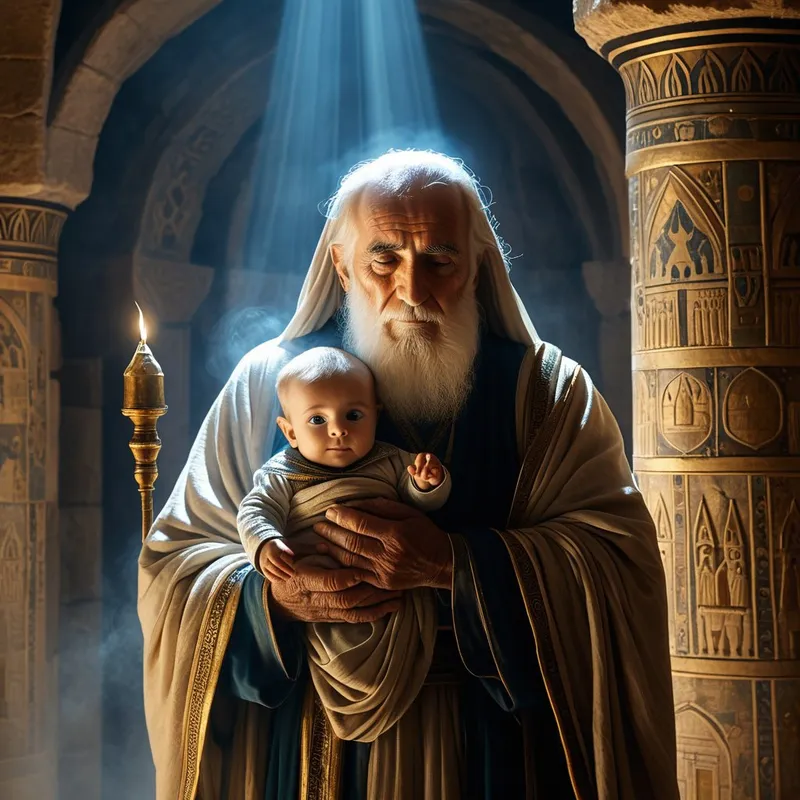
His old eyes, clouded by years but sharpened by hope, fell upon the small family. He moved through the crowd, his steps sure. He took the infant into his arms, a bundle of new life against his aged robes. And as he held him, a light seemed to kindle not in the temple lamps, but within the old man’s very breast. He lifted his voice, not in a shout, but in a song that pierced the ritual hum:
“Now, Master, you may let your servant go in peace, according to your word, for my eyes have seen your salvation, which you have prepared in the sight of all nations: a light for revelation to the Gentiles, and for glory to your people Israel.”
The words hung in the incense-laden air. A light. A revelation. But then, his gaze turned to the young mother, and his song turned to a prophecy edged with sorrow. “This child is destined to cause the falling and rising of many in Israel… and a sword will pierce your own soul too.”
Before the echo faded, another figure emerged: Anna, a widow of eighty-four years who never left the temple, worshipping night and day with fasting and prayer. She gave thanks to God and spoke of the child to all who were looking forward to the redemption of Jerusalem.
Then, the moment passed. The family, having performed everything required by the Law, returned to their own town. The temple returned to its business. But a flame had been lit. A promise, recognized by the very old and the endlessly devout, was now carried back into the world, a tiny, vulnerable light against the retreating winter dark.

Cultural Origins & Context
This narrative, found in the second chapter of the Gospel of Luke, is not a myth in the sense of a pre-Christian fable, but it functions mythically within Christian culture. It commemorates the event known as the Presentation of Jesus at the Temple and, in the West, the Feast of the Purification of the Blessed Virgin Mary. By the late 4th century, it was being observed in Jerusalem. Its evolution into “Candlemas” (from Candela, candle) in the West by the 7th century saw the ritual blessing of candles, whose light symbolized the “light to the Gentiles” proclaimed by Simeon.
The feast was strategically placed on February 2nd, forty days after Christmas (December 25th), meticulously following the Mosaic law of purification (Leviticus 12). Its societal function was multifaceted. It was a hinge in the liturgical year, formally closing the Christmas cycle and turning attention toward Easter. The blessing and procession of candles ritually enacted the bringing of Christ’s light into the world and into the homes of the faithful for the year ahead. Furthermore, in the agrarian calendars of Europe, it syncretized with older, pre-Christian festivals marking the mid-point of winter, such as the Celtic Imbolc, a time of stirrings and the first signs of spring’s return. Thus, the story was passed down not just from pulpits, but through the very act of carrying light into the February gloom, blending divine revelation with the deep, human longing for the sun’s return.
Symbolic Architecture
At its core, Candlemas is a myth of thresholds and recognition. It is about the necessary passage from a sacred, hidden state into the realm of communal law and public destiny.
The 40 days of seclusion represent a liminal, incubatory space. It is the psychological womb where a new consciousness (the “divine child” or nascent self) is nurtured in protected intimacy. Emerging from this state is not optional; it is a requirement of life and growth. The purification offering is not about cleansing sin in a modern moral sense, but about ritually re-ordering oneself after the profound, boundary-dissolving experience of birth (whether of a child, an idea, or a new phase of the self) to re-enter the structured world.
The most profound revelations occur not in isolation, but at the moment we bring our inner truth to the communal altar.
Simeon and Anna are archetypes of fulfilled expectation. They represent the accumulated wisdom and patience of the psyche—the parts of us that have waited a lifetime for a specific inner truth to become manifest. Their recognition validates the new consciousness. Simeon’s Nunc Dimittis is the soul’s sigh of completion; his subsequent prophecy of a “piercing sword” acknowledges that this new light will inevitably cast shadows and bring necessary suffering. Anna, the perpetual witness, represents the aspect of the soul that sustains hope through devoted, daily practice. Together, they form the temple’s welcoming committee for the new, ensuring it is seen, named, and blessed before its journey into the world continues.
The Dreamer's Resonance
When this mythic pattern stirs in the modern dreamer, it signals a psychic “presentation.” You may dream of:
- Bringing a baby or a vulnerable, precious object to a formal, public building (a courthouse, a museum, a school). This is the ego presenting a nascent, tender part of the self to the internal “authorities” or collective norms for approval and integration.
- An elderly, wise figure bestowing a blessing or making a startling prophecy about something you are carrying. This is the Simeon-function of the unconscious, confirming the significance of your inner development while also warning of its costs.
- Being in a ritual procession with light (candles, lanterns) during a dark time, or feeling a profound sense of “duty fulfilled” after a period of withdrawal.
Somatically, this can feel like a release of tension held since a period of intense creativity or personal transformation. It is the psychological process of validation and contextualization. The dreamer is moving from the subjective, private reality of their experience (“This happened to me, it changed me”) into a phase where that experience must find its place in the broader narrative of their life and relationships. There is often anxiety (the vulnerability of the child) mixed with deep relief (Simeon’s peace).

Alchemical Translation
The alchemical journey mirrored in Candlemas is the Opus Sanctum, the sacred work of bringing the scintilla—the divine spark—into conscious reality.
The first operation is the Nigredo of winter and seclusion. This is the necessary, often dark, period of gestation where the new potential is formed in secret. The second is the Albedo, represented by the purification ritual and the illuminating recognition by Simeon. The “white” stage is not a final purity, but the clarity that comes when the inner truth is seen and named for what it is.
Individuation requires that we present our most vulnerable, nascent self to the inner temple of our conscience and history, to be both blessed and wounded by its truth.
The myth models the critical step many spiritual bypass: the integration of the law. Joseph and Mary meticulously follow the Mosaic code. In psychological terms, this is the conscious ego’s respect for the internal and external structures that give life form—personal ethics, commitments, responsibilities. The “divine child” (the transcendent function, the reconciling symbol) is not born to destroy the law, but to fulfill it, to give it new meaning and light. The final prophecy of the piercing sword ensures the process is not sentimentalized; the new consciousness will differentiate you, will create conflict, and will demand sacrifice. The return to Nazareth is the Rubedo—carrying this now-blessed and now-sobering light back into the ordinary world, where the long work of embodying it truly begins. Candlemas, therefore, is the feast of the fragile, recognized flame, held aloft at the precise threshold between the hidden mystery and the arduous, illuminated path ahead.
Associated Symbols
Explore related symbols from the CaleaDream lexicon: