
Calchas Myth Meaning & Symbolism
The story of the seer who saw the gods' will for the Trojan War, yet could not escape the fate he foresaw for himself.
The Tale of Calchas
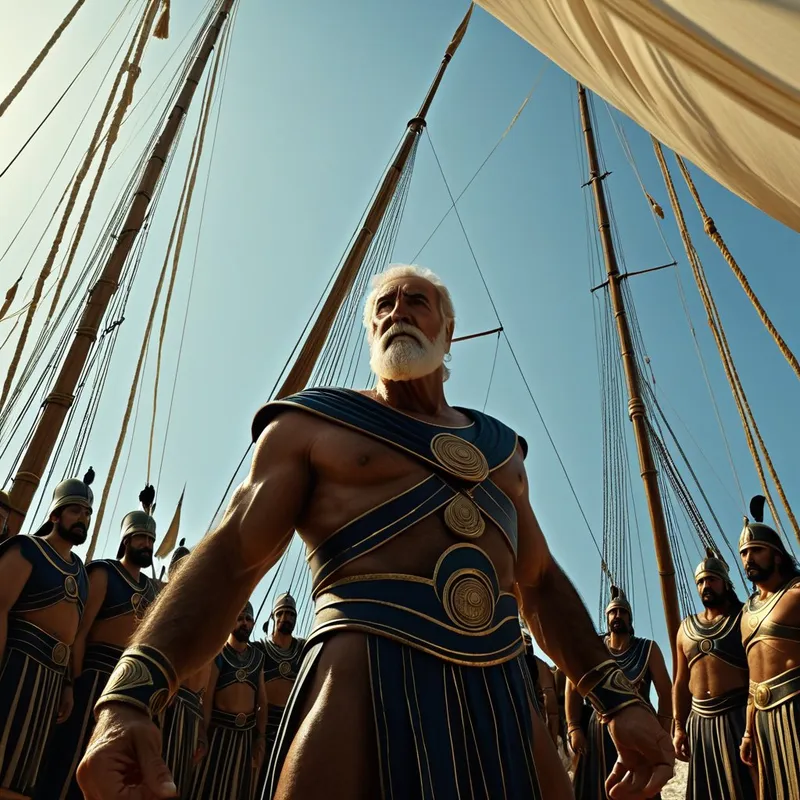
The air at Aulis was thick, not with sea-spray, but with a silence that curdled the blood. A thousand ships, the pride of Hellas, sat like painted toys on a glassy sea, their sails slack, their oars idle. A curse lay upon the host, a breathless, malevolent stillness sent by Artemis herself. Men whispered of a hidden offense, a king’s boast, a sacred stag slain. But whispers are for the blind. Only one man saw.
His name was Calchas, son of Thestor. He did not walk among the warriors; he moved through the spaces between their fears. His eyes were not for the sunlit world of spears and shields, but for the shadow-world where the threads of Moira are spun. The commanders—Agamemnon, the cunning Odysseus, the fierce Achilles—gathered around him not as a peer, but as a conduit to the divine. They needed the wind. He alone could name the price.
In the smoky dimness of the council tent, the weight of the unseen pressed down. Calchas felt the shape of the truth before it formed words—a cold, sharp geometry in his soul. He spoke, and his voice was the rustle of oak leaves at Delphi. “The wrath of the Huntress is upon us. She demands a sacrifice. The fleet will not stir…” he paused, the taste of ash on his tongue, “…until the king offers up what he holds most dear. His daughter, Iphigenia, must be brought to the altar.”
The silence that followed was louder than any war cry. Agamemnon’s face was a mask of crumbling stone. Calchas had delivered the will of the gods, but the horror of men now belonged to him. He became the architect of a father’s damnation, the herald of a maiden’s doom, all to serve a war not yet begun.
This was his burden through the ten long years at Troy. He read the flight of birds, interpreting the zigzag dance of herons as the strategy of Ares. He parsed the entrails of sacrifices, finding in the coiled liver the hidden duration of the conflict. He declared that the arrows of Paris alone could slay Achilles, and that the city could not fall without the bow of Philoctetes. His prophecies were flawless, his sight unclouded. Yet with each revelation, he drew the resentment of those whose fate he unveiled. To know the future is to become complicit in its arrival.
And then, in the smoldering aftermath of Troy’s fall, his own thread came clear. In a grove at Colophon, he met Mopsus. A contest was proposed—a simple, dreadful question about a pregnant sow. Calchas, the venerable seer of the great war, gave his answer. Mopsus gave his, and his was more precise. In that moment, Calchas did not need augury; he felt the laughter of Apollo, his patron, who grants the gift and dictates its limits. The prophecy that had guided armies shattered against a finer grain of truth. His art was superseded; his purpose, spent. He saw the end of his own story, and it was not in glory, but in the quiet, bitter acknowledgment of a better seer. They say he died of shame, or perhaps of a truth too heavy for any mortal heart to carry. The man who had foreseen the fate of heroes could not escape the fate of a man.
Cultural Origins & Context
The figure of Calchas is woven into the very fabric of the Epic Cycle, most prominently in Homer’s Iliad. He is not a hero of action, but a hero of knowledge, a necessary institutional figure within the epic world. In a culture where divine will was considered the ultimate causal force behind human events, the seer (mantis) was as crucial as the general. Calchas represents the official, sanctioned form of divination—a professional interpreter of signs (terata) who served the army collective.
His stories were passed down by rhapsodes and poets, not as a standalone saga, but as an integral strand in the vast tapestry of the Trojan War mythos. His function was societal and narrative: to move the plot by revealing divine obstacles and their grim solutions, thereby highlighting the tragic gap between human desire and cosmic decree. He embodies the Greek anxiety about knowledge—its power, its necessity, and its inherent curse. The community relies on his vision, yet isolates him for the uncomfortable truths he delivers. He is a living reminder that contact with the gods is not a blessing, but a terrible responsibility.
Symbolic Architecture
Calchas is the archetype of the Knower, but his myth deconstructs the fantasy of omniscience. His gift is not one of control, but of witness. He symbolizes the human intellect confronted with a predetermined cosmos.
To see fate is to be bound by it. The seer’s curse is the paralysis of certainty; he is the first prisoner of the future he announces.
His key symbols are profound. The sacrificial altar at Aulis represents the brutal transaction at the heart of his power: knowledge is purchased with innocence, direction is paid for in blood. His prophecies are not creative acts but translations of a fixed text written by the gods; they symbolize a knowledge that is received, not earned, and thus carries no authority, only burden. His defeat by Mopsus is the ultimate symbol of the limit of any singular perspective. It represents the moment when one’s guiding paradigm, one’s entire identity built on a special skill or insight, is rendered obsolete by a deeper, more nuanced truth. Calchas does not die from a wound, but from the psychological collapse that occurs when the foundation of one’s self—the “I who knows”—is shattered.

The Dreamer's Resonance
When the pattern of Calchas stirs in the modern psyche, it often manifests in dreams of unbearable clarity amidst collective confusion. You may dream of being in a meeting or family gathering where you alone perceive the looming disaster in a plan everyone else celebrates, but your voice is silent or goes unheard. You may dream of reading a book where the words rearrange themselves to spell out a personal catastrophe you feel powerless to avoid.
Somatically, this can feel like a pressure behind the eyes, a tightness in the throat—the body of the seer, choked with unspoken truths. Psychologically, this is the process of the emerging shadow-sage. The dreamer is confronting a difficult knowledge they have been avoiding, often about their own complicity in a painful situation (“I knew this would happen”) or about a truth that, if spoken, would disrupt their relational world. The Calchas dream asks: What truth are you carrying that feels both essential and destructive? Where have you traded your peace for the heavy coin of foresight?

Alchemical Translation
The alchemical journey of Calchas is the transmutation of divine knowledge into human wisdom. His initial state is that of the united vessel: he is perfectly aligned with Apollo’s will, a clear channel. The sacrifice of Iphigenia is the nigredo, the blackening—the moment his gift is stained with the horror of its consequences. He must confront the moral cost of his clarity.
The ten years at Troy represent the albedo, the whitening, a long purification through service. He applies his knowledge, but it is always in service to a bloody, external goal, divorcing the insight from inner meaning. His defeat by Mopsus is the crucial rubedo, the reddening. This is not a failure, but a fierce initiation.
The death of the specialist is the birth of the human. When our prized skill is surpassed, we are forced to find value not in what we do, but in who we are beyond our function.
For the modern individual, the Calchas process models the individuation step where one must surrender their identifying “superpower”—the brilliant intellect, the healing profession, the artistic gift—not because it is lost, but because clinging to it as an identity prevents deeper growth. The prophecy was his persona. Its shattering allows for the integration of his own mortal ignorance, his own capacity for error, his own subjective humanity. The ultimate alchemy is to move from being a seer of fate to becoming a soul in time, who can hold knowledge lightly, accept its limits, and die not of shame for being wrong, but in peace for having tried to see truly. The gift was Apollo’s. The wisdom, earned through tragic service and humiliating defeat, becomes his own.
Associated Symbols
Explore related symbols from the CaleaDream lexicon: