Cain Myth Meaning & Symbolism
The first murderer, marked by God, becomes the eternal wanderer, embodying the exiled shadow of civilization and the unbearable weight of divine disfavor.
The Tale of Cain
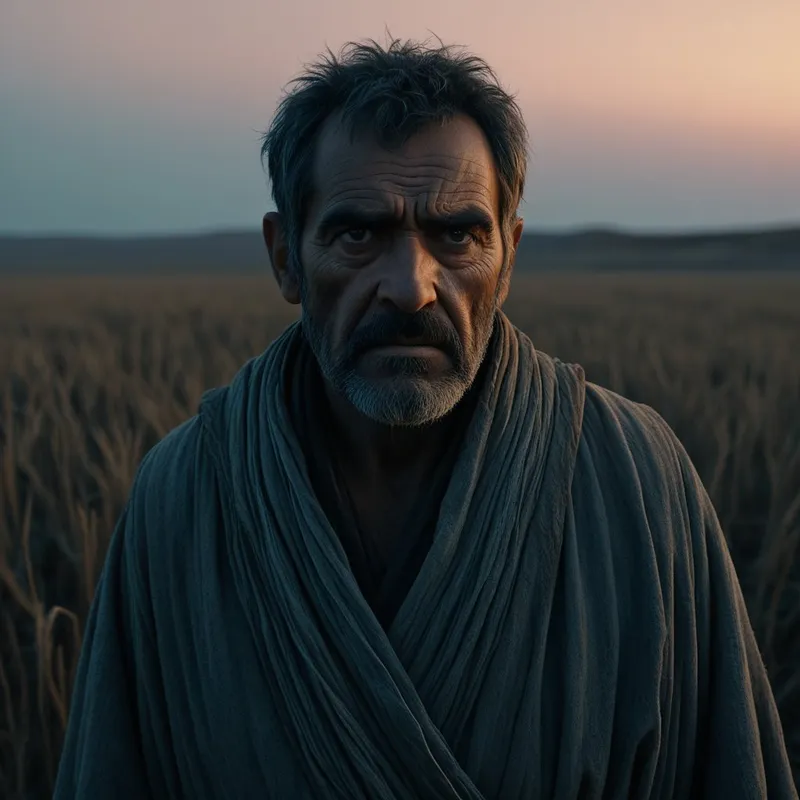
Listen. In the beginning, after the great exile from the garden, the world was raw and new. The first man and woman, Adam and Eve, knew the ache of labor. From this ache came two sons. The first was Cain, a tiller of the ground, his hands calloused from wrestling life from the stubborn soil. The second was Abel, a keeper of sheep, whose life moved to the rhythm of the flock.
In the fullness of time, they brought offerings to Yahweh. Cain brought the fruit of the ground, a portion of his sweat and toil. Abel brought the firstlings of his flock, their fat portions rich and steaming. The fire consumed them, and a silence followed—a silence that spoke louder than thunder. Yahweh looked with favor upon Abel and his offering, but upon Cain and his offering, He did not look. No reason was given. The wind carried only the scent of roasted meat, not of grain.
A terrible heat bloomed in Cain’s chest. His face, once open like a furrowed field, fell and hardened into stone. Yahweh’s voice came to him, not in a roar, but as a whisper in the marrow of his bones. “Why are you angry, and why has your face fallen? If you do well, will you not be accepted? And if you do not do well, sin is crouching at the door. Its desire is for you, but you must rule over it.”
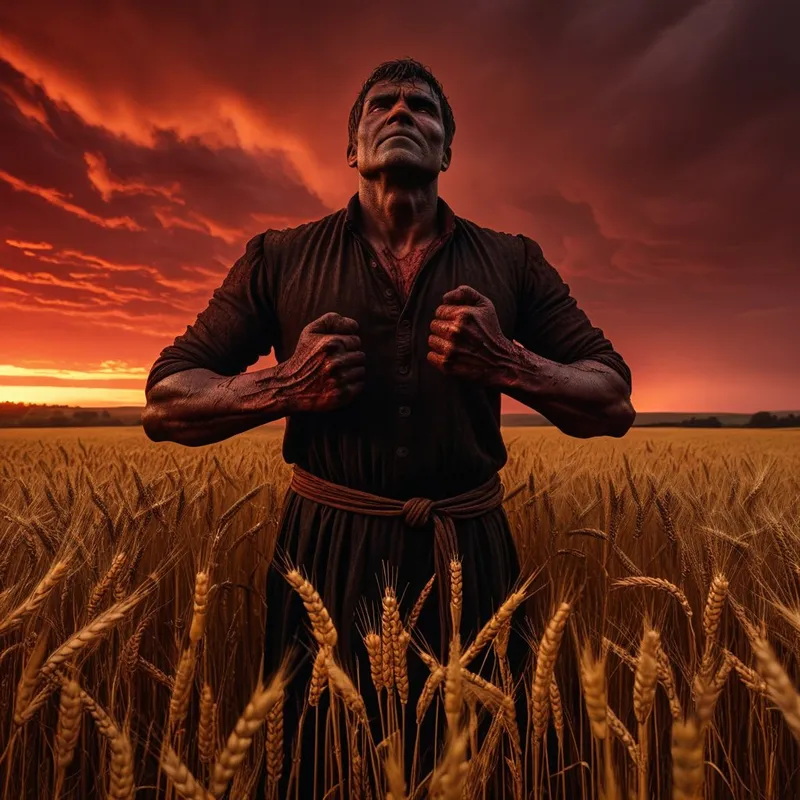
The words were a warning, but they found no purchase. The crouching beast at the door became the pounding in his temples. Cain spoke to Abel, his brother. “Let us go out to the field.” The sun was high, the earth warm. And there, in that open place meant for life, Cain rose up against his brother and killed him. The blood of the first spilled life seeped into the dust, and the ground, which Cain had worked, drank it in and cried out.
The voice of Yahweh came again. “Where is Abel your brother?” Cain’s reply was a snarl wrapped in innocence. “I do not know; am I my brother’s keeper?” And the voice answered, “What have you done? The voice of your brother’s blood is crying to me from the ground. And now you are cursed from the ground, which has opened its mouth to receive your brother’s blood from your hand. When you work the ground, it shall no longer yield to you its strength. You shall be a fugitive and a wanderer on the earth.”
Terror, colder than the first rejection, seized Cain. His punishment was to be cast out from the very presence of Yahweh, to become utterly rootless. “My punishment is greater than I can bear,” he cried. “Behold, you have driven me today away from the ground, and from your face I shall be hidden. I shall be a fugitive and a wanderer on the earth, and whoever finds me will kill me.”
Then Yahweh did a mysterious thing. He put a mark on Cain, so that no one who found him would strike him down. And Cain went out from the presence of Yahweh and dwelt in the land of Nod, and he built a city. The first murderer became the first city-builder, a wanderer who tried to make a home.
Cultural Origins & Context
This foundational narrative is embedded in the Book of Genesis. It belongs to the Yahwist (J) tradition, characterized by its vivid, anthropomorphic storytelling. For ancient nomadic and early agrarian Israelites, this was not mere history but a profound etiological myth. It explained the existential realities of their world: the fraught relationship between farmer and herdsman, the capriciousness of divine favor, the origin of blood vengeance, and the mysterious existence of other, seemingly cursed peoples (the Kenites) who lived on the margins.
Told around fires and later inscribed on scrolls, it served as a cautionary tale about the consequences of unchecked emotion and the breakdown of fraternal duty. It established a fundamental theological principle: that violence against a brother is a crime against the community and the earth itself, which becomes polluted by innocent blood. The story functions as the dark mirror to creation, detailing not how life begins, but how death and exile enter human relations.
Symbolic Architecture
Cain is the archetype of the rejected one, the one whose sincere effort is deemed insufficient by an inscrutable authority. His offering—the fruit of his labor—is not inherently flawed, but it is not chosen. This primal rejection is the seed of the shadow.
The first sin was not murder, but the inability to bear the gaze of a God who looks elsewhere.
The conflict is not between good and evil, but between the chosen and the unchosen, the blessed and the unblessed. Abel represents the one who intuitively knows the rules of the sacred transaction; Cain represents the one who works hard but misses the mark, whose psychology is literal and earthbound. The “crouching sin” is the unintegrated shadow—the rage, envy, and shame that coalesce when our fundamental worth feels negated.
The mark upon Cain is profoundly ambiguous. It is a curse of protection, a branding that makes him both an outcast and untouchable. He becomes the eternal fugitive, carrying the burden of his crime and his divine safeguard. This symbolizes the psychological state of the conscious bearer of the shadow: isolated, haunted, yet paradoxically protected by the very awareness of one’s own darkness. He cannot return to naive belonging, but he cannot be destroyed by those who remain in that state.

The Dreamer's Resonance
When this myth stirs in the modern psyche, it manifests in dreams of profound inequity and explosive rage. You may dream of working tirelessly on a project only to have it ignored while a sibling or colleague receives accolades for seemingly less effort. You may find yourself in a stark, empty field, filled with a simmering, wordless fury that threatens to erupt.
Somatically, this can feel like a hot, tight coil in the solar plexus—the seat of personal power and will. The psychological process is one of confronting the “unacceptable” feelings: jealousy, hatred toward those we are supposed to love, and a deep-seated conviction of our own fundamental inadequacy. The dream asks: What part of you feels chronically unseen? What offering of yours has been rejected, and what beast of rage is now crouching at the door of your consciousness? To dream of Cain is to be called to acknowledge this inner outcast before it acts out.

Alchemical Translation
The individuation process modeled here is brutal but essential: the integration of the rejected self. The initial stage is the inferior offering—our conscious persona, our best effort, which fails to win the “divine” favor (wholeness, self-acceptance). The rejection plunges us into the nigredo, the blackening, where envy and murderous shadow impulses surface.
The alchemical fire is not lit under the successful offering, but under the rejected one. The gold is found in the curse.
The killing of Abel represents the necessary, though tragic, death of the idealized self-image (the “good brother” who is always chosen). We cannot become whole by identifying only with Abel, the innocent victim. We must own Cain, the perpetrator. The subsequent exile—the feeling of being cast out from self-righteousness or naive belonging—is the beginning of the real work.
The “land of Nod” is the wilderness of the psyche where we wander with our guilt and our mark. Building a city there is the critical act of alchemical translation: we must construct consciousness (a city) out of our exiled state. The mark, the conscious burden of our shadow, becomes our protection. It forces us to develop a complex identity that is neither purely victim nor purely villain, but a wanderer who carries the memory of both. We transmute the curse of rejection into the lonely, responsible freedom of the one who has seen the darkness within and must now build a life in full knowledge of it.
Associated Symbols
Explore related symbols from the CaleaDream lexicon: