
Butterfly Soul Myth Meaning & Symbolism
A myth of a soul's journey from death to life, embodied as a butterfly that must navigate darkness to find its true form and purpose.
The Tale of Butterfly Soul
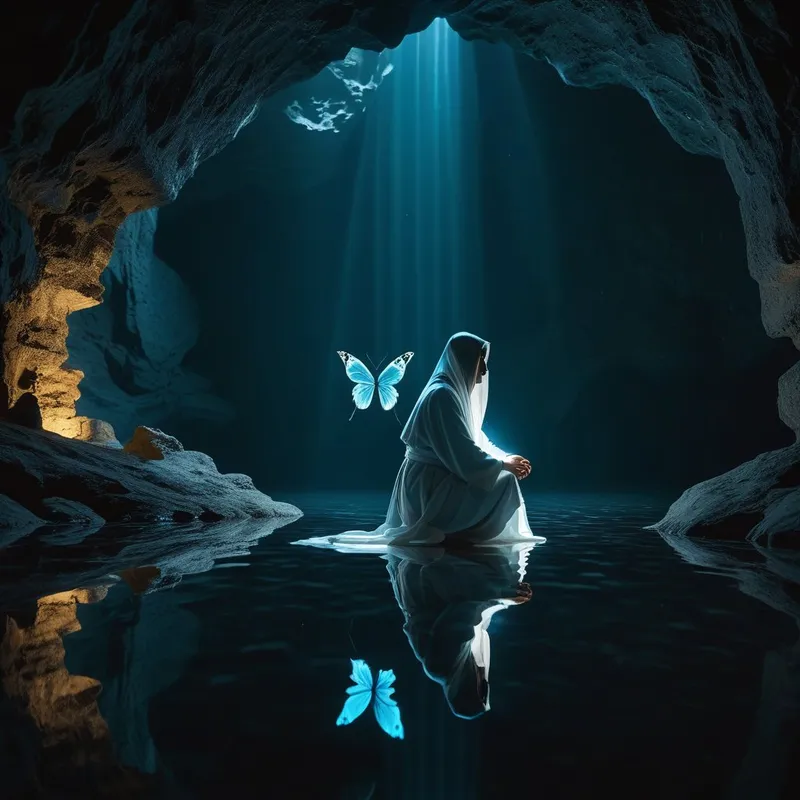
In the time before time, when the world was soft and the sky hung low enough to touch, there was a silence so deep it had a name: The Root of the World. Here, in the absolute dark beneath the great World Tree, all things ended. But endings, in that ancient logic, were merely a different kind of beginning, a folding inwards.
In that root-dark lived the Keeper of Unfinished Songs. It was not a creature of malice, but of profound patience, a being woven from memory and shadow. Its charge was the essence of those who had passed from the sunlit world—not their bones or their stories, but the shimmering, fragile core of what they might yet become. These essences slept, formless and dreaming, in the still black pools that dotted the cavern floor.
One such essence dreamed a dream of wind and light. It had no name, for names are things of the world above. It knew only a profound longing, a pull towards a warmth it could not remember. This longing grew so fierce that it began to stir the stagnant waters of its pool. The Keeper of Unfinished Songs took notice. Its voice was the sound of stone settling. "Little hunger," it intoned. "To leave is to be unmade. Here, you are safe. Here, you are potential. Out there, you will be a brief, fragile thing, battered by sun and storm."
But the essence trembled with its wanting. It had heard whispers, carried on the slow drip of water from the world above, of a dance in the light, of colors that had no name in the dark.
"Then you must weave yourself a vessel," said the Keeper, not unkindly. "But know this: the thread you must use is your own substance. To have form is to have less of yourself. The journey upwards is through the Tunnel of Forgetting. You will lose pieces of the dark to gain pieces of the light. And at the end, if you arrive at all, you will be the most fragile thing in creation."
The essence did not hesitate. From its own shimmer, it began to spin. It pulled filaments of memory-that-was-not-memory, of longing and hope, and wove them into a shape. It was a painful making, a diminishment. What emerged from the pool was not glorious. It was a damp, crumpled thing, wings glued shut, body heavy. It was a Mortal Cocoon with the ghost of a butterfly inside.
The climb began. The Tunnel of Forgetting was not stone, but a gradient of being. With every painful push upward, a piece of the comforting, knowing dark fell away. In its place came sharp, confusing sensations: a grain of grit, a whisper of moving air that felt like violence, a terrifying, growing warmth. The creature grew lighter as it lost the substance of its old home, becoming more defined and more vulnerable. Its new wings, still folded, ached with the promise of a function it could not comprehend.
Finally, it pushed into a blinding, searing brilliance. The world above was a cacophony of color and movement. Exhausted, it clung to a stem, its body trembling. The sun, that distant god it had yearned for, beat down upon it. It felt a cracking, a final shedding. And then, a miracle of mechanics: its wings, paper-thin and painted with the maps of forgotten stars, began to slowly, painfully unfurl. They dried in the light, and for the first time, it felt the wind not as a threat, but as a partner. It pushed from the stem, and its first flight was not graceful, but it was its own. It was no longer an essence in the dark. It was a Butterfly Soul, dancing its brief, glorious dance between earth and sky, a living prayer made of sacrificed darkness and hard-won light.
Cultural Origins & Context
The motif of the Butterfly Soul is not the property of a single culture, but a shimmering thread woven through the tapestry of global folklore. It appears in the funerary art of ancient Greece, where the word psyche meant both "soul" and "butterfly." It whispers through Mesoamerican myth, where the butterfly was a symbol of the fiery sun and the spirits of fallen warriors. It finds a home in Slavic tales and in the philosophical allegories of ancient China.
This was not a myth told in royal courts, but one carried on the breath of grandmothers and shamans. It was a story for the threshold moments: whispered at a deathbed to describe the journey beginning, or murmured to a child to explain the changing caterpillar. Its primary societal function was explanatory and comforting. It provided a narrative for the greatest mystery—what becomes of the essential us after death—and mirrored the smaller, daily deaths of transformation: puberty, marriage, a change in station. The story was an anchor, suggesting that even in dissolution and radical change, a core of intentionality—that initial "hunger" for the light—guides the process. The teller was often a threshold figure, one familiar with transitions, who used the butterfly's tangible, beautiful metamorphosis to make the soul's intangible journey comprehensible and even beautiful.
Symbolic Architecture
At its heart, the myth is a masterclass in the symbolism of metamorphosis. Each stage is a psychic state. The Root of the World is not hell, but the unconscious itself—the fertile, dark womb of all potential where things exist in a state of pure being, without differentiation or conflict. The longing for the light is the first stirring of individuation, a painful but necessary rupture from undifferentiated bliss.
The soul must sacrifice its oceanic infinity to gain the fragile, beautiful specificity of a single life.
The Keeper of Unfinished Songs represents the deep, conservative pull of the unconscious, which seeks to preserve us in a state of potential. It is the internal voice that fears risk, change, and exposure. The act of spinning the cocoon from one's own substance is the critical act of ego-formation. We literally create our conscious selves from the raw material of the unconscious, and it is a work of self-cannibalization that feels like loss. The Tunnel of Forgetting is the arduous path to consciousness, where we must "forget" or disconnect from the primal, instinctual layers of the psyche to operate in the differentiated world. The final emergence, the drying of the wings, is the moment of self-actualization—terrifying, vulnerable, but ultimately allowing for a new kind of movement and relationship with the world.
The Dreamer's Resonance
When this myth stirs in the modern dreamer, it often announces a period of profound inner transition that the conscious mind may be resisting. To dream of being trapped in a dark, damp place, or of struggling to break out of a confining shell, is to somatically experience the cocoon phase. The body in sleep may feel heavy, paralyzed, or gripped by anxiety—this is the psyche's physics, mirroring the struggle to birth a new aspect of the self.
Dreams of fragile, beautiful wings that are wet or torn speak directly to the vulnerability of a nascent identity or a newly embraced truth. The dreamer waking with a sense of poignant sadness mixed with awe has touched the core truth of the Butterfly Soul: that beauty and fulfillment are inextricably linked to temporality and fragility. Conversely, dreams of effortless flight after a struggle can signal the successful integration of a transformation, a psychological "drying of the wings" where a new capability or perspective has finally become operational. The myth plays out in our somatics as the tension between the deep, safe pull of the known (the dark pool) and the exhilarating, terrifying call of becoming (the light).

Alchemical Translation
For the individual navigating the modern path of individuation, the Butterfly Soul myth is a precise alchemical map. The first operation, nigredo, is the voluntary descent into the Root of the World—the conscious engagement with the shadow, the repressed, the unfinished business of our personal and ancestral past. This is the "dark pool" phase of therapy, introspection, or crisis, where we confront our formless potential and our deepest longing.
The cocoon is not a prison, but a crucible. We do not wait there; we actively dissolve to be rewoven.
The spinning of the cocoon is albedo, the purification. Here, we consciously fashion a new structure for the self from the insights gained in the dark. This is the hard work of changing habits, integrating insights, and building new neural pathways—it feels like a loss of the old, comfortable, amorphous identity. The struggle through the Tunnel of Forgetting is the citrinitas, where the newly formed self is tested against the friction of the world, shedding the last vestiges of a purely internal perspective.
The final emergence is rubedo, the attainment of the philosophical gold. This is not a state of perfect, static being, but the achieved ability to "fly"—to move with agency and grace between different levels of reality (inner and outer, thought and feeling, instinct and spirit). The modern individual completes this cycle not once, but many times. Each major life transition, each creative death and rebirth, asks us to be the essence in the pool, the spinner in the dark, and the fragile, glorious butterfly, dancing its brief, meaningful dance in the sun.
Associated Symbols
Explore related symbols from the CaleaDream lexicon: