Butterfly Maiden Myth Meaning & Symbolism
A Hopi kachina whose sacred dance pollinates the crops, embodying the vital, delicate, and transformative relationship between spirit and sustenance.
The Tale of Butterfly Maiden
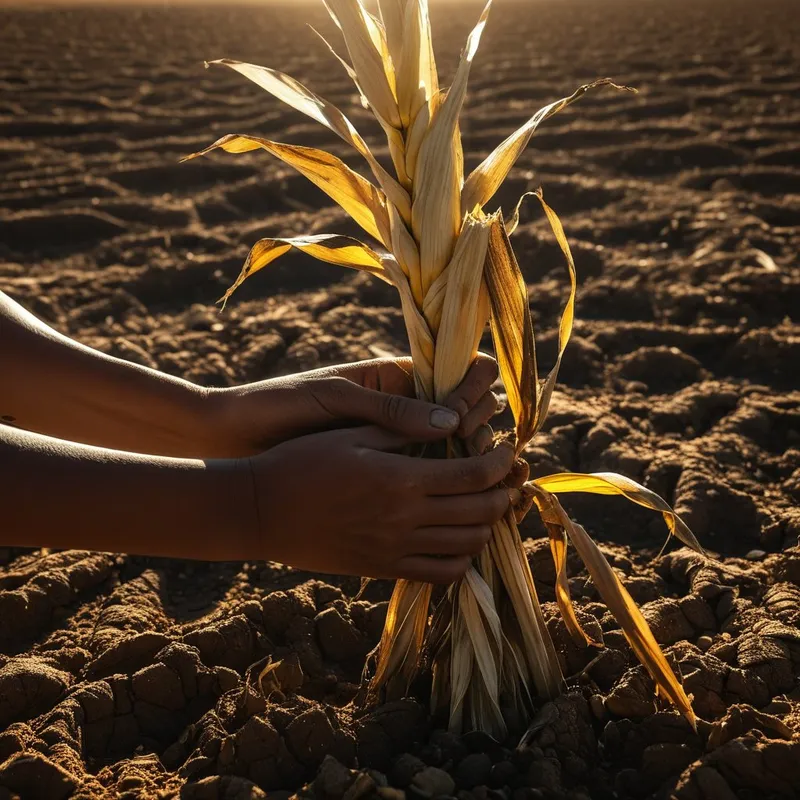
Listen. In the beginning, there was the breath of the sun and the silence of the stone. The People lived in the high, arid lands, their lives woven from the threads of corn, bean, and squash. But one season, the breath of the sun became a furnace wind. The clouds were ghosts that refused to weep. The corn, the heart of the People, stood brittle and pale, its tassels dry as dust, offering no pollen, bearing no fruit. A great stillness fell, a stillness not of peace, but of dread. The songs of the fields had ceased.
In this silence, a young maiden walked. She was not a chief, nor a warrior, but her heart was a vessel for the land’s sorrow. Each day, she would go to the most withered patch, kneel in the cracked earth, and sing the old planting songs, her voice a fragile thread against the vast, blue silence. Her tears, where they fell, made dark stars in the dust.
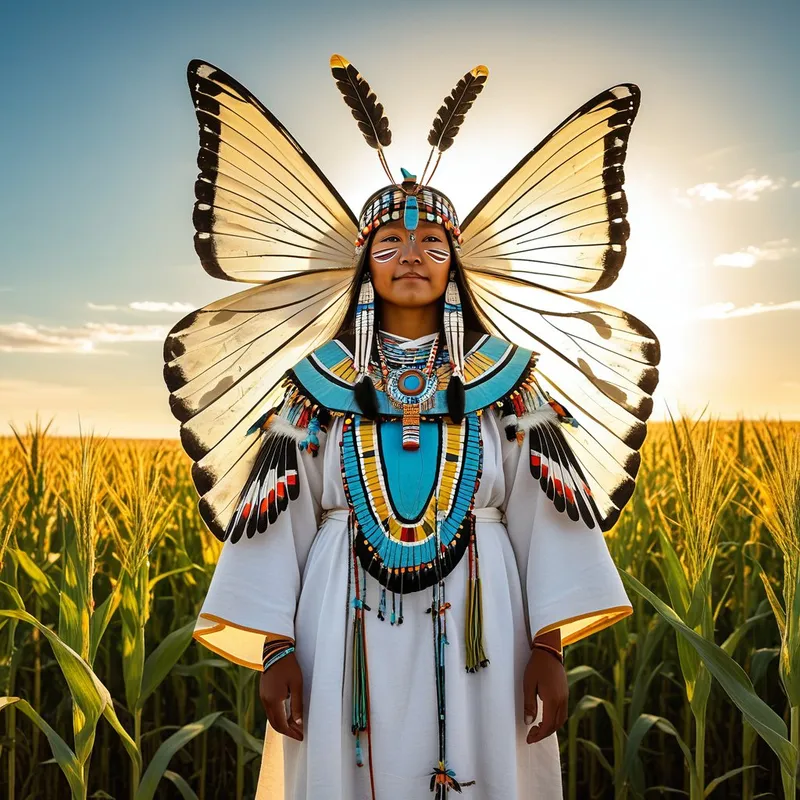
One evening, as the sun bled into the mesa, a whisper stirred the dead air. It was not a sound, but a feeling—a delicate tremor. From the direction of the sacred mountains, a figure approached. She was Kachina, but unlike any other. Upon her head rose a tablita painted with the symbols of rain-bearing clouds. Her body was wrapped in a white robe, but upon it danced the forms of wings—not of birds, but of butterflies, in every color of the flower and the sky. This was Butterfly Maiden.
She did not speak to the maiden with words. Instead, she began to move. Her dance was not the heavy stamping of a warrior, but a fluttering, hovering step, a vibration so gentle it seemed to barely touch the earth. She moved through the dying cornfield, her arms weaving patterns in the air, her body a living prayer for motion, for connection. As she danced, a fine, luminous dust—a sacred pollen—began to fall from the symbols on her robe and the tips of her fingers.
The young maiden watched, her own breath stilled. She saw the golden dust settle on the barren tassels of the corn. She saw a faint, green shudder pass through the stalks. The Butterfly Maiden’s dance was the missing piece: the spirit of pollination itself, the vital, erotic spark that connects male and female, sky and earth, promise and fruit. The Maiden danced until the first star appeared, and as she faded into the twilight, she left behind not just a physical residue, but a pattern, a rhythm imprinted on the world.
The next morning, the People emerged to a miracle. The corn stood taller, its tassels heavy and golden with pollen, ready to bless the silks. The field hummed with a new energy, the energy of life resuming its sacred contract. And the young maiden who had sung to the dust? She now held within her the knowledge of the dance. She had become the vessel for the story, the human link to the Butterfly Spirit. The drought of fruit was over, replaced by a fertility born of delicate, persistent, sacred motion.
Cultural Origins & Context
The story of Butterfly Maiden is rooted deeply in the cosmology of the Hopi and other Pueblo peoples of the American Southwest. This is not a myth of a distant, forgotten past, but a living narrative enacted and reaffirmed. It is transmitted not solely through spoken word, but through ceremonial practice. Butterfly Maiden is a Kachina, a spirit being integral to the Hopi religious cycle.
During the Kachina season, men of the Pueblo embody these spirits, donning elaborate masks and regalia to become vessels for their power. The dancer who becomes Butterfly Maiden performs a specific, gentle, fluttering dance during plaza ceremonies. This performance is not theater; it is a participatory act of world-making. The dance is believed to directly influence the pollination of crops, ensuring the fertility of corn, beans, and squash—the Three Sisters. The myth explains the why of the ritual, and the ritual enacts the truth of the myth. It is a supreme example of mythopoeic life, where story, belief, and action are a single, seamless whole, aimed at sustaining the delicate balance of life in a demanding landscape.
Symbolic Architecture
At its core, the myth of Butterfly Maiden is a map of a fundamental psychic and ecological principle: connection as the catalyst for creation. The barren cornfield represents a state of dissociation, where elements are present but lifeless because the relationship between them is broken.
Pollination is the universe's most intimate conversation. It is the silent, essential exchange that transforms potential into being.
Butterfly Maiden herself is the archetypal spirit of this relationship. She is not the rain (that is another Kachina), nor the soil, nor the seed. She is the agent of connection between them. Her butterfly nature is key: the butterfly is a universal symbol of transformation, but here, its specific role as pollinator is paramount. She represents the delicate, often overlooked, yet utterly vital processes that underpin life. Psychologically, she embodies the Anima in its connective, nurturing, and eros-driven aspect. She is the feeling-function that bridges isolated thoughts, the empathy that connects isolated selves, the creative impulse that fertilizes dormant ideas.
The young maiden’s role is equally crucial. She represents the human capacity for receptivity and faithful action. Her silent vigil and songs prepare the psychic "field" for the arrival of the numinous. She is the ego that must first acknowledge barrenness and then become humble enough to witness and receive the transformative pattern from the deeper Self.
The Dreamer's Resonance
When this mythic pattern stirs in the modern dreamer, it often signals a psychic state of potential that feels frustratingly unfulfilled. One may dream of beautiful but sterile gardens, of intricate projects that never quite cohere, or of feeling surrounded by resources yet experiencing a profound inner drought.
Dreams of butterflies in this context are not merely about personal change. They may appear stuck, unable to land, or shedding glowing dust. The somatic sensation is one of subtle agitation—a fluttering in the chest or stomach, a feeling of being "on the verge" without release. This is the psyche's depiction of the pollination process. The dreamer is in a state where elements of their life or personality (the "male" and "female" aspects, the logical and the intuitive, the idea and the action) are present but disconnected. The dream is highlighting the need for a specific, delicate kind of inner work: not forceful effort, but a focused, rhythmic, connecting dance. It is the work of bringing disparate parts of oneself into a fertile relationship.
Alchemical Translation
The alchemical journey modeled here is that of conjunctio—the sacred marriage. For the modern individual navigating a world that often feels fragmented, the myth prescribes a path of sacred mediation.
The initial state is the nigredo: the barren field, the sense of creative or emotional drought. The first operation is the maiden's vigil: the conscious acknowledgment of this state without despair, a commitment to showing up (the singing in the dust). This is the work of humility and patience.
The arrival of Butterfly Maiden is the influx of the archetypal pattern from the unconscious—the albedo, or illuminating insight. But the key is that this insight is not a static image; it is a pattern of motion. The ego's task is not to "become" the butterfly in a grandiose way, but to learn its dance.
Individuation is not about acquiring a new mask, but about internalizing a sacred rhythm.
The final rubedo, the reddening, is the fruitfulness that arises from this integration. It is the successful project, the healed relationship, the sustained creative flow that emerges when we stop forcing outcomes and instead cultivate the delicate, persistent art of connection within ourselves. We pollinate our own souls. We learn that the most profound transformations are not always cataclysmic breaks, but often the result of a faithful, fluttering, daily dance that brings the fertile dust of the spirit to the waiting silks of our world.
Associated Symbols
Explore related symbols from the CaleaDream lexicon: