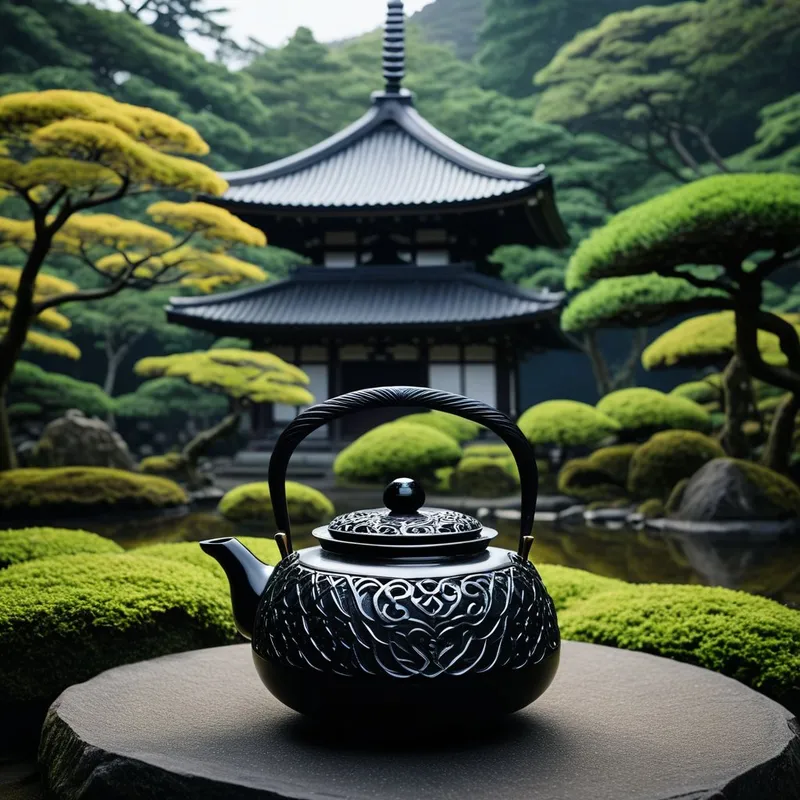
Bunbuku Chagama Myth Meaning & Symbolism
A poor priest frees a shape-shifting tanuki trapped in a teapot. In gratitude, the creature transforms into a wondrous spectacle, bringing prosperity to them both.
The Tale of Bunbuku Chagama
In the quiet, mist-shrouded mountains of old Japan, where ancient cedars whispered secrets to the wind, there lived a priest. He was a man of simple means, his robes worn thin, his temple humble and cold. His days were a quiet prayer of poverty, a meditation on lack. One autumn evening, as the last copper light bled from the sky, he sought a vessel to warm his bitter tea. His hands, chilled to the bone, reached into the temple’s shadowed storage and found not a simple pot, but an old iron chagama, black with age and dust.
He placed it upon the hearth, the fire cracking hungrily beneath it. But as the water began to sing, a strange sound joined it—not a boil, but a whimper. A pained, muffled cry. Startled, the priest snatched the pot from the heat. Peering inside, he saw not water, but a pair of large, liquid-dark eyes blinking up at him from the sooty interior. With a gentle shake, a small, furry creature tumbled out onto the tatami—a tanuki, its fur singed, its spirit trapped.
The creature bowed low, its voice a gravelly rustle of leaves. “Honorable priest,” it said, “I am a tanuki of these woods. A cruel hunter captured me, and in my terror, I shape-shifted into this teapot to hide. But the transformation became my prison. Your kindness in removing me from the fire has saved me. I am in your debt.”
Moved by compassion, the priest offered the tanuki shelter. For days, it rested, regaining its strength. But the tanuki’s heart was heavy with the weight of gratitude unfulfilled. It watched the priest’s quiet struggle, the empty offering box, the meager meals. A resolve hardened within its clever mind.
One morning, the tanuki approached the priest. “Your kindness must be repaid. I have a proposal. Do not see me as a mere teapot or a simple animal, but as a partner.” The priest, bewildered, agreed.
The tanuki then revealed its true magic. It transformed once more into the iron chagama, but this was no ordinary vessel. It was Bunbuku Chagama—the Teapot of Literary and Military Fortune. The priest, following the tanuki’s whispered instructions, traveled to the bustling town. He set up a small stage and, for a single coin, presented a wonder: the teapot, walking on its own spout and lid like legs, dancing a滑稽 (comical), graceful jig. It balanced on a taut string, poured tea without being touched, and performed acrobatics no human hand could mimic.
Word spread like wildfire. Crowds flocked, coins filled the priest’s purse, and laughter echoed where once there was only silence. The partnership flourished. The tanuki, in its chosen form, found joyous purpose in delighting the masses, and the priest’s poverty melted away, replaced by humble prosperity. They lived not as master and servant, but as two beings liberated by an act of mercy, bound by mutual respect and a shared, invented fortune. The teapot did not just dance; it danced them both into a new life.
Cultural Origins & Context
The tale of Bunbuku Chagama is a mukashibanashi, a “story of long ago,” belonging to the rich oral tradition of the Edo period. It is a classic example of the tanuki as a benevolent trickster, a shift from earlier, more fearsome yōkai depictions. These stories were told by traveling storytellers, around village hearths, and later published in cheap, woodblock-printed booklets called akahon, making them accessible to the common people.
Its societal function was multifaceted. On one level, it is a simple, satisfying rags-to-riches story that affirmed the values of kindness (jin) and reciprocity (on). On another, it reflects a burgeoning merchant-class ethos: prosperity is not solely a matter of noble birth or agricultural luck, but can be ingeniously created through cleverness, partnership, and offering a unique service. The tanuki’s spectacle is pure entertainment capitalism—a novel product that generates wealth. The myth thus sits at a crossroads between ancient animistic beliefs, where all objects and animals possess spirit (kami), and the pragmatic, entrepreneurial spirit of early modern Japan.
Symbolic Architecture
At its core, Bunbuku Chagama is an alchemical parable of containment, liberation, and purposeful transformation. Each element is a psychic symbol.
The Iron Teapot (chagama) is the vessel of containment. It represents a rigid role, a societal identity, or a traumatic experience that has become a prison. It is the “shape” we are forced into by circumstance—the job that stifles, the grief that encases, the mask we feel we cannot remove. It is functional but lifeless, a tool rather than a being.
The Tanuki is the untamed, instinctual spirit of creativity, adaptability, and playful intelligence—the Self in its raw, natural state. Its initial trapping symbolizes how our wild, creative essence can be captured and suppressed by the “fires” of life’s pressures, forced into a form that does not serve its true nature.
The greatest prison is often the form we take to survive, mistaken for the form we are meant to live.
The Priest represents the conscious mind, or the ego, in a state of poverty—not just materially, but spiritually and psychologically impoverished. His compassionate act of removing the pot from the fire is the crucial moment of recognition and intervention. It is the decision to stop the habitual “heating” of our wounds, to look deeper into our containment, and to offer kindness to the trapped spirit within ourselves.
The Dancing Spectacle is the sublime integration. The tanuki chooses to return to the teapot form, but this time as an act of empowered expression, not fearful hiding. The vessel is no longer a prison but a stage; its limitation becomes the very source of its unique talent. This symbolizes the moment a personal wound or limitation is alchemized into a unique gift, a “prosperity” that benefits both the inner spirit (tanuki) and the outer life (priest).
The Dreamer's Resonance
When this myth stirs in the modern unconscious, it often manifests in dreams of constrained animation. You may dream of a cherished object—a watch, a car, a houseplant—coming to life and performing an impossible, joyful function. Or you may dream of being trapped in a small, functional space (an elevator, a closet, a piece of office equipment) that suddenly becomes expansive and allows for miraculous movement.
Somatically, this process may feel like a constriction in the chest or throat—the “teapot” feeling—suddenly giving way to a fluid, dancing energy. Psychologically, it signals a confrontation with a long-held self-concept that has become restrictive. The dream is the tanuki’s plea from within the pot: the creative spirit is not dead, only waiting for the conscious mind (the priest) to stop applying the heat of self-judgment and perfectionism, and to instead offer the cool, liberating water of self-acceptance. The conflict is between the loyalty to the old, safe form and the terrifying, exhilarating call to repurpose that form into something joyous and prosperous.
Alchemical Translation
The individuation journey modeled here is not about breaking the pot, but about learning to dance with it. It is a path of sacramentalizing the vessel.
The first stage is Containment and Heat. We all have our “teapots”—the personality adaptations, career paths, or relational roles we formed under pressure. Initially, they served a purpose: they protected a vulnerable part of us. But the fire of ongoing life stress can make this containment unbearable.
The alchemical shift begins with the Cooling Liberation. This is the priest’s act: the conscious decision to engage in self-inquiry, therapy, or a radical pause. It is removing oneself from the destructive heat and looking inside with compassion instead of criticism. This acknowledges the trapped spirit (the innate talents, the repressed joys, the true vocation) that has been hiding there all along.
Individuation is the process by which the vessel of the personality becomes a chosen instrument, and its former limits become the signature of its song.
The final, transformative stage is Purposeful Re-embodiment. This is not a return to a pristine, pre-trapped state. The tanuki does not just run back into the forest. It reinhabits the teapot with full awareness and agency, transforming a symbol of captivity into a source of wonder and sustenance. Psychically, this translates to taking the very thing that once limited you—your anxiety, your unconventional past, your perceived flaw—and, through a partnership between your conscious mind and your creative spirit, turning it into your unique offering to the world. You don’t discard your history; you learn to dance with it on a tightrope, and in doing so, you create a fortune that is entirely, authentically your own. The Bunbuku Chagama myth ultimately teaches that prosperity is not found in escaping one’s form, but in mastering the magical art of making it dance.
Associated Symbols
Explore related symbols from the CaleaDream lexicon: