Buddha's lotus throne Myth Meaning & Symbolism
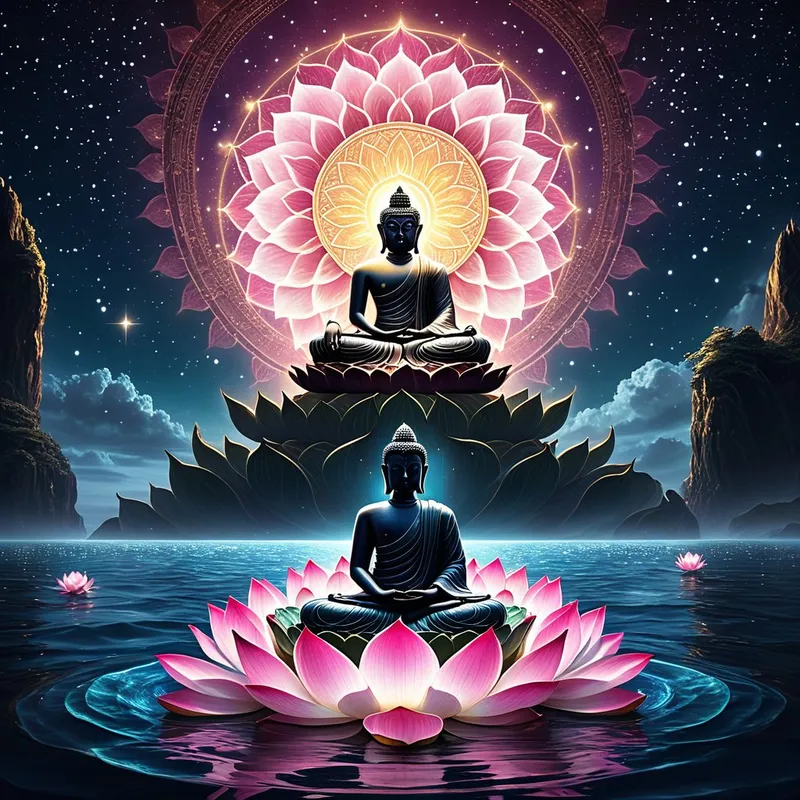
A myth of enlightenment's birth from chaos, where the Buddha's throne of lotuses rises from primordial waters, symbolizing purity emerging from the mud of existence.
The Tale of Buddha’s lotus throne
Before time had a name, before the wheel of seasons began to turn, there was only the Waters of [Chaos](/myths/chaos “Myth from Greek culture.”/). They were not waters of life, but of potential—dark, deep, and silent, holding within their infinite depths every seed of what could be, and every shadow of what had been. It was a silence so profound it was a roar in the ears of the cosmos.
From the heart of this boundless dark, a stirring began. Not a sound, but a yearning. A vibration of intent so pure it needed no form. This was the Bodhicitta, the mind of awakening, adrift in the formless ocean. It sought a place to be, a point from which to witness itself. And so, it called, not with a voice, but with the sheer pressure of its presence.
In response, from the very bed of [the abyss](/myths/the-abyss “Myth from Kabbalistic culture.”/), from the silt and the mire of unformed matter, a green shoot pushed upward. It was the first [Padma](/myths/padma “Myth from Hindu culture.”/), a tender spear of life moving against the weight of [the world](/myths/the-world “Myth from Tarot culture.”/). It climbed through the cold, pressing darkness, driven by an intelligence older than growth. It did not seek the light, for there was none; it became the light’s destination.
Breaking the surface of the still, obsidian waters, the bud held its breath for an aeon. Then, petal by petal, it unfolded. It did not bloom with a sound, but with a revelation. Each layer revealed was a plane of existence, a realm of possibility. The innermost heart of the flower glowed with a soft, golden radiance—the color of dawn before the sun, of understanding before knowledge.
And upon this radiant heart, the form of the [Buddha](/myths/buddha “Myth from Buddhist culture.”/) manifested. Not descending from a heaven, but arising from the bloom itself, as if the flower had conceived him from its own essence. He seated himself in the unmovable posture of Vajrasana, the diamond pose. As he did, the single [lotus](/myths/lotus “Myth from Hindu culture.”/) beneath him multiplied. A second bloom opened beneath his feet, then a third, a fourth, until a great throne of interwoven lotuses cradled him—a seat not built, but born.
The dark waters, once chaotic, grew calm. They became a mirror, reflecting the throne and the seated one in perfect stillness. The throne did not float on the waters; it was anchored through them, its roots deep in the unseen mud. [The Buddha](/myths/the-buddha “Myth from Buddhist culture.”/) did not conquer the chaos; he became its still point, and from that point, the wheel of the [Samsara](/myths/samsara “Myth from Buddhist culture.”/) could finally begin to turn, not as a prison, but as a path. The first teaching was not a word, but an image: enlightenment rooted in the mud of the world.
Cultural Origins & Context
The image of the Buddha seated upon a [lotus throne](/myths/lotus-throne “Myth from Buddhist culture.”/) is not the product of a single story, but a foundational icon that emerged from the fertile ground of early Buddhist art and narrative. In the centuries following the Parinirvana, as the [Sangha](/myths/sangha “Myth from Buddhist culture.”/) spread across India, artists faced a profound challenge: how to depict the one who had transcended all form? The answer was symbolism, and [the lotus](/myths/the-lotus “Myth from Hindu culture.”/) became paramount.
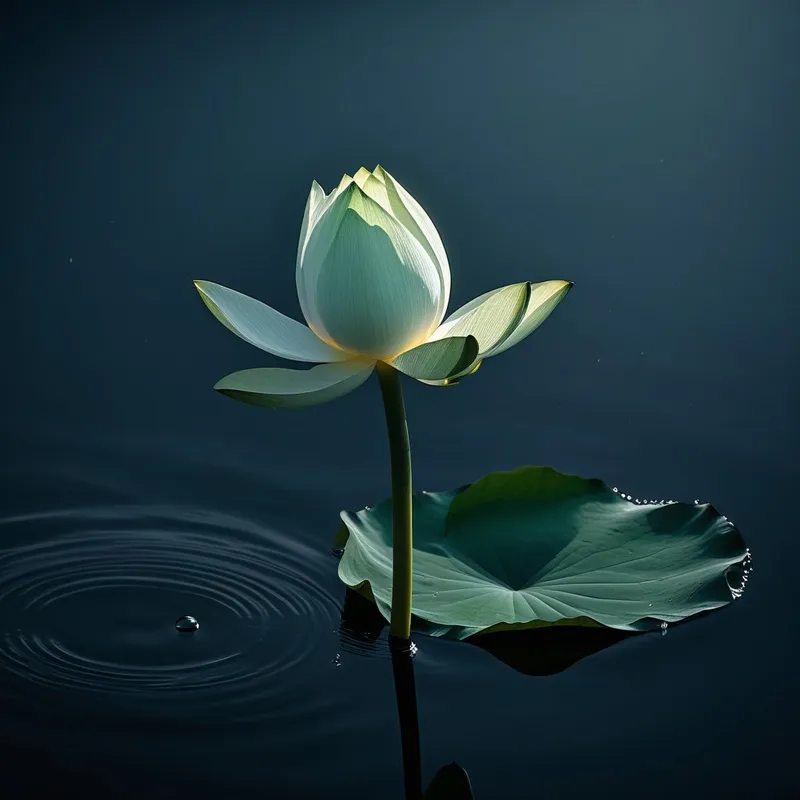
This symbolism is deeply embedded in the Suttas. The Buddha often used the lotus as a metaphor for the individual who develops in the world without being stained by it. In the Dhammapada, it is said: “As a lotus, fair and lovely, is born in the [water](/myths/water “Myth from Chinese culture.”/) and grows up in the water, but rises above it and stands untouched by it, so I, born in the world and grown up in the world, have transcended the world.” The throne, therefore, is a visual sermon, a doctrinal truth rendered in stone, paint, and gold leaf.
Its societal function was multifaceted. For the devotee, it provided a focal point for reverence—a reminder that the goal was not escape from the world, but perfect poise within it. For the monk and philosopher, it was a cosmological diagram. The throne, often depicted as multi-tiered, represents the stages of meditative attainment (Jhanas) and the layered nature of reality. Passed down not by [bards](/myths/bards “Myth from Celtic culture.”/) but by artisans and meditators, the lotus throne became the non-negotiable base upon which every image of the awakened one rests, from the humblest village shrine to the grandest temple [mandala](/myths/mandala “Myth from Buddhist culture.”/).
Symbolic Architecture
The myth is a masterclass in symbolic [paradox](/symbols/paradox “Symbol: A contradictory yet true concept that challenges logic and perception, often representing unresolved tensions or profound truths.”/), where opposites are not resolved but held in creative, fertile [tension](/symbols/tension “Symbol: A state of mental or emotional strain, often manifesting physically as tightness, pressure, or unease, signaling unresolved conflict or anticipation.”/).
The lotus throne is the ultimate symbol of grounded transcendence. It does not flee the mud; it requires it. Enlightenment is not an airy abstraction but a fact rooted in the soil of experience.
The Mud represents the unconscious, the chaotic swirl of instincts, desires, memories, and karmic patterns ([Karma](/myths/karma “Myth from Hindu culture.”/)). It is the [realm](/symbols/realm “Symbol: The symbol of ‘Realm’ often signifies the boundaries of one’s consciousness, experiences, or emotional states, suggesting aspects of reality that are either explored or ignored.”/) of suffering (Dukkha), [confusion](/symbols/confusion “Symbol: A state of mental uncertainty or disorientation, often reflecting internal conflict, lack of clarity, or overwhelming choices in waking life.”/), and primal matter. The Stem is the [path](/symbols/path “Symbol: The ‘path’ symbolizes a journey, choices, and the direction one’s life is taking, often representing individual growth and exploration.”/) itself—the spiritual practice, the discipline, the effortful [journey](/symbols/journey “Symbol: A journey in dreams typically signifies adventure, growth, or a significant life transition.”/) through the murky [depths](/symbols/depths “Symbol: Represents the subconscious, hidden emotions, or foundational aspects of the self, often linked to primal fears or profound truths.”/) of one’s own [psyche](/myths/psyche “Myth from Greek culture.”/). It is the vertical [axis](/symbols/axis “Symbol: A central line or principle around which things revolve, representing stability, orientation, and the fundamental structure of reality or consciousness.”/) connecting the depths to the [heights](/symbols/heights “Symbol: Represents ambition, fear, or spiritual elevation. Often symbolizes life challenges or a desire for perspective.”/).
The [Bloom](/symbols/bloom “Symbol: Represents growth, vitality, and the flourishing of potential, often tied to emotional awakening or physical health.”/) is the awakened mind, the fully realized [consciousness](/symbols/consciousness “Symbol: Consciousness represents the state of awareness and perception, encompassing thoughts, feelings, and experiences.”/). Its opening to [the sky](/myths/the-sky “Myth from Persian culture.”/) symbolizes [insight](/symbols/insight “Symbol: A sudden, deep understanding of a complex situation or truth, often arriving unexpectedly and illuminating hidden connections.”/), wisdom (Prajna), and [compassion](/symbols/compassion “Symbol: A deep feeling of empathy and concern for others’ suffering, often involving a desire to help or alleviate their pain.”/). It is receptive to the light of [truth](/symbols/truth “Symbol: Truth represents authenticity, honesty, and the quest for knowledge beyond mere appearances.”/). The [Buddha](/symbols/buddha “Symbol: The image of Buddha embodies spiritual enlightenment, peace, and a quest for inner truth.”/) Seated represents the integrated Self. He is not the flower, but the one who rests upon it—the [consciousness](/symbols/consciousness “Symbol: Consciousness represents the state of awareness and perception, encompassing thoughts, feelings, and experiences.”/) that has mastered its own [foundation](/symbols/foundation “Symbol: A foundation symbolizes the underlying support systems, values, and beliefs that shape one’s life, serving as the bedrock for growth and development.”/), achieving perfect [equilibrium](/symbols/equilibrium “Symbol: A state of balance, stability, or harmony between opposing forces, often representing inner peace or external order.”/). The [throne](/symbols/throne “Symbol: A seat of authority, power, and sovereignty, representing leadership, divine right, or social hierarchy.”/) is not him; it is his [relationship](/symbols/relationship “Symbol: A representation of connections we have with others in our lives, often reflecting our emotional state.”/) to existence.
The Dreamer’s Resonance
When this myth stirs in the modern dreamer, it often signals a profound process of psychic grounding and integration. To dream of murky water where beautiful, unexpected flowers suddenly bloom is to witness the unconscious spontaneously generating symbols of order and beauty from its own apparent chaos.
A dream of sitting on a flower, or a seat that is organic and growing, speaks to a somatic experience of finding one’s authentic foundation. The body-mind is discovering a support that is not imposed from the outside (societal roles, rigid beliefs) but that grows from within, from the very “mud” of one’s personal history and instincts. There is often a felt sense of calm authority, of being rightly placed. Conversely, dreaming of a lotus that wilts, or a throne that crumbles into water, may reflect a fear that one’s hard-won stability or purity is being contaminated by unresolved “muddy” emotions or life circumstances. The myth in dreams is a testament to the psyche’s innate drive to create meaning and beauty from the raw material of our lives.

Alchemical Translation
The journey of the lotus from mud to bloom is the archetypal map of individuation. The alchemical work is the transmutation of the [prima materia](/myths/prima-materia “Myth from Alchemical culture.”/)—the leaden, confused stuff of our unexamined life—into the gold of authentic selfhood.
The first and most critical stage is not aspiring upward, but consenting downward. One must consciously embrace the “mud”—the shadow, the trauma, the messy, rejected parts of the self. This is the Nigredo, a descent into the personal and collective murk.
The growth of the stem is the long, often dark, work of therapy, meditation, or any disciplined practice of self-observation. It is the [Albedo](/myths/albedo “Myth from Alchemical culture.”/), where insights begin to clarify the murky waters. This phase requires patience and trust in a process one cannot fully see.
The blooming is the Citrinitas, the dawning of conscious insight and the flowering of a new perspective. Finally, the Buddha taking his seat is the [Rubedo](/myths/rubedo “Myth from Alchemical culture.”/)—the culmination. Here, the transformed ego does not identify with the glorious flower (a new spiritual ego), but rests upon it. It becomes the ruler of its own inner kingdom, grounded in reality, compassionate towards the mud from which it came, and radiant with a wisdom that illuminates without denying the darkness below. The throne is the achieved personality—not perfect, but perfectly balanced, a conscious creation rooted in the totality of what one is.
Associated Symbols
Explore related symbols from the CaleaDream lexicon: