
Buddha's Footprints Myth Meaning & Symbolism
A myth where the Buddha's enlightened footprint challenges the dominion of a god, leaving an eternal mark of wisdom and a transformed cosmic order.
The Tale of Buddha's Footprints
Listen, then, to a tale from the time when gods walked the earth and sages challenged the heavens. The air in the celestial city was thick with the scent of divine flowers and the murmur of eternal praise. Here ruled Indra, resplendent upon his throne, his elephant Airavata by his side, a sovereign whose dominion over the skies was unquestioned. His court was a spectacle of light and power, a testament to a cosmic order where divinity resided firmly above.
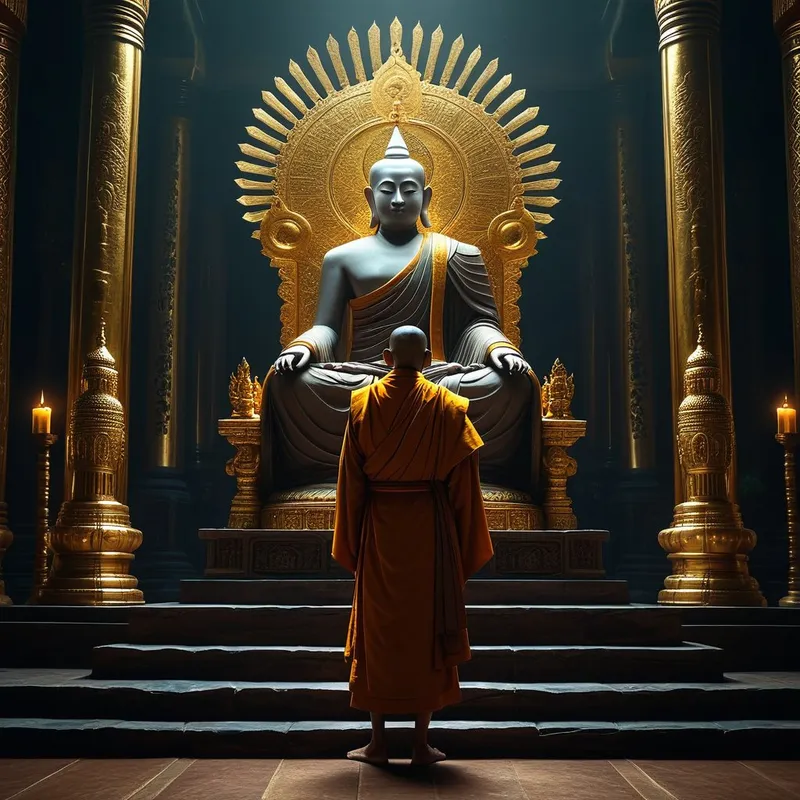
But a ripple moved through this perfected realm. A presence approached—not with the clamor of an army, but with the profound silence of a deep, still lake. It was Shakyamuni Buddha, the awakened one. He walked not as a petitioner, but as one who had transcended the very wheel of samsara that bound even the gods. He entered Indra’s hall, his simple ochre robe a stark contrast to the dazzling silks and jewels. No weapon was in his hand, only the immeasurable weight of his realization.
A challenge, silent and immense, hung in the air. It was not a challenge of force, but of truth. Who truly held sovereignty? The god who ruled the heavens, or the sage who had conquered the mind, the source of all heavens and hells? Indra, perceiving the threat to his station, issued a test born of divine pride. “If your wisdom is so vast,” the god thundered, his voice echoing through the pillars, “then leave a mark of it upon my world. A sign that all may see.”
The Buddha did not speak. He simply lifted his foot and placed it upon the solid stone of the divine mountain, Mount Meru. Where his sole touched, the rock did not crack—it yielded, as if to a seal pressed into warm wax. An imprint formed, perfect and deep. But this was no ordinary footprint. Upon its surface bloomed the Dharmachakra, its spokes turning with the law of cause and effect. Around it swirled a thousand-petaled lotus, symbol of pristine purity rising from mud. There were conch shells, victory banners, and endless knots—the Ashtamangala—all etched into the stone by the mere pressure of his being.
The court fell into a silence more absolute than any noise. The radiant footprint glowed with a soft, inner light, a scripture written not in ink but in presence. Indra looked upon the mark, and in its profound depth, he saw the reflection of his own transient glory. The conflict dissolved, not in defeat, but in revelation. The god bowed his magnificent head. The Buddha’s footprint remained—not as a trophy of conquest, but as a perpetual teacher, a bridge between the sovereignty of power and the sovereignty of wisdom. The cosmic order had not been broken, but forever deepened.
Cultural Origins & Context
This myth, found in texts like the Divyavadana and echoed in Puranic lore, occupies a fascinating interstitial space in the Indian religious landscape. It is a distinctly Hindu narrative about the Buddha, reflecting a period of intense dialogue and debate between the traditions. Far from being a mere folk tale, it functioned as a sophisticated theological and cultural negotiation.
Told by Brahmin scholars and Buddhist monks alike, often in the courts of kings who patronized both traditions, the story served multiple societal functions. For a Hindu audience, it acknowledged the Buddha’s immense spiritual stature by having him interact with, and ultimately humble, the king of the gods himself. It assimilated him into the Hindu cosmic framework as a divine being or a supreme sage, a not-uncommon fate for powerful spiritual figures in the subcontinent’s syncretic history. For Buddhists, it was a powerful testament to the supremacy of enlightenment (bodhi) over even the most powerful celestial beings, who are still subject to rebirth. The story legitimized the presence of Buddha footprints (Buddhapada) as objects of veneration, explaining their origin as direct, physical manifestations of the Buddha’s transcendental state.
Symbolic Architecture
The myth’s power lies in its dense symbolic architecture, where every element is a node of meaning. The central symbol, the footprint itself, is a masterpiece of paradoxical meaning.
The imprint is not the foot, yet it proves the foot’s reality. The teaching is not the truth, yet it is the path to it.
The footprint is an aniconic representation—it shows the presence through the mark of absence. It signifies the Buddha’s passage through the world, his impact, while reminding us that his true nature (tathata) is ultimately ungraspable, like the foot that has moved on. The intricate symbols carved within it—the wheel, the lotus—are not decorations but a complete cosmological and psychological map, a compressed mandala of awakened mind.
Indra represents the established, outer order—the ego’s kingdom of status, power, and external validation. His court is the psyche invested in its own self-importance. The Buddha represents the inner sovereign, the Self that emerges when identification with the ego’s dramas ceases. Their encounter is the inevitable, often tumultuous, confrontation between the psyche’s old ruler and its destined, wiser governor. The stone of Mount Meru, the axis mundi, is the very foundation of the individual’s perceived reality, which must be reshaped by the pressure of authentic being.

The Dreamer's Resonance
When this myth stirs in the modern unconscious, it may surface in dreams not of gods and mountains, but of profound, quiet challenges to one’s personal status quo. One might dream of leaving a permanent, beautiful mark on an unyielding surface at work or at home, a mark that feels deeply, authentically “you.” Alternatively, one might dream of facing a magnificent, authoritative figure (a boss, a parent, an internal critic) and, without a word, demonstrating a competence or calm that fundamentally alters the balance of power.
Somatically, this process can feel like a deep, grounding pressure—a sense of “standing your ground” not aggressively, but with immense, quiet density. Psychologically, it is the process of the nascent, authentic Self applying its weight to the hardened structures of the persona and the ego’s defenses. There is often anxiety (Indra’s thunder) before the resolution, followed by a profound sense of rightness and solidified identity. The dreamer is undergoing the embodiment of their own values, imprinting their unique pattern onto the raw material of their life.

Alchemical Translation
The alchemy here is the transmutation of spiritual insight into tangible, worldly reality—the opus of making the inner realization outer. Indra’s realm is the prima materia, the leaden world of conventional identity and inherited values. The Buddha’s enlightened consciousness is the alchemical solvent, the aqua permanens, that dissolves rigid hierarchies not to destroy them, but to reconstitute them around a new center.
The goal is not to depose the king, but to enlighten the monarchy. The ego must not be slain, but made servant to the Self.
The “footprint” is the philosopher’s stone of this process—the tangible evidence that the transmutation has occurred. It is the new habit formed from insight, the creative work born of meditation, the relationship healed not by force but by understanding. The process models individuation perfectly: the conscious personality (Indra) is confronted by the Self (the Buddha) in a moment of crisis. Through a non-violent but utterly transformative act (the imprinting), the ego-complex is relativized. It acknowledges a higher authority, not of domination, but of wisdom. The psyche’s center of gravity shifts from the celestial, fickle court of external validation to the grounded, immutable mountain of inner truth. The individual becomes, like the footprint, a stable point where the patterns of the cosmos and the depths of the soul are forever recorded, a sacred site in their own right.
Associated Symbols
Explore related symbols from the CaleaDream lexicon: