Buddha's Alms Round Myth Meaning & Symbolism
The Buddha walks silently for alms, transforming the simple act of receiving food into a sacred teaching on humility, grace, and the interdependence of all beings.
The Tale of Buddha’s Alms Round
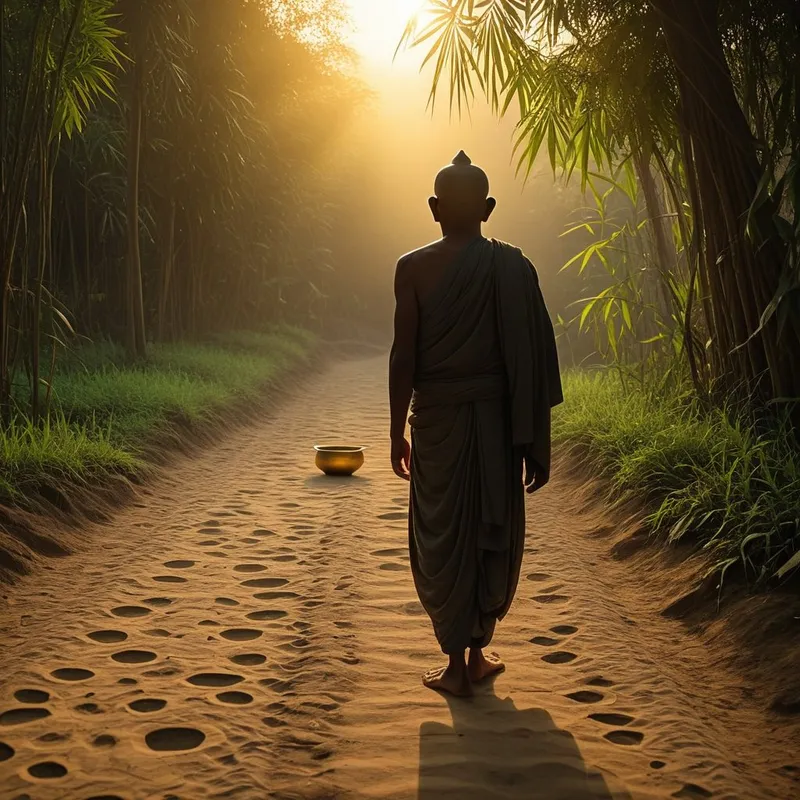
The world held its breath at dawn. In the grey light before the sun, a figure emerged from the stillness of the Sangha. It was the Buddha, his robes the color of earth after rain. In his hands, he carried not a scepter nor a sword, but a simple, empty bowl.
He did not fly. He did not vanish and reappear. His feet, bare and mindful, touched the dust of the road between Jetavana and Sravasti. The air was cool, carrying the scent of damp soil and waking blossoms. This was his battlefield; his chariot, his own body; his weapon, a profound and silent openness.
He entered the city gate as the first vendors stirred. The clatter of pots, the murmur of morning chores—these were the sounds of the world he had renounced, yet to which he now returned with a different purpose. He walked without haste, his gaze lowered, his presence a calm eddy in the stream of worldly life. People paused. A wealthy merchant, seeing the enlightened one in such humble guise, felt a strange contraction in his heart—a mix of reverence and confusion. A poor potter, her hands stained with clay, looked up and her weariness softened into wonder.
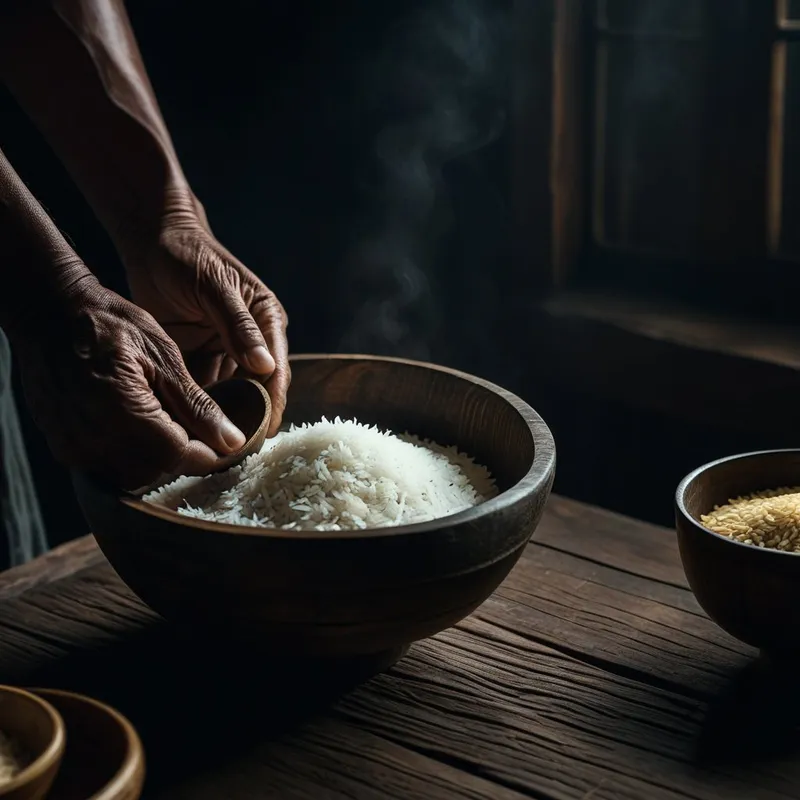
The Buddha stopped before a humble dwelling. He did not speak. He simply stood, a living question mark. The woman within, Visakha, saw him through her doorway. A rush of devotion, pure and sharp, flooded her. With hands that trembled not from fear but from awe, she scooped the plainest of her family’s rice—the very substance of their sustenance—and approached. The moment stretched, eternal. Her hand extended over the rim of his bowl. The grains, still warm from the hearth, fell with a soft, rustling whisper.
Plink. Plink. Plink.
In that sound was the thunder of a thousand teachings. It was not charity given, but a gift received. It was not a saint bestowing grace upon a sinner, but the universe, through the hands of a potter, feeding its own awakened heart. He accepted the offering with the same serene grace with which he would accept a king’s homage. A slight nod, a depth of silent acknowledgment that spoke more than any blessing. Then he turned, and continued his round, his bowl now bearing the weight of a single, sacred connection. The alms round was not a quest for food, but a ritual of mutual awakening—the giver was given the chance to give; the receiver, the grace to receive. And in that dusty street, with the sun finally cresting the rooftops, Nirvana walked, bowl in hand.
Cultural Origins & Context
This is not a myth of cosmic battles or miraculous births, but a distilled narrative embedded in the earliest Buddhist texts, the Sutta Pitaka. It is a daily reality elevated to doctrine. Following his awakening, the Buddha established the Vinaya, the rules for the monastic community. The alms round, or pindapata, was codified as the primary means for monastics to obtain food. This practice served multiple vital functions.
It was a radical act of social and economic deconstruction. By relying entirely on the generosity of the lay community, the monastics severed ties to worldly labor and possession, embodying non-attachment. Conversely, it gave the lay community a tangible, daily role in supporting the spiritual path, weaving a sacred interdependence between the Sangha and the world. The stories of the Buddha on his alms round, passed down by monks and nuns for centuries, were not mere anecdotes but central teaching tools. They illustrated the perfection of humility, the dignity of radical dependence, and the sanctification of the mundane. The mythos surrounding his alms round transformed a disciplinary rule into a profound archetypal image of how enlightenment engages with the world—not from a throne above it, but within its very streets, hand outstretched.
Symbolic Architecture
The symbolism here is an elegant, devastatingly simple architecture built on inversion. The bowl, the patra, is the central symbol. It is not a cup to be filled, but a vessel of sacred space.
The empty bowl is the precondition for receiving the world. It is the mind cleared of preconception, the heart emptied of ego, the life surrendered to the flow of Dependent Origination.
The act of walking, step by mindful step, symbolizes the path itself—the Noble Eightfold Path—grounded, present, and moving intentionally through the marketplace of Samsara. The food offered is not merely sustenance but the raw, unprocessed “stuff” of life—its joys, its sorrows, its mundane reality. The Buddha does not transform the rice into ambrosia; he transforms the act of receiving it into a sacrament.
Psychologically, the alms round represents the dissolution of the heroic, self-sufficient ego. The archetype of the Sage here is not a distant oracle, but one who demonstrates that wisdom is found in acknowledged need. The bowl held out is the vulnerable self, admitting its dependence on the other, on community, on the universe itself. The giver, in turn, is not a superior benefactor but a participant in a cosmic exchange. The myth teaches that grace flows not to the one who has everything, but to the one who has made space for it.

The Dreamer’s Resonance
When this myth stirs in the modern unconscious, it often surfaces in dreams of profound humility or disorienting exchange. You may dream of walking through a familiar yet alien landscape—your office, your hometown—holding out an empty container: a cup, a hat, your own cupped hands. The people you meet may be faceless, or they may be significant others from your life, offering you objects that are puzzlingly mundane or symbolically charged: a stone, a key, a piece of fruit, a forgotten toy.
The somatic feeling is crucial. It is not the anxiety of begging, but the vulnerable stillness of waiting to receive. There may be a deep, quiet ache of openness, a sense of your psychological defenses being down. This dream pattern signals a psyche undergoing a crucial process: the ego’s capitulation to a larger order. You are, perhaps, exhausted by the modern imperative of self-creation, of “earning” your worth. The dream proposes a radical alternative—that your next nourishment, your next piece of the puzzle, your next step forward, may not come from your own striving, but from accepting what the world, in its mysterious wisdom, places in your bowl. It is the dream of the over-functioning caregiver learning to be fed, the isolated hero learning to accept help, the intellectual magician learning that truth is served on a plate of simple rice.

Alchemical Translation
The alchemical process modeled here is the transmutation of pride into humility, and of lack into sacred connection. For the modern individual striving for individuation—the integration of the conscious and unconscious into a whole self—the path is often envisioned as a conquest: slaying dragons, climbing mountains, claiming treasures. The Buddha’s Alms Round presents a paradoxical, more profound formula.
The first operation is not to acquire, but to empty. To consciously lay aside the accumulated identities of achiever, provider, and expert, and to stand in the dawn as a simple vessel.
This is the nigredo, the darkening, the humbling. The walk through the “city” of one’s own life—past the inner critics (the wealthy merchants), the neglected parts (the poor potters), the daily routines—while holding that emptiness, is the albedo, the whitening, the purification by exposure. The moment of offering is the rubedo, the reddening. It is the point of conjunction, where the outer world (the other, circumstance, the unconscious) meets the prepared inner vessel. The plain rice of everyday experience—a difficult emotion, a moment of unexpected help, a simple sensory pleasure—is dropped into the bowl of awareness.
The final transmutation is not in the food, but in the receiving. The ego does not consume the offering; it is dissolved by it. What is integrated is not a new skill or insight, but the fundamental reality of interdependence. The Self that emerges is not a fortified castle, but a clear bowl: empty, yet containing the entire universe; dependent, yet utterly free. The alms round becomes the daily ritual of the individuated life—walking through the world not to take what you want, but to be given what you need, and in that receiving, to find the feast of awakening.
Associated Symbols
Explore related symbols from the CaleaDream lexicon: