
Broken Mirror Myth Meaning & Symbolism
A tale of a shattered divine mirror scattering soul-fragments across reality, demanding a perilous journey of recollection and integration.
The Tale of Broken Mirror
In the time before time, when the world was a whisper and the sky a held breath, there existed the First Mirror. It was not a thing of glass and silver, but a pool of perfect, silent awareness, hung in the void where the Great Dreamer slept. Its surface was the boundary between Is and Is-Not, reflecting not images, but essences. In it, the Dreamer saw the totality of itself—a flawless, singular soul.
But within that perfect reflection, a curiosity stirred. A question formed like a ripple from the depths: "What lies beyond the One?"
Driven by this yearning, the Dreamer reached a finger of thought to touch the Mirror's face. At the moment of contact, the question crystallized, and the Mirror—unable to contain a paradox within its perfect unity—shattered. Not with a crash, but with a sound like a universe sighing. A billion-billion shards, each a sliver of the original whole, exploded into the nascent cosmos.
Each fragment, in its flight, caught a different reflection. One shard reflected only courage, and where it landed, mountains thrust skyward. Another held only sorrow, and from it wept the first rivers. One gleamed with pure joy and became sunlight dappling on leaves; another, heavy with fear, sank into the earth as dark, cold stone. The largest piece, still holding a distorted memory of the original Self, spun into the center of things and became the heart of the first mortal. And so the world was populated: not from clay or word, but from the scattered reflections of a broken soul.
The Great Dreamer awoke to a cosmos of dazzling, terrifying diversity. Where there was once a silent "I," there was now a cacophony of "thou"s. The world was beautiful, but it was a beauty born of profound loneliness. The Dreamer's essence was now outside itself, living a thousand-thousand separate lives in stone and stream, in beast and human, in shadow and light.
A deep mourning settled over the void. The myth tells that the Dreamer's tears became the rain, seeking to wash the shards clean, and its breath became the wind, trying to gather them back. But the fragments were stubborn. They had grown accustomed to their singular reflections. The shard of rage liked its fire; the shard of grief cherished its deep pools. To be whole meant to lose their distinct, fierce identities.
Thus began the Long Remembering. It is said the Dreamer walks the world still, not as a giant, but as a whisper in the blood, a pull in the heart. It calls the fragments not to return, but to recognize each other. When a wolf howls at the same moon that a poet loves, that is a shard calling to its kin. When a hero's courage falters and they touch the earth for strength, that is a fragment remembering its source. The myth ends not with a reassembled mirror, but with a promise: that every act of true seeing, every moment one recognizes the self in the other, and the other in the self, is a piece of the Great Mirror healing itself from the inside out.
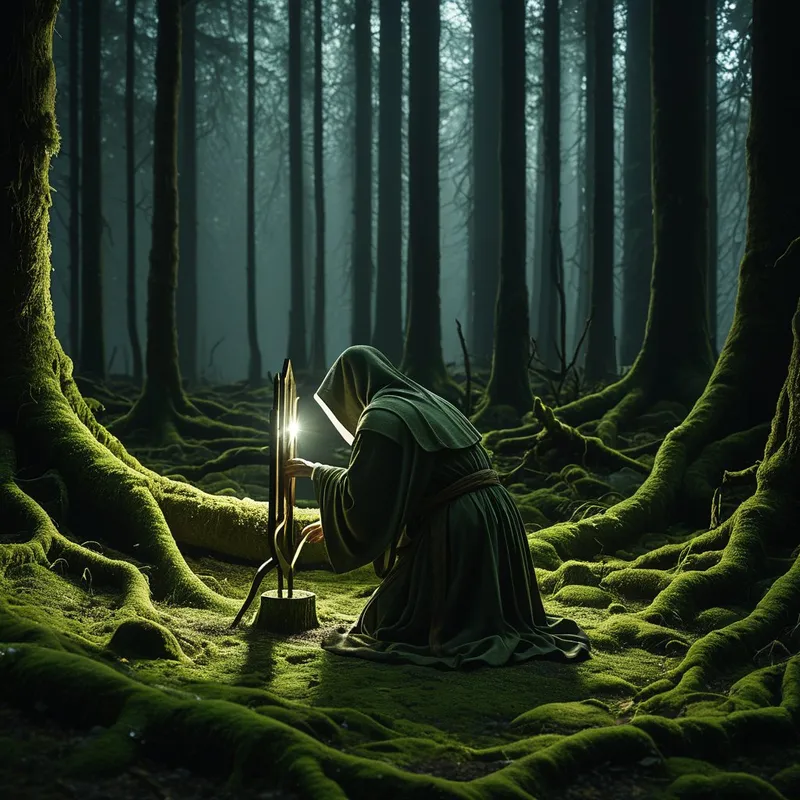
Cultural Origins & Context
The myth of the Broken Mirror is a foundational cosmogonic narrative found in the oral traditions of diverse "Folklore" cultures, from nomadic steppe-dwellers to forest-bound tribes. Unlike myths centered on a pantheon of gods, this story is profoundly psychological and animistic. It was not recited to glorify a ruler or explain natural phenomena in a literal sense, but to answer the most intimate of human questions: Why do we feel so separate? Why is there both beauty and terror in the world? Why do we recognize something of ourselves in a stranger's eyes?
It was traditionally told during rites of passage—at puberty, marriage, and most importantly, before death. The teller was often the community's Memory-Keeper, not a priest. The telling was a communal act of remembrance, a somatic experience where listeners were encouraged to feel the shattering within their own bodies and the longing for cohesion in their own hearts. Its function was societal glue; it taught that every member of the tribe, every animal, every feature of the landscape, was an essential, irreplaceable fragment of a single, fractured reality. This fostered a deep ethic of interdependence and respect, as harming another or the land was, mythically, an act of self-mutilation.
Symbolic Architecture
The myth's power lies in its elegant, devastating symbolism. The First Mirror represents the original, unconscious unity of the psyche—a state of wholeness that precedes ego-consciousness. It is the pleroma, the self-contained paradise. The "question" that shatters it is the dawn of consciousness itself, the emergence of the ego that seeks to know itself, an act that inevitably creates duality (self/other, subject/object).
The original sin is not disobedience, but awareness. To know oneself is to break the mirror of the unconscious One.
The shards are the archetypal contents of the psyche—the complexes, instincts, talents, and wounds—that are "projected" out into the world. We don't see the world as it is; we see it through our fragments. The angry person lives in a world full of provocation (the shard of rage). The joyful person finds beauty everywhere (the shard of joy). The world itself, in this view, is the Objective Psyche made manifest.
The heart of the first mortal, made from the largest shard, symbolizes the human ego—the central organizing principle of consciousness that carries a faint, homesick memory of wholeness (The Self). Our lifelong sense of incompleteness, our search for meaning and connection, is the ego's recollection of its origin in the broken mirror.

The Dreamer's Resonance
When this myth activates in the modern psyche, it often manifests in dreams of fragmentation and searching. Common motifs include: searching for lost pieces of a puzzle or a broken object in a vast landscape; being in a house with endless, unfamiliar rooms (the unexplored psyche); or seeing one's reflection shatter in a mirror, with each piece showing a different emotion.
Somatically, this can feel like a literal "falling apart"—a sense of dissociation, anxiety, or being pulled in multiple directions. Psychologically, it marks a critical juncture: the collapse of a previously held, but false, sense of unity. This could be the end of an identity ("I am only a caregiver," "I am only my career"), where the other suppressed fragments (the artist, the rebel, the child) demand recognition. The dreamer is experiencing what Jung called a "complex invasion," where autonomous psychic fragments temporarily overwhelm the ego. This is not a pathology, but a summons. The psyche is forcing a confrontation with its own disowned parts, initiating a process of individuation.

Alchemical Translation
The myth of the Broken Mirror is a perfect map for the alchemical process of individuation. The journey is not about retrieving the shards to rebuild the old mirror—that pristine, unconscious unity is forever lost, and rightly so. The goal is the transmutation of the fragments into a new, conscious whole.
The first alchemical stage, nigredo (the blackening), is the shattering itself—the experience of depression, breakdown, or profound disillusionment that reveals our fractured state. The Great Dreamer's mourning is this stage.
The albedo (the whitening) is the Long Remembering—the careful, often painful work of gathering the projections. This is shadow work: recognizing that the colleague who infuriates you holds a disowned fragment of your own aggression; that the art that moves you to tears touches a shard of your own buried grief. Each act of reclamation is a "whitening," a purification of the fragment from its literal, projected form back into a psychic content.
The new whole is not a repaired object, but a living constellation. The cracks become the design.
Finally, the rubedo (the reddening) is the integration. This is symbolized not by a seamless mirror, but by kintsugi. The gathered fragments are assembled, and the seams where they join are filled with gold—the gold of conscious awareness, earned insight, and self-compassion. The resulting soul is more complex, more resilient, and more beautiful precisely because of its history of fracture. The modern individual undergoing this process moves from being a passive shard, reflecting one narrow truth, to becoming a conscious participant in the Great Dreamer's work: a localized center of awareness, through which the cosmos slowly, painfully, gloriously, remembers itself.
Associated Symbols
Explore related symbols from the CaleaDream lexicon: