Broc Myth Meaning & Symbolism
A tale of a shapeshifting badger who navigates the underworld, embodying the soul's resilience and the alchemical power of confronting the shadow.
The Tale of Broc
Listen now, by the hearth-fire’s glow, to a tale not of kings and shining swords, but of the quiet earth and the creature who knows its deepest secrets. In the time when the world-tree’s roots drank from the same dark waters as our souls, there lived Broc.
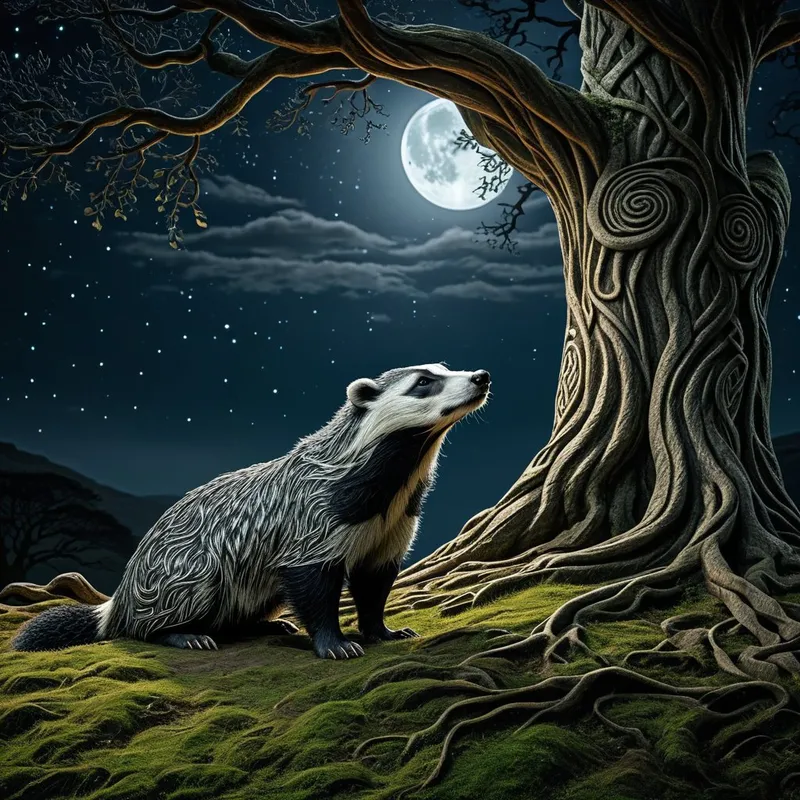
He was not always as you see him. Once, he walked as a man of the oak, a druid whose songs could calm the storm and whose sight could peer into the heart of a stone. But knowledge has its price, and a thirst for the world’s hidden veins led him to a forbidden compact. He sought the wisdom that sleeps in the marrow of the earth, the knowing that is not sung but dug, not seen but felt in the tremor of deep roots. For this, he was given a form to match his seeking: the low, powerful body of the badger, the digger, the unbending dweller in the dark.
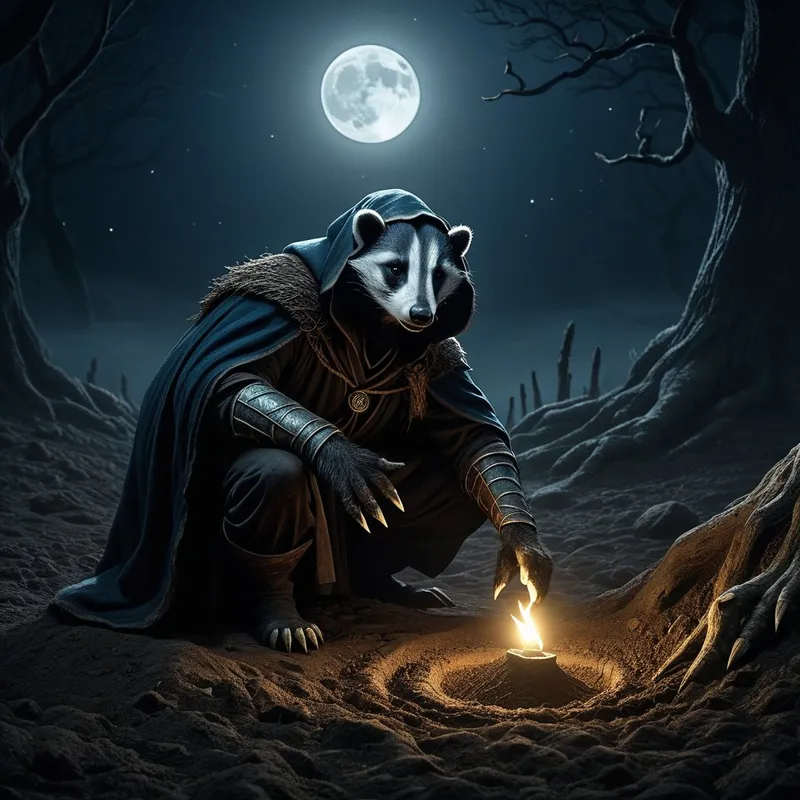
And so Broc, the man-mind in the beast-shape, descended. His world became the tunnel, the press of cool soil, the scent of stone and root-fungus. He learned the language of worms and the patience of bedrock. He built his broc, a labyrinthine fortress of chambers, a mirrored Tír na nÓg beneath the green fields. Here, in the absolute dark, his old sight faded, and a new one grew—a vision that felt the weight of history in a stratum of clay, that heard the memories of the land in the trickle of an underground spring.
The crisis came not from above, but from below. A trembling began in the deepest roots of the world, a sickness in the land’s dream. The springs soured; the trees whispered of pain. The people above feared famine and blight. Their songs and sacrifices could not reach the source of the ailment, for it festered in the places only a creature of the underworld could go.
Broc felt it first as a wrongness in the taste of the earth, a coldness where there should be warmth. He followed the tremor, down, ever down, past the bones of ancient hills, into a cavern no living thing had seen. There, in a silence older than sound, he found not a monster, but a wound—a great, crystalline geode cracked and weeping a slow, black tears, its vital energy congealed and stagnant. This was the heart of the sickness. To heal it, he would have to enter it, to let its stagnant darkness mix with his own fierce, tenacious life.
With a sound that was neither snarl nor sigh, Broc pressed his body against the cold crystal. He did not fight it. He began to dig, not away, but into the heart of the wound, his claws scraping against the poisoned crystal, his breath fogging the dark glass. He dug until he was surrounded, encased. And in that terrible, perfect solitude, he did the only thing left: he slept. He entered the dream of the wounded earth.
In that dream, he was both badger and druid, both root and branch. He saw the land’s memory—its joys and its battles, its periods of richness and lack. The black tears were forgotten grief, unhonored death, a pact with the land broken. In his dream, Broc began to sing, a low, rumbling chant that was the sound of roots growing, of stones settling. He sang the story of the wound, giving it form, giving it voice, and in the singing, he began to transmute it.
When he awoke, the geode was whole, but warm. The blackness had become a vein of shining obsidian, and from a new crack in its surface, a clear, sweet spring bubbled forth, washing over his matted fur. He drank, and the water tasted of memory and release. He climbed back to the world of light, emerging at dawn under a hawthorn tree. Where he shook the water from his fur, flowers sprang from the once-blighted soil. He had not slain a beast, but had dreamed a healing, becoming the conduit between the world’s deep pain and its capacity for renewal.
Cultural Origins & Context
The figure of Broc is less a singular character from a grand epic and more a pervasive presence in the Celtic mythological ecosystem. This tale is woven from threads found in the Metrical Dindshenchas (lore of places), folkloric remnants, and the deep-seated veneration of animals in Celtic spirituality. The badger (Broc in Irish, Broc in Scottish Gaelic) was a creature of profound ambiguity and respect.
Unlike the noble stag or the cunning salmon, the badger belonged wholly to the Sídhe—the underworld. Its elaborate, multi-generational setts were seen as gateways to the Otherworld, mirroring the complex, chambered cairns of the ancestors. Stories of Broc were likely told not to entertain courts, but to explain the landscape: a peculiar mound, a suddenly fertile patch of ground, a sacred spring. They were tales of the local genius loci, the spirit of a place, often embodied in an animal form.
The tellers would have been the folk themselves, farmers and hunters who observed the badger’s unmatched tenacity, its cleanliness, and its fearsome defense of its home. The druids, keen observers of nature’s symbology, would have seen in the badger a model for their own seeking: the pursuit of hidden, chthonic wisdom. The myth served a societal function of grounding. It taught that healing and knowledge often come not from conquering heights, but from engaging with depths; that the guardian of the land’s wholeness might be a humble, fierce creature of the dark, not a shining hero on a hill.
Symbolic Architecture
Broc is the archetype of the Underworld Self. His transformation from druid to badger is not a punishment, but an initiation into a necessary form of consciousness. The badger’s body is his tool and his teacher: low to the ground, powerful, built for excavation and defense.
The true sage does not look up to the stars for all answers, but down to the roots, where the memory of the world is stored in darkness.
His sett is a profound symbol. It is not a mere hole, but a crafted labyrinth, a model of the psyche itself—with its hidden chambers, its stored provisions (memories, instincts), and its multiple, guarded entrances to the outer world. The journey to heal the geode-wound represents the core of depth psychology: the descent into the personal and collective shadow. The sickness is not an invading monster, but a crystallized trauma, a forgotten, stagnant energy within the foundation of the self (or the land, or the culture).
Broc’s method is critical. He does not attack the wound. He enters it. He sleeps within it. This is the symbolic act of holding the tension of opposites, of engaging directly with the symptom until it reveals its meaning. His healing song from within the crystal is the act of symbolization—giving unconscious, poisoned content a form that can be integrated, thereby transmuting its nature. The resulting spring is the liberated life-energy, the creative flow that returns when a complex is made conscious.

The Dreamer's Resonance
To dream of Broc, or of the badger in a mythic context, is to feel the call of the earthy, neglected aspects of the psyche. It often surfaces during periods of profound fatigue with the "above-ground" world—the persona, the achievements, the conscious striving. The body may feel heavy, rooted; there may be a somatic sense of pressure, of being drawn downward.
Psychologically, this dream marks the beginning of a necessary regression in service of the ego. It is not depression, but a gathering. The dream-ego is being instructed to stop looking outward for solutions and to begin the careful, often messy work of self-excavation. One might dream of discovering hidden rooms in a familiar house (the sett), of finding precious, forgotten objects in the dirt, or of being protectively accompanied by a fierce, quiet animal guide through tunnels.
The emotional tone is not of terror, but of solemn, gritty purpose. There is resistance—the badger in the dream may snarl, may be initially frightening—because this work involves confronting what we have buried: old grief, instinctual rage, primal fears. The dream of Broc signals that the psyche is ready to engage its own foundations, to clean out the sett, and to find the source of the stagnation that is poisoning one’s vitality from below.
Alchemical Translation
The myth of Broc is a perfect map for the individuation process, specifically its nigredo and albedo stages. The voluntary descent into the badger-form is the nigredo: the blackening, the confrontation with the shadow and the material of the unconscious. It is a willing immersion in the "prima materia" of one’s own base, instinctual nature.
The alchemist and the psyche do not transform by rejecting the base matter, but by submitting to its laws, until it reveals its own latent light.
Broc’s life in the sett is the long, patient work of separatio and solutio—sorting through the contents of the unconscious, dissolving rigid complexes in the "earth-waters" of attention and feeling. The cracked, weeping geode represents a core complex, a psychic injury that has solidified and blocked the flow of life.
The climax—entering the wound and dreaming the healing—is the albedo, the whitening. It is the moment when the engaged ego, having fully identified with the problem, suddenly gains a transcendent perspective from within it. The singing is the coniunctio oppositorum (union of opposites) happening at the deepest level: conscious mind and unconscious material join in a creative act. The poison becomes medicine; the stagnant crystal becomes a flowing spring.
For the modern individual, Broc’s path teaches that healing and wisdom are subterranean arts. It calls one to embrace the "badger-self"—the tenacious, unglamorous, deeply grounded part that is willing to get its claws dirty in the soil of the soul. The triumph is not emergence as a hero, but emergence as a conduit, one who has made the underworld journey and now carries its renewing waters back into the light of day, fertilizing the conscious world with the hard-won wisdom of the dark.
Associated Symbols
Explore related symbols from the CaleaDream lexicon: