
Breastplate of Aaron Myth Meaning & Symbolism
A sacred priestly garment holding twelve stones, used to discern divine will, binding the tribes of Israel into a single, luminous covenant.
The Tale of the Breastplate of Aaron
The air in the Tabernacle was thick with the scent of incense and animal fat, a holy smoke that coiled toward the tent of goat-hair and fine linen. Outside, the desert sun hammered the sands of Sinai, but here, in the Holy of Holies, a cool, trembling darkness reigned. Before the Ark of the Covenant, a man stood, his breath shallow. This was Aaron, son of Amram, his heart a drum against his ribs.
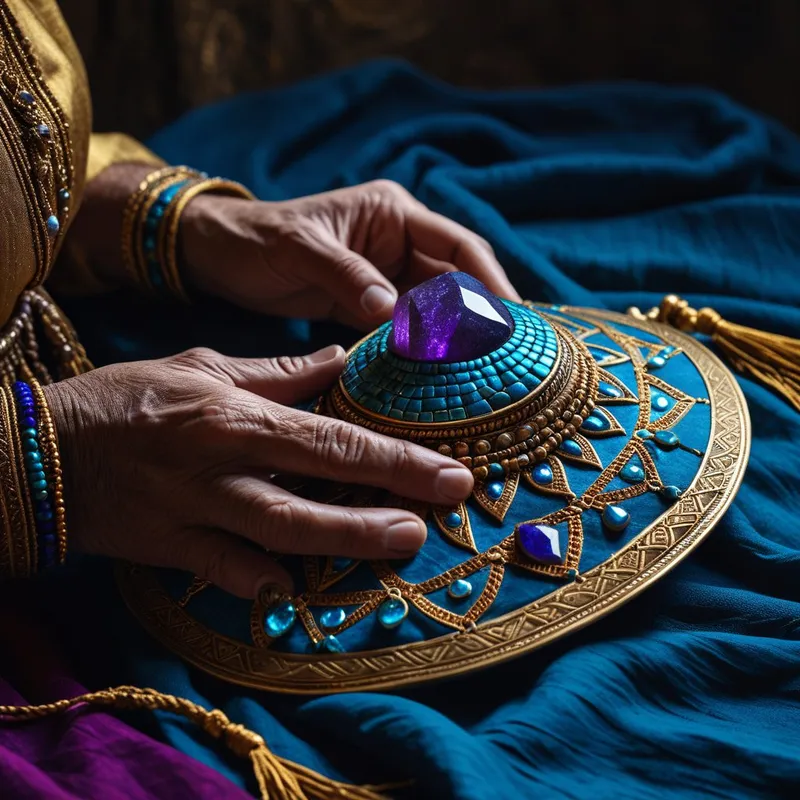
Upon his shoulders rested two onyx stones, each engraved with six names—the tribes of Israel, a people born from a promise, now a nation murmuring in the wilderness. But upon his heart lay the true wonder. The Breastplate of Judgment. Woven of the same fine linen, blue, purple, and scarlet, it was a square of doubled cloth, a span wide and a span long. And upon it, set in four rows of three, blazed twelve stones. A sardius, a topaz, a carbuncle—an emerald, a sapphire, a diamond—a ligure, an agate, an amethyst—a beryl, an onyx, a jasper. Each stone was a world, a tribe, a fragment of the divine light caught in mineral sleep.
And in the fold of the breastplate, against Aaron’s very heart, lay the Urim and Thummim. No man knew their shape—perhaps flat stones, perhaps lots of light and shadow. They were the instruments of the Unseen. When the people were lost, when a king’s fate hung in the balance, when war loomed like a storm cloud, Aaron would enter this trembling dark. The weight of the tribes was upon his shoulders; the judgment of heaven lay over his heart. He would stand, the names of the sons of Israel pressing into his skin, and through the mystery of the stones and the sacred lots, a verdict would shine forth. Not a voice, but a knowing. A “Yes” or a “No.” A light emerging from the perfections. In that moment, Aaron was no longer merely a man. He was the vessel where the chaos of human inquiry met the terrible clarity of divine will. The breastplate did not speak; it illuminated, and in its cold, gemstone fire, a path was carved through the wilderness of doubt.
Cultural Origins & Context
This myth originates from the Book of Exodus, a foundational text of priestly Torah. It is not a narrative myth of gods battling chaos, but a ritual and legal one, detailing the exact construction of sacred objects for the nascent cult of YHWH. Its transmission was likely guarded by priestly castes, for whom the precise details of the ephod, breastplate, and Urim were not mere decoration but the operational mechanics of maintaining the covenant.
Societally, its function was profound. In a culture defining itself against the idolatrous divination practices of surrounding nations (reading entrails, consulting household gods), the Breastplate provided a sanctioned, centralized channel to the divine. It transformed random chance or ambiguous omens into a controlled, priestly ritual. It physically manifested the idea that the twelve fractious tribes were, in truth, a single organism—a “kingdom of priests”—whose collective identity was literally borne on the shoulders and over the heart of their representative before God. The breastplate was a technology of unity and a tool for sovereign decision-making, removing judgment from the realm of human whim and placing it in the realm of sacred revelation.
Symbolic Architecture
The Breastplate is a masterpiece of symbolic architecture. It is a map of a complete psyche. The twelve stones represent the twelve tribes, but psychologically, they signify the totality of the human personality—the diverse, often conflicting “tribes” within us: our instincts, emotions, intellects, and intuitions. They are the fragmented parts of the Self awaiting integration.
The sacred artifact is not a shield against the world, but a lens placed directly over the heart, through which the multifarious self is organized into a legible text for the divine to read.
The doubling of the cloth suggests a container, a holding space. The Urim and Thummim—“Lights and Perfections”—symbolize the fundamental binary code of existence: potential and actuality, question and answer, darkness and illumination. They are the dynamic, unknowable core of the process, the mysterious interface between human inquiry and transpersonal truth. Aaron, as the wearer, symbolizes the conscious ego that must courageously submit to this process. He does not possess the answers; he wears the mechanism that reveals them. His role is to stand in the tension, bearing the weight (the shoulder stones) and presenting the question (the heart stones), allowing a synthesis to emerge that is greater than his own understanding.

The Dreamer's Resonance
To dream of the Breastplate of Aaron is to dream of a profound moment of internal judgment and the need for discernment. The dreamer may be at a critical life crossroads, feeling pulled in multiple directions by the different “tribes” of their own psyche—the tribe of duty versus the tribe of desire, the tribe of security versus the tribe of adventure. The somatic sensation is often one of a heavy, precious weight on the chest, a constriction that is also sacred.
Psychologically, this dream marks a process where the dreamer’s consciousness (the Aaron-ego) is being called to mediate between these inner factions not through force or suppression, but through a ritual of presentation. The dream asks: Can you hold the totality of your contradictions over your heart? Can you bear their weight without collapsing? The appearance of the Urim and Thummim suggests the dreamer is seeking a “yes or no” from a deeper, more authoritative layer of the Self, a verdict that feels ordained rather than chosen. It is a dream of seeking inner law, a divine mandate to resolve an otherwise paralyzing conflict.

Alchemical Translation
The alchemical process modeled here is the opus contra naturam—the work against nature—of synthesizing opposites into a higher, third thing. The prima materia is the chaotic, tribal psyche. The furnace is the darkened Tabernacle of introspection. Aaron, the alchemist, does not discard any of the twelve “stones” (base elements); he arranges them in a sacred, geometric order (four rows of three) upon the matrix of the heart.
Individuation is not the selection of a single, perfect stone, but the fashioning of a setting that can hold the fire of all twelve without shattering.
The Urim and Thummim are the secret catalyst, the lapis philosophorum (philosopher’s stone) of this inner work. They represent the acceptance of a transcendent function. The modern individual must cultivate their own “Urim and Thummim”—not for divining God’s will for a nation, but for discerning the will of the Self. This is the development of intuition and ethical conviction that emerges not from logic alone, but from a solemn consultation with the totality of one’s being. The “verdict” that shines forth is the next step in one’s individuation path, a step that feels “right” because it honors all the constituent parts of the psyche, binding them into a new, conscious unity. The gold of the setting is the enduring, resilient consciousness forged in the process; the glowing stones are the transformed and acknowledged aspects of the Self, now serving a unified purpose. One becomes, in a psychological sense, both the priest and the living breastplate—the vessel and the revelation.
Associated Symbols
Explore related symbols from the CaleaDream lexicon: