Bārû priests Myth Meaning & Symbolism
The story of the seers who navigated the terror of divine silence, finding meaning in the entrails of the world to guide a civilization.
The Tale of Bārû priests
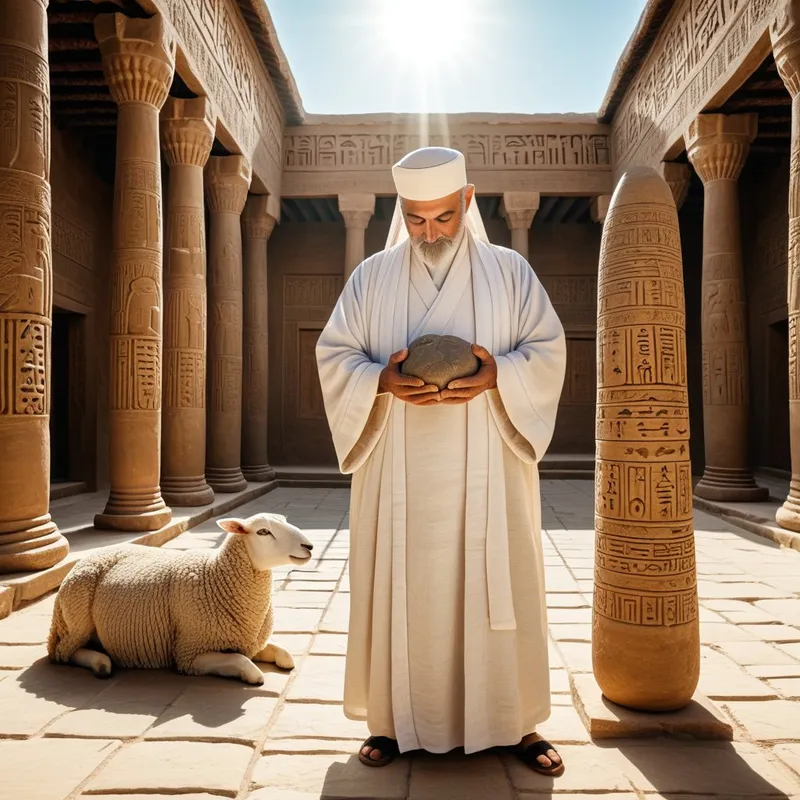
The world was a tablet of wet clay, and the gods wrote upon it in a script of blood and star-fire. Beneath the crushing blue dome of Anu, where the sun-god Shamash burned all secrets bare, walked men whose eyes were trained not on the horizon, but on the hidden architecture within. They were the Bārû</abû>, the seers, the listeners in the temple’s deepest silence.
Our tale begins not with a king’s decree, but with a king’s terror. The Euphrates ran sluggish and brown. Blight spotted the barley. A child was born under an ill-starred constellation, its first cry sounding like the warning call of a carrion bird. The palace, built of cedar and ambition, felt suddenly frail. The divine dialogue had grown faint, replaced by an echoing, ominous quiet. The king, robed in the weight of his people’s fate, sent for the Master of the Bārû.
The priest came not in haste, but in a procession of profound deliberation. He purified himself in water scented with juniper, donned the ritual white linen, and entered the sacred precinct. The air was thick with the smell of incense and animal fear. A perfect, unblemished sheep was led to the altar of Shamash. Its breath steamed in the cool dawn. The priest’s knife was not an instrument of slaughter, but a key. With a prayer that hung in the air like smoke, he performed the sacrifice. The animal’s life did not end; it was translated.
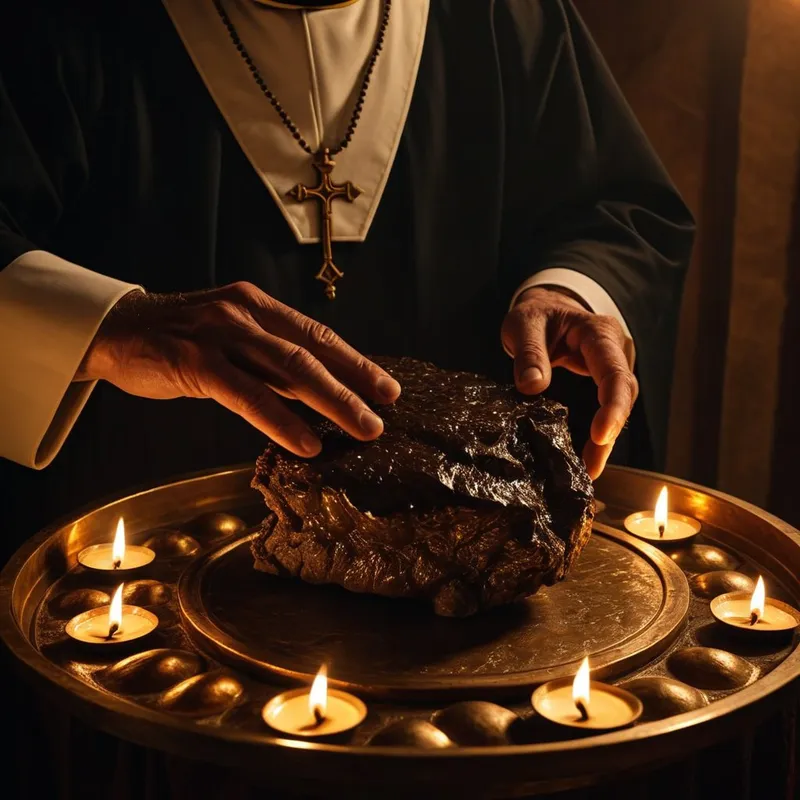
Then, in the holy stillness, he lifted the liver—the seat of the soul, the mirror of the cosmos—and laid it upon the pure reed mat. All breath was held. His fingers, trained by decades of study, traced the landscape of the divine will. He felt the ridges of the Processus Papillaris, the fissures of the Pars Loba. A dark spot here, a peculiar texture there—each was a word in the gods’ letter. He consulted the celestial maps inscribed on clay tablets: if the gallbladder resembles a crouching lion on the right side, the enemy will flee; if the portal vein is doubled, the harvest will be doubled. The terror of divine silence was being parsed into a grammar of prognosis. He did not create the message; he was its humble, terrified, and exultant scribe. Rising, his face illuminated by a understanding born of dread and clarity, he delivered the verdict to the king: the gods are angered by a neglected canal, a broken ritual. Order could be restored. The world’s clay could be smoothed, and rewritten.
Cultural Origins & Context
The practice of the Bārû was not mere superstition; it was the central nervous system of Mesopotamian civilization, spanning the Sumerian, Akkadian, Babylonian, and Assyrian empires from the third to the first millennium BCE. In a universe perceived as a cosmic state, where gods made decisions that directly impacted floods, wars, and health, humanity’s primary task was to discern and align with the divine will. The Bārû were the master technicians of this alignment.
Their art, extispicy, was a rigorous science of observation and taxonomy. They worked from vast, standardized compendia—clay tablets detailing thousands of omens paired with their prophetic meanings. These texts were the accumulated data of centuries, a collective project to map the correlation between celestial and terrestrial events. The liver was chosen as the prime organ for inspection because it was seen as the seat of emotion and life, a microcosm of the entire body, and thus, by symbolic extension, of the world. The Bārû’s pronouncements guided statecraft, military campaigns, medical treatments, and personal affairs. They were the human interface between the chaotic, willful realm of the gods and the desperate human need for order and predictability.
Symbolic Architecture
At its heart, the mythos of the Bārû is a profound drama about finding meaning in the visceral, chaotic interior of existence. The sacrificial animal represents the raw, unprocessed stuff of life and fate—the "given" reality that is often bloody, complex, and seemingly senseless.
The priest does not look away from the mess of life; he leans into it, believing that within its very entrails lies a coherent text.
The liver is the ultimate symbol of the imago mundi—the world in miniature. Its lobes, vessels, and markings are not random; they are a landscape to be read. This act transforms terror (the unknown will of the gods) into information. It alchemizes anxiety into action. Psychologically, the Bārû represents the archetypal function of interpretation. He embodies the part of the psyche that refuses to accept events as mere accidents or meaningless suffering. Instead, it insists on asking, "What does this mean? What pattern is being revealed? What is the universe trying to communicate through this event, this illness, this failure?" He is the opponent of nihilism.
The Dreamer's Resonance
When this mythic pattern stirs in the modern unconscious, it often manifests in dreams of deciphering cryptic messages. You may dream of finding a strange, organic object (a stone, a piece of fruit, a lump of clay) covered in indecipherable writing or symbols. You feel a compulsive need to understand it. Alternatively, you might dream of being a surgeon or an archaeologist, carefully examining an intricate, internal landscape—a cave system that looks like organs, or a ruined city laid out like a circulatory system.
Somatically, this process correlates with a felt sense of "gut knowing" or visceral intuition that you are struggling to articulate into conscious understanding. There is a psychological "sacrifice" happening—the surrender of a simplistic, surface-level narrative about your life. The dream-ego is being called to become its own Bārû, to examine the often messy, uncomfortable "entrails" of a situation—a broken relationship, a career crisis, a period of depression—not with disgust, but with the reverent attention of a seer looking for signs. The anxiety in the dream is the ancient king’s terror of divine silence; the act of looking closely is the beginning of the ritual.
Alchemical Translation
The individuation process modeled by the Bārû is one of psychic divination. It is the transmutation of fate into destiny, of symptom into symbol. The first step is the Sacrifice of Literalism: killing the naive hope that life will be straightforward or that answers will come from outside. One must offer up one’s simplistic stories to the altar of reality.
The second is the Internal Inspection: turning one’s attention inward with disciplined focus. This is the hard, unglamorous work of self-observation—examining the lumps and discolorations of one’s own psyche: the repressed anger (the "dark spot" on the lobe), the twisted patterns of relationship (the "abnormal fissure"), the swollen pride (the "engorged vessel").
The clay tablet of the compendium is replaced by the internalized wisdom of one’s own lived experience and psychological insight—the personal canon against which omens are checked.
The final alchemical stage is Pronouncement and Integration. The modern Bārû does not deliver a verdict to a king, but to the ego. "The drought in your creativity is linked to a neglected inner child (a blocked canal). The repeating conflict at work mirrors an unhealed authority wound (a broken ritual)." Meaning is restored not by changing the external facts, but by understanding their internal correspondence. Order is re-established from within. The chaotic, bloody mess of lived experience is revealed to have been a sacred text all along, waiting for the priest within to learn its language. One becomes, simultaneously, the sacrifice, the organ, the seer, and the king—the integrated self that can bear the terrifying and magnificent dialogue with the divine.
Associated Symbols
Explore related symbols from the CaleaDream lexicon: