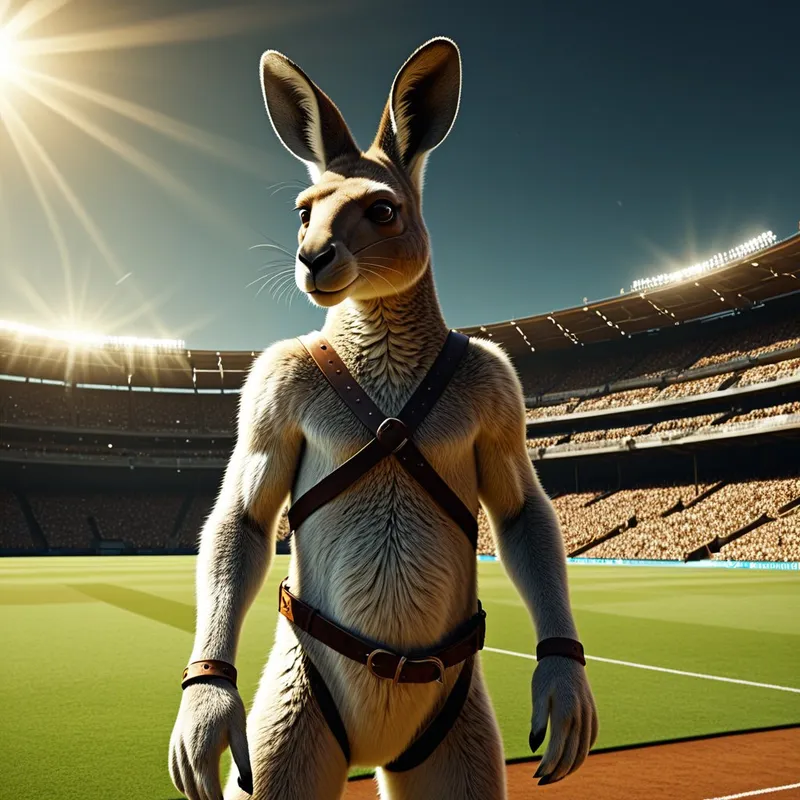
Boxing Kangaroo Myth Meaning & Symbolism
A mythic figure from modern sports culture, embodying the spirit of playful defiance and the transformation of instinct into conscious, strategic power.
The Tale of Boxing Kangaroo
Listen, and hear the rhythm of a new world’s dreaming. Not in the deep forests of old, but under the searing sun and the electric hum of stadium lights. This is the tale of the Boxing Kangaroo.
In the beginning, there was the great, red, dreaming land. Its children moved with a rhythm born of the earth itself—a powerful, bounding gait that spoke of vast distances and enduring patience. Among them was one whose spirit burned with a different fire. Where others fled the threat of the wild dog or the cunning hunter, this one felt a stirring. Not just the instinct to leap away, but a rising heat in the chest, a gathering in the powerful arms. It watched the storms roll in, not with fear, but with a recognition of a coming clash.
The conflict arrived not as a monster, but as a cage. A fence of steel and expectation, built by those who saw only a curious beast. They sought to contain the boundless spirit, to define it, to make it small. The Kangaroo felt the walls press in, not on its body at first, but on its soul. The ancient rhythm of bound and retreat grew frantic, a trapped thunder in its blood. In the close dark, the great tail, once a balance for glorious flight, became a weight. The mighty legs, engines of escape, had nowhere to go.
Then came the moment of turning. Cornered, with the scent of confinement thick in its nostrils, the Kangaroo did not crouch. It rose. It planted its tail, the pillar of its being, and raised its forelimbs. They were not tools for grazing, but limbs now, poised. The instinct to push back transformed. It was no longer a blind shove, but a measured, conscious act. The first movement was a parry, deflecting a thrown net. The second was a testing jab, a language of space and threat spoken with a clenched fist.
The rising action was a dance learned in solitude. At dawn, by a drying billabong, it would shadow-box with its own reflection, the movements evolving from frantic slaps to precise arcs. It learned to roll with imagined blows, to weave, to use the opponent’s force as a lever for its own. The Great Pivot was not an attack, but a stance. Defense became an offensive art. Retreat was re-framed as strategic withdrawal, a gathering of power for the counter-strike.
The resolution was not a bloody victory, but an emergence. When the gate finally fell open, the Kangaroo did not simply bolt for freedom. It stepped out, upright, its gaze level. It had metabolized the pressure of the cage into a new posture toward the world. It carried the arena within itself. The myth ends not with the Kangaroo conquering a foe, but with it standing at the boundary between the red desert and the paved road, a living bridge between raw instinct and conscious power, forever ready, forever balanced, having turned confinement into its own sacred ring.
Cultural Origins & Context
This myth did not emerge from ancient scrolls, but from the living tapestry of 20th-century national identity, most potently within Australian culture. Its primary vessels were not bards, but athletes, soldiers, and cartoonists. The image of the boxing kangaroo—a literal depiction on World War II fighter planes, a mascot for sports teams, a symbol on flags—became a modern national totem.
It was passed down through popular, almost folkloric, channels: on souvenir patches, in animated shorts, and in the roaring stands of sporting arenas. Its societal function was multifaceted. For a young nation often positioned as the underdog on the world stage, it embodied a "plucky" defiance, a willingness to punch above its weight. It reframed the colonial narrative of the "frontier" into one of resilient self-determination. The myth served as a psychological container for the national character: easy-going yet fiercely competitive, seemingly laid-back but formidably strong when challenged. It transformed a perceived vulnerability—isolation, a "quirky" fauna—into a symbol of unique strength.
Symbolic Architecture
At its core, the Boxing Kangaroo is an archetypal image of psychic alchemy. The kangaroo’s natural defense is its powerful hind legs, used for flight and kicking. The myth is about the conscious elevation of the secondary function—the smaller, seemingly less useful forelimbs—into the primary instrument of engagement.
The true battle is not against an external opponent, but against one’s own instinct to flee from confrontation. The ring is the circumscribed space where one chooses to stand and meet the self.
The Leather Straps (wraps or gloves) symbolize the conscious, cultural shaping of raw instinct. They are both a protection and a ritual binding, marking the transition from natural animal to cultural entity. The Upright Stance is the central symbol. It represents the movement from a reactive, four-legged relationship with the earth (unconscious instinct) to a balanced, two-legged relationship with the world (conscious ego). It is the moment of facing reality eye-to-eye. The act of Boxing itself is not mere aggression. It is ritualized conflict, bounded by rules, a metaphor for the necessary and conscious engagement with life’s adversities, transforming chaotic struggle into a strategic dance.
The Dreamer's Resonance
When this myth stirs in the modern dreamscape, it often signals a critical juncture in the dreamer’s relationship with power and conflict. To dream of the Boxing Kangaroo is to encounter the part of the psyche that is learning to "stand its ground."
Somatically, the dreamer may awaken with tension in the shoulders, chest, or hands—the body preparing for, or remembering, a stance of engagement. Psychologically, this dream pattern emerges when one feels "cornered" by life circumstances—a demanding job, a relational conflict, an internal critic. The instinct (the kangaroo’s leap) is to escape, avoid, or dissociate. The dream presents the alternative: to turn, plant your feet, and raise your guard. It is the psyche rehearsing resilience. The dream may feature the dreamer being the kangaroo, feeling the strange power in the upright stance, or watching it, witnessing a model for transforming felt powerlessness into poised readiness. The conflict in the dream is rarely resolved with a knockout; more often, it’s about maintaining balance, enduring the round, and learning the rhythm of the fight itself.

Alchemical Translation
For the individual on the path of individuation, the Boxing Kangaroo myth models the transmutation of the victim complex. The initial state is one of identification with a natural, perhaps overly adaptive, defense mechanism (the flight of the kangaroo). Life’s pressures (the cage) force a crisis where this mechanism fails.
The alchemical vessel is the conscious ego that agrees to be contained in the conflict long enough to transform it. The lead of passive suffering is turned into the gold of active engagement.
The prima materia (base material) is the raw, instinctual energy of fear and avoidance. Through the heat of confrontation—be it an internal shadow or an external challenge—this energy is subjected to the separatio. The old, monolithic identity ("one who flees") is broken apart. Then comes the coniunctio oppositorum (union of opposites): the powerful legs (instinct, foundation, momentum) are united with the strategic forelimbs (conscious action, precision, boundary-setting). The new entity that emerges from this psychic process is the Conscious Warrior. This is not a brutal aggressor, but an integrated self that knows when to bound away and when to stand and deliver a measured response. It has internalized the ring, so all of life becomes a mindful engagement where every challenge is met not with blind panic, but with the balanced, ready stance of the one who has turned confinement into consciousness.
Associated Symbols
Explore related symbols from the CaleaDream lexicon: