Borobudur Myth Meaning & Symbolism
A cosmic mountain-mandala rises from the Javanese earth, charting the soul's journey from the world of form to the formless, from ignorance to awakening.
The Tale of Borobudur
In the beginning, there was the mountain. Not a mountain born of fire and rock, but one dreamed into being from silence. It rose from the fertile plains of Mataram, a perfect, silent answer to the chaos of the world. The air hummed with the chants of ten thousand unseen monks, and the scent of frangipani and wet stone hung heavy.
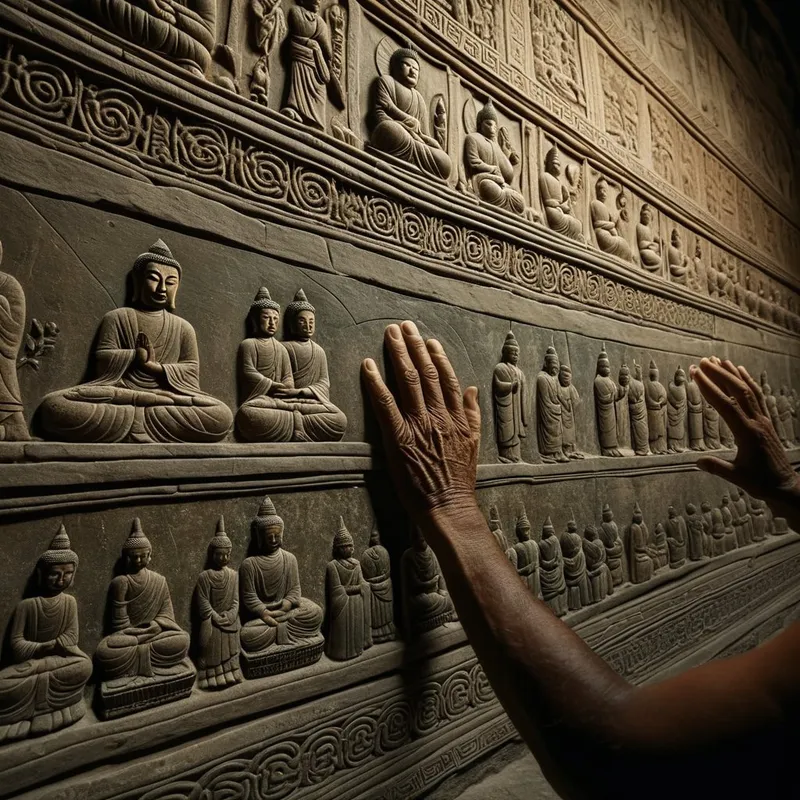
This was no mere temple, but a mandala given stone flesh. Its builders, the Sailendra kings, were not just rulers but midwives to a vision. They commanded the earth to remember the path. And so, the mountain grew: a vast, square base, heavy with the weight of the world, carved with tales of cause and consequence, of desire and its bitter fruit. Here, in stone, the Buddha was once a hare, a king, a merchant—living, loving, and losing, caught in the great wheel.
Then, the mountain shed its worldly skin. The path turned inward, spiraling upward to a second realm. The carvings here were not of the world, but of the journey out of it. The stories were of the Bodhisattva’s quest, a being who walks the edge between compassion for the suffering and the pull of final release. The air grew thinner, the vistas wider. The jungle below became a green sea, and the pilgrim, a solitary figure on a vast stone prayer.
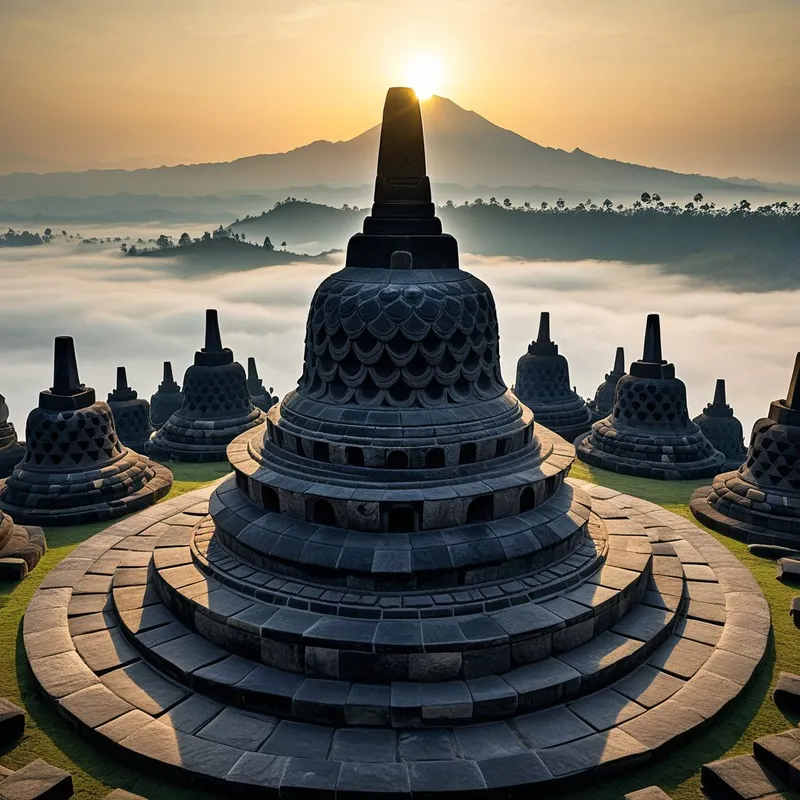
Finally, the path broke free of narrative entirely. The pilgrim emerged onto the great circular terraces. Here, seventy-two perforated stupas, like stone bells or inverted alchemical vessels, sat in silent rows. Within each, a statue of the Buddha in the gesture of Dharmachakra Mudra was visible only in fragments through the diamond-shaped lattices—present, yet unseen; manifest, yet beyond form.
At the summit, the spiral path ended. It did not culminate in a grand hall or a towering statue, but in a single, massive, central stupa. This final monument was closed, seamless, empty. It did not point to anything. It simply was. Here, the mountain of form dissolved into the formless. The pilgrim’s breath became one with the wind whispering through the lattices. The story was over. Only the silence, vast and complete, remained. The mountain had told its tale, and in the telling, had become the listener.
Cultural Origins & Context
The myth of Borobudur is not inscribed on parchment but etched into the landscape of central Java. Its origins are entwined with the Sailendra Dynasty (“Lords of the Mountain”), which flourished between the 8th and 9th centuries CE. This was a period of profound cultural synthesis, where indigenous Javanese ancestor worship and reverence for sacred mountains (Gunung) merged seamlessly with the sophisticated cosmology of Mahayana Buddhism.
The monument itself was the primary “text.” It functioned as a three-dimensional mandala and a cosmic map of the Buddhist path. Its societal function was multifaceted: a statement of royal piety and cosmic authority, a unparalleled center for pilgrimage and merit-making, and a vast pedagogical tool. Monks and pilgrims would perform the pradakshina, walking clockwise around each level, “reading” the 2,672 relief panels and 504 Buddha statues as a guided meditation. The myth was not merely told; it was physically enacted, internalized step by step, breath by breath, in a ritual ascent that mirrored the soul’s journey from the profane to the sacred.
Symbolic Architecture
Borobudur is a monumental diagram of the psyche’s structure and its potential for transformation. Its architecture is a direct reflection of the Triyana or the threefold path to enlightenment.
The massive, square base represents Kamadhatu, the world of desire and suffering we inhabit. The detailed carvings of worldly life and the law of karma depict the unconscious, conditioned psyche, driven by instinct, passion, and consequence.
The base is the shadow, the unexamined life, the weight of personal and ancestral history that grounds—and often traps—the spirit.
The five square terraces above symbolize Rupadhatu, the world of form. Here, the narrative shifts to the lives of the Bodhisattva. This is the realm of the conscious ego’s striving, of diligent practice, moral discipline, and cultivated wisdom. The self is being purified and refined, but is still identified with form, with the “story” of becoming a better person.
The three circular terraces and the great central stupa embody Arupadhatu. This is the realm of the formless, the Self (in a Jungian sense) or Tathata. The shift from square to circle is critical: the rigid, defined boundaries of the ego (the square) dissolve into the wholeness and infinity of the Self (the circle). The latticed stupas represent the threshold state where the archetypal image (the Buddha) is glimpsed but not grasped, signifying the intuition of the transcendent. The empty, closed central stupa is the ultimate symbol: it represents Sunyata, the ineffable center, the paradoxical fullness of absolute emptiness.
The Dreamer's Resonance
To dream of Borobudur is to dream of a psychic structure awakening. One does not dream of the monument as a tourist, but as a participant within its architecture.
You may dream of ascending an endless, spiraling staircase within a vast stone structure. This somatic experience speaks to a process of psychological integration—a conscious effort to “rise above” a chaotic or base emotional state (the Kamadhatu of your personal life). The body in the dream feels the effort, the thinning air of new perspectives.
A dream of being within a latticed stone dome, seeing a serene face fragmented through geometric openings, indicates a confrontation with the Self archetype. The Self is perceived, but not directly; it is mediated by the structures of your own psyche (the lattice). This is a moment of profound insight, where a unifying principle of your life is sensed but not yet fully integrated or understood.
Conversely, a dream of being lost in the crowded, narrative carvings at the base reflects a state of being overwhelmed by the contents of the personal unconscious—life stories, traumas, familial patterns (karma). You are “stuck in your own story.” The dream is a call to begin the conscious work of observation and detachment, to start the climb.
Alchemical Translation
The myth of Borobudur is a master blueprint for the alchemical process of individuation. It models the opus—the great work—of psychic transmutation.
The process begins with nigredo, the blackening, represented by the heavy, earth-bound base. This is the confrontation with the shadow, the acknowledgment of one’s personal Kamadhatu: the desires, complexes, and unresolved karma that form the foundation of one’s suffering. One must fully walk through this gallery of one’s own making, observing the carvings of one’s patterns without immediate judgment.
The ascent is the albedo, the whitening. It is the purification and differentiation of the ego in Rupadhatu. Through conscious discipline (therapy, meditation, creative work), the personal narrative is refined. The ego learns its role not as the master, but as the dedicated pilgrim on the path.
The emergence onto the circular terraces signifies the citrinitas, the yellowing or illumination. The rigid ego-boundaries soften. One encounters archetypal truths (the Buddhas in the stupas) not as external doctrines, but as internal realities glimpsed through the lattice of one’s own understanding. This is the stage of intuitive wisdom.
Finally, the empty central stupa is the rubedo, the reddening, the culmination. It symbolizes the attainment of the Philosopher’s Stone—which, in psychological terms, is the fully realized Self. This is not an inflation of the ego, but its graceful dissolution into a greater totality.
It is the paradoxical state where the individual, fully realized, is also no-thing. The center is empty because it is everywhere; the self is silent because it has become one with the symphony. The mountain has been climbed only to discover that the climber, the path, and the peak were never separate. The myth ends where true consciousness begins: in the seamless, stupa-like silence of being.
Associated Symbols
Explore related symbols from the CaleaDream lexicon: