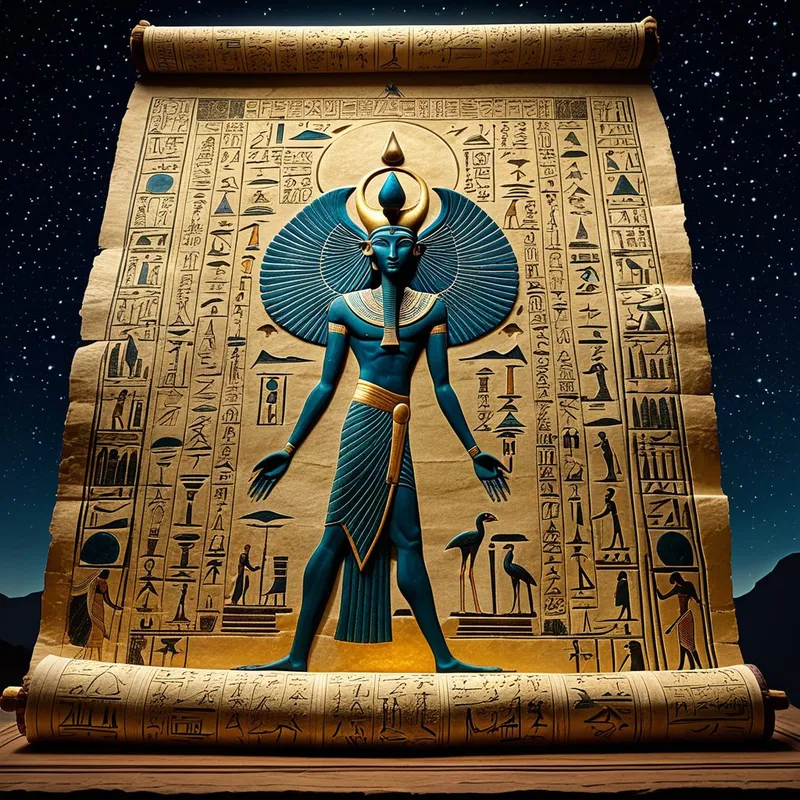
Book of Thoth Myth Meaning & Symbolism
A prince seeks the forbidden Book of Thoth, gaining divine power at the cost of his humanity, in a myth about the dangerous allure of ultimate knowledge.
The Tale of the Book of Thoth
Hear now a story whispered on the hot winds that blow from the western desert, a tale of a knowledge so profound it could unmake the world. It begins not with a king, but with a prince whose mind was a restless, hungry thing. Neferkaptah, son of Pharaoh, was the most learned man in the Two Lands. He had mastered every scroll in the House of Life, yet his soul thirsted for a draught from a deeper well.
In the silent hours, the scribes and priests spoke of a legend: the Book of Thoth. It was said the god of wisdom himself, Thoth, had penned its pages not with ink, but with the essence of creation. To read but a single spell was to command the sun and moon, to understand the speech of beasts and birds, and to see the gods in their true forms. But it was guarded. It lay in a series of nested boxes—of cedar, bronze, and iron—at the bottom of the Nile near Coptos, watched over by immortal serpents.
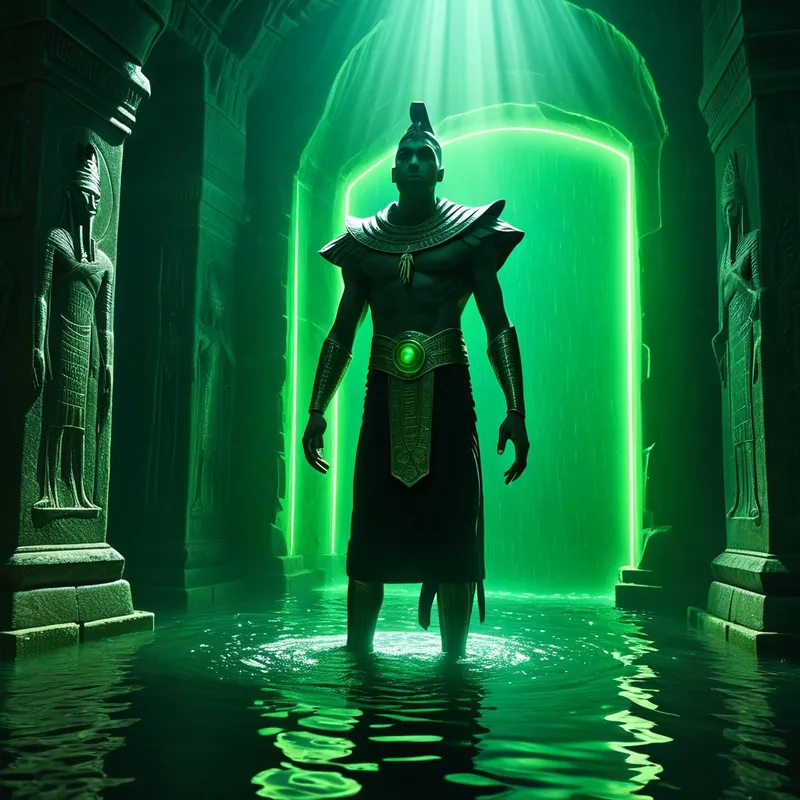
Driven by a fire that outshone reason, Neferkaptah journeyed to Coptos. For three days and nights, he performed rituals of purification. Then, with a heart of flint, he fashioned a magical barque of wax, crewed it with wax sailors, and spoke a charm that gave them life. He sailed this phantom vessel to the sacred mid-point of the river. There, he cast powdered sand into the waters, parting them like a curtain. He descended into the revealed riverbed, past the coiling, sleeping serpents, and found the boxes. The iron box hissed when he touched it, but he spoke the words to pacify it. He broke the seals. He opened the lid.
A light, not of this world, erupted from the Book of Thoth. He read a single page, and the knowledge flooded him—he understood the orbit of stars and the whispering of fish. He read another, and he felt the earth tremble at his unspoken command. He took the book and fled, sealing the river behind him. But as he celebrated his triumph, a great shadow fell upon his heart. His young son, playing on the riverbank, was pulled into the depths by an unseen force and drowned. Then his beloved wife, in her grief, took her own life. Neferkaptah, clutching the book that granted power over life and death, could not save them. He buried his family with royal honors, and in his final act, had the Book of Thoth buried with him, its terrible light extinguished within his tomb, a final, lonely guardian of a knowledge too heavy for any mortal to bear.
Cultural Origins & Context
This myth survives not in official king lists or temple inscriptions, but in a demotic papyrus from the Roman period, a story told for entertainment and moral instruction. It belongs to a late cycle of Egyptian narrative literature, where the magical and the moral intertwine. While set in a pharaonic past, its themes reflect a world where Egyptian identity was under pressure, and the nature of sacred, exclusive knowledge was a potent concern. It was likely recited by storytellers, a gripping tale of adventure that served as a profound caution. Its function was societal: to reinforce the idea that the cosmic order, Maat, could not be usurped without catastrophic consequence, and that some divine mysteries are meant to remain with the gods. It is a narrative firewall against the hubris of ultimate knowing.
Symbolic Architecture
The myth is a perfect symbolic engine of the psyche’s relationship with transpersonal knowledge. The Book of Thoth is not merely a spellbook; it is the archetype of the unintegrated Self, the totality of conscious and unconscious knowledge. It is wholeness in its raw, undigested form.
To seek the Book is to seek the source code of reality, but to possess it without the concomitant consciousness is to be possessed by it.
Neferkaptah represents the brilliant but naive ego, the part of us that believes it can comprehend and control the totality of the psyche through intellect and will alone. His journey—the magical boat, the parted waters—is a successful but premature descent into the unconscious. He retrieves the treasure, but he cannot "carry" it. The price, paid not by him directly but through the loss of his family (his connections to life, love, and future), symbolizes the alienation and sacrifice of human relatedness demanded by an ego inflated with divine knowledge. The serpents and the drowning are manifestations of the unconscious itself, which ultimately claims what is owed when balance is violated.
The Dreamer's Resonance
When this myth stirs in the modern dreamer, it often manifests as dreams of finding a powerful, forbidden object—a glowing device, a lost manuscript, a cryptic key. The dreamer feels exhilarated by the discovery but is soon pursued by ominous forces or witnesses the sudden collapse of their personal world. Somatic sensations might include a feeling of electric energy in the hands (touching the forbidden) followed by a chilling dread or profound grief in the chest.
Psychologically, this signals a critical phase where the conscious mind has accessed a deep layer of insight—perhaps through therapy, a spiritual practice, or a creative breakthrough—but has not yet developed the vessel to contain it. The psyche is sounding an alarm: the new knowledge is destabilizing the old structures of life. The dream is a compensatory image, showing that the pursuit of wisdom, if undertaken without humility and integration, can lead to a sterile, isolated citadel of the mind, cut off from the warm currents of human feeling and connection.

Alchemical Translation
The alchemical process mirrored here is the perilous stage of separatio and mortificatio. Neferkaptah successfully performs the separation—he extracts the precious prima materia (the Book) from the chaotic waters of the Nile (the unconscious). But he bypasses the essential, slow work of coniunctio, the marrying of this knowledge to the heart. The result is a psychological mortificatio—the death of his familial attachments, the very things that grounded him in the human world.
The individuation journey requires not just finding the gold, but suffering the transformation that allows one to become the vessel that can hold it without being shattered.
For the modern individual, the myth does not counsel against the quest for knowledge, but against the obsession with possession. The true alchemy begins after the Book is found. It involves the voluntary relinquishment of egoic control over that knowledge, allowing it to transform the seeker from within. The integrated Self is not a prince who owns the Book, but a sage who has been rewritten by it, who understands that the ultimate spell is the compassionate and responsible use of wisdom within the fragile, beautiful confines of a human life. The tomb where Neferkaptah rests with the Book is not just an end; it is the symbolic vas hermeticum, the sealed vessel where, in another telling, the long, slow work of true psychic transmutation might finally begin.
Associated Symbols
Explore related symbols from the CaleaDream lexicon: