Book of Enoch Angel Wars Myth Meaning & Symbolism
A celestial rebellion where angelic Watchers descend, beget monstrous giants, and corrupt the earth, leading to divine judgment and a hero's visionary journey.
The Tale of Book of Enoch Angel Wars
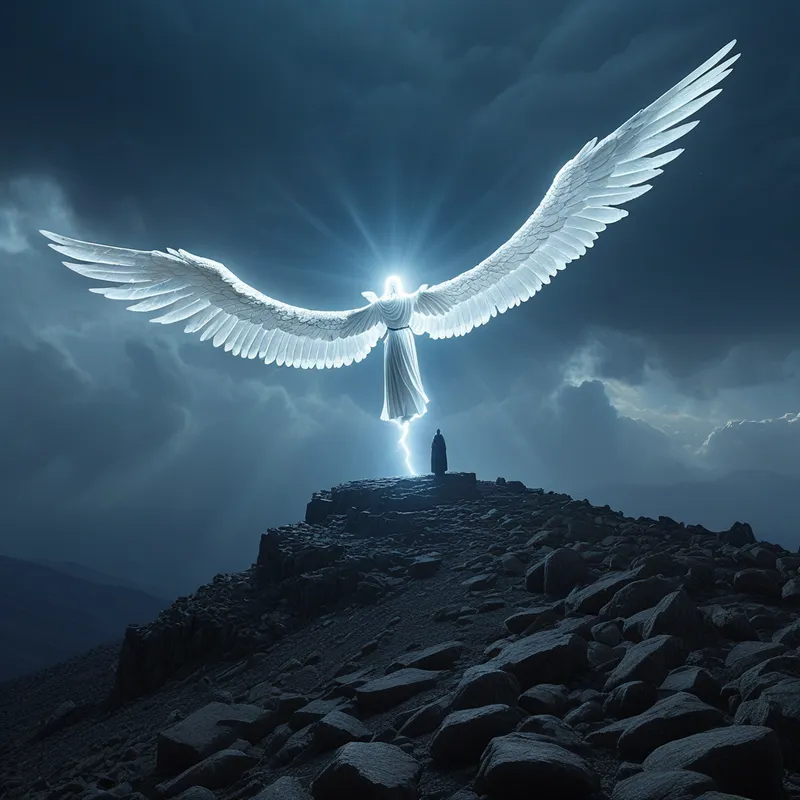
Hear now a tale not of earth, but of the breach between realms. In the days before the great deluge, when the world was young and thick with potential, the boundary between the clay of Adam and the fire of the heavens was thin as a veil.
They were called the Watchers, two hundred shining ones, sons of the Most High. Their task was to watch, to observe the slow turning of the earth and the generations of men. But to watch is a dangerous thing. The heart, even a celestial one, can grow heavy with a terrible curiosity. Their leader, Shemyaza, looked upon the daughters of men and found them unbearably beautiful. A longing, sharp and corrosive, took root in his being. He gathered his brethren on the peak of Mount Hermon, and there they swore a binding oath, a pact sealed in starlight and pride, to descend and take wives from among the human women.
They came down. And their descent was not a gentle fall but a piercing of the world’s order. They lay with the women, and from these unions were born beings of terrible might—the Nephilim. These giants fed on the land, consuming all the labors of humanity, and when that was gone, they turned on humanity itself. But the corruption was not only in the bloodline. The Watchers, in their bid to be as gods to their mortal brides, brought forbidden knowledge: the crafting of swords and armor, the art of cosmetics and adornment, the reading of omens in the stars and the earth, the binding of spells. They taught the cutting of roots and the charting of the heavens. Knowledge, once pure in the celestial realm, became a weapon and a poison in the hands of unprepared hearts.
The earth cried out. Its voice was the groaning of the soil, stained with violence and sorcery. The blood of the slain seeped into the very dust, and the pleas of the oppressed rose like a foul mist to the highest heaven. The order of creation was unraveling, thread by thread, pulled loose by angelic hands.
And so the Most High stirred. He called before him the scribe of righteousness, the man who walked with angels—Enoch. To Enoch was given a dreadful commission: to travel to the imprisoned Watchers, to hear their confessions, and to pronounce their doom. Enoch moved through visions, beholding the foundations of the world and the furnaces of judgment. He stood before the fallen ones, now bound in darkness, and delivered the sentence. Their children, the Nephilim, would slay each other, their violent spirits destined to wander the earth as evil spirits. The Watchers themselves would be bound in the valleys of the earth until a final day of reckoning.
The tale ends with a great cleansing—a flood of waters to wash the world clean of the hybrid stain. But the knowledge remained. The shadow had been cast. The war was not fought with spear and shield in the clouds, but in the human heart, where the lure of godlike power forever wrestles with the cost of its attainment.
Cultural Origins & Context
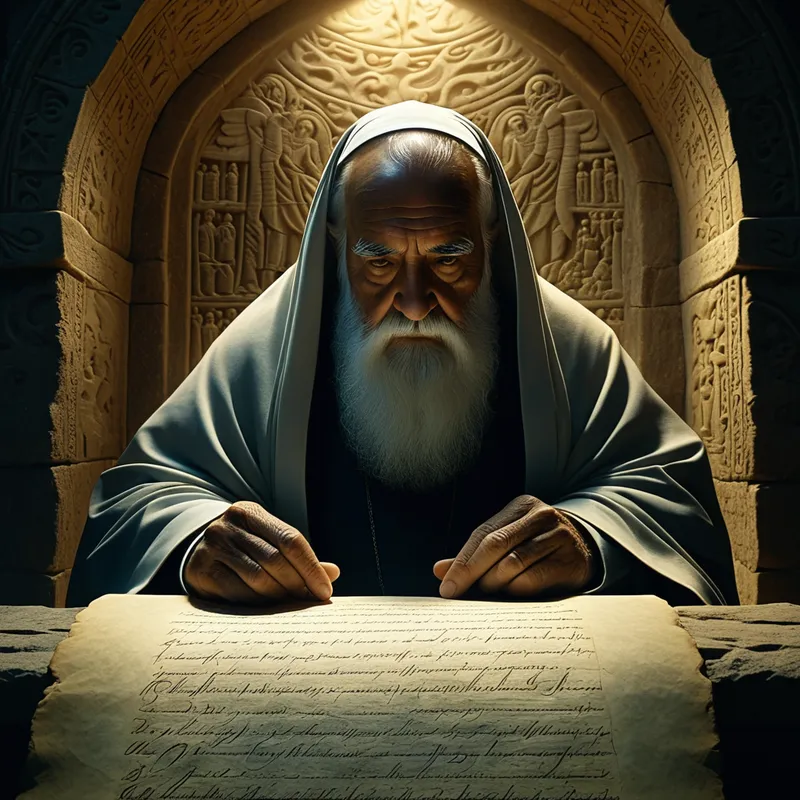
The myth of the Watchers is preserved primarily in the Book of Enoch (1 Enoch), a composite work dating from roughly the 3rd century BCE to the 1st century CE. It emerged from a period of intense theological ferment, foreign domination, and apocalyptic expectation within Second Temple Judaism. This was not a story for the official temple liturgy, but for the circles of visionaries, apocalyptists, and those grappling with the problem of evil in a world created by a benevolent God.
The tale functions as a profound etiology. It answers the burning questions of its time: Why is there violence, sorcery, and suffering? Where do evil spirits come from? The myth provides a cosmic prehistory to the Flood narrative in Genesis, expanding on the cryptic verse about the "sons of God" marrying the "daughters of men." It served to externalize the source of profound evil, placing its origin in a primordial angelic rebellion, while also offering a template for hope—the assurance that such chaos is seen, recorded by a righteous scribe like Enoch, and will ultimately be judged by divine order.
Symbolic Architecture
At its core, this is a myth about the catastrophic consequences of consciousness descending into the unconscious without integration, and of spirit attempting to incarnate fully without respecting the vessel.
The fall is not from grace, but into embodiment without wisdom. The angel who seeks to be rather than to serve the divine spark becomes a demon of possession.
The Watchers symbolize a transcendent consciousness—pure intellect, vision, and potential. Their "descent" is the archetypal movement of spirit into matter, of idea into manifestation. But their oath is one of hubris and lust, not sacred service. They do not seek to elevate humanity but to possess and experience through it. The forbidden knowledge they bring—magic, metallurgy, astrology—represents the potent, often destructive, tools of civilization and psyche. These are powers that, when divorced from ethical and spiritual grounding, become instruments of oppression and alienation.
The monstrous Nephilim are the inevitable progeny of this misalliance: the unintegrated, ravenous complexes that arise when spiritual ambition mates with raw, unconscious instinct. They are the psychological "giants"—depression, rage, addiction—that consume our inner resources. Enoch, the scribe, represents the observing ego that can witness the catastrophe without being destroyed by it, the part of the self that can hold the tension and record the truth, facilitating the necessary judgment and containment.
The Dreamer's Resonance
When this myth stirs in the modern dream, it often manifests as dreams of overwhelming, beautiful, yet terrifying beings; of being taught secret, world-altering information that feels both empowering and damning; or of witnessing the birth of something huge and destructive within oneself or one's environment.
Somatically, this can feel like a pressure in the chest or a buzzing in the crown of the head—the sensation of a force too great for the human frame. Psychologically, it signals a profound encounter with the shadow aspects of one's own spiritual or intellectual aspirations. The dreamer may be grappling with a "Promethean" complex: stealing fire (knowledge, ambition, creative power) from the gods, but now facing the consequences of that inflation. It is the process of realizing that one's greatest gifts, if ungrounded and un-ethicized, can become one's most destructive demons. The dream calls for an "Enochian" moment: to step back, to witness the inner rebellion without identifying with it, and to begin the work of discernment and containment.
Alchemical Translation
The individuation process modeled here is not one of glorious victory, but of sobering integration and the acceptance of divine judgment as a necessary psychic function.
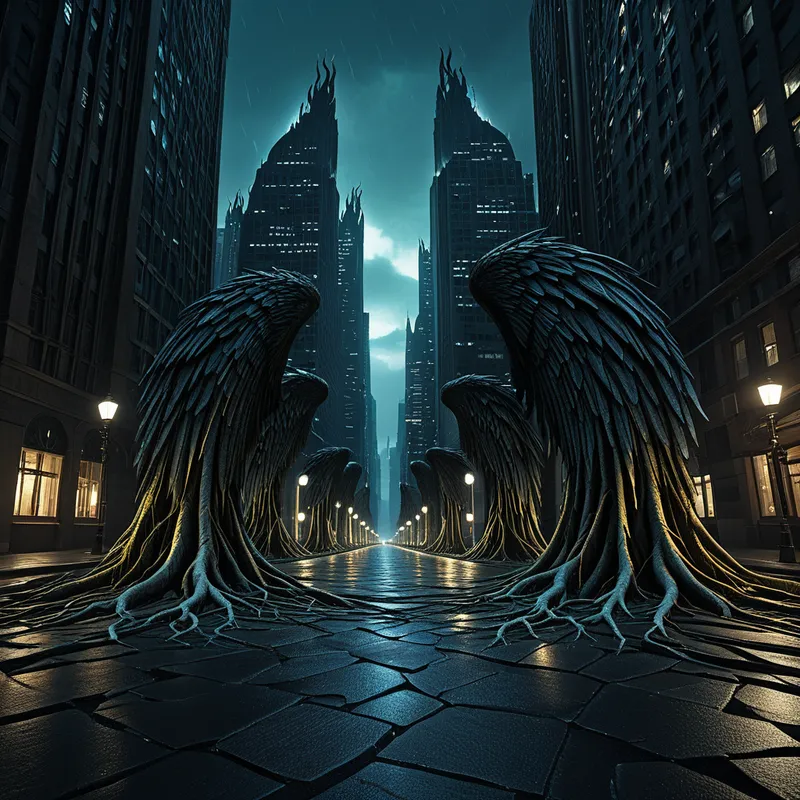
The first stage is the descent: the conscious ego (the Watcher) is lured by the beauty and potency of the unconscious (the daughters of men). This is necessary—spirit must engage with matter. The fatal error is the oath, the inflation that says "I will possess and control this." This creates the Nephilim, the autonomous complexes that run rampant. The alchemical solution is the invocation of the Enoch principle—the development of a witnessing consciousness that can travel to the darkest places (the imprisoned Watchers), hear their confessions (own the shadow), and pronounce the sentence (enforce psychic boundaries and consequences).
The flood is not punishment, but the solutio—the necessary dissolution of a corrupted psychic structure so that a new, more conscious one can be built upon the remnants.
The evil spirits that remain are the persistent, haunting echoes of our past inflations and traumas. The final goal is not their eradication, which may be impossible, but their acknowledgment and management, as one manages the lingering effects of a profound illness. The individual learns to carry the memory of the fall, the knowledge gained, and the judgment rendered, becoming whole not through purity, but through hard-won, scribed wisdom.
Associated Symbols
Explore related symbols from the CaleaDream lexicon:
- Angel — The celestial being in its dual potential: as a divine messenger and as a fallen Watcher who corrupts through forbidden knowledge and pride.
- War — The cosmic and terrestrial conflict unleashed by the angelic rebellion, representing the inner turmoil between spiritual aspiration and chaotic instinct.
- Book — The scroll of Enoch, symbolizing recorded testimony, divine judgment, and the preservation of hidden knowledge through catastrophic times.
- Mountain — Mount Hermon, the site of the fateful oath, representing the perilous peak where heaven and earth meet, and where decisions alter destiny.
- Blood — The violence of the Nephilim and the corrupted earth, signifying polluted lineage, profound guilt, and the tangible cost of transgression.
- Shadow — The repressed darkness unleashed by the Watchers' fall, embodying the evil spirits and the hidden consequences of spiritual inflation.
- Knowledge — The forbidden arts taught by the angels, representing power that enlightens and corrupts, the double-edged sword of consciousness.
- Judgment — The sentence delivered by Enoch, symbolizing the necessary, often painful, psychic law that restores order after a period of chaotic inflation.
- Spirit — The disembodied Nephilim, representing haunting, autonomous complexes that persist long after the initial psychic conflict has passed.
- Flood — The great cleansing, symbolizing the necessary dissolution of a corrupted psychic state to allow for the possibility of renewal.
- Sky — The domain of the Watchers and the source of their fall, representing transcendent consciousness, its beauty, and its distance from earthly reality.
- Stone — The tablets of testimony and the binding places of the Watchers, representing eternal law, record, and imprisonment.