Bodhi Tree Enlightenment Myth Meaning & Symbolism
A prince sits beneath a sacred fig tree, vowing not to rise until he pierces the root of all suffering, confronting the armies of his own mind.
The Tale of Bodhi Tree Enlightenment
Hear now the tale of the great unmoving, the night when [the world](/myths/the-world “Myth from Tarot culture.”/) turned on an axis of silence.
The prince was gone. [The ascetic](/myths/the-ascetic “Myth from Christian culture.”/) was spent. A man named [Siddhartha Gautama](/myths/siddhartha-gautama “Myth from Buddhist culture.”/), skin stretched over bone from years of fierce denial, walked to the banks of the Nairañjanā River. He bathed. A village woman named Sujātā saw not a wasted hermit, but a being of luminous potential. She offered a bowl of rich milk-rice, and he accepted, his body remembering the pact of flesh necessary to hold the coming light.
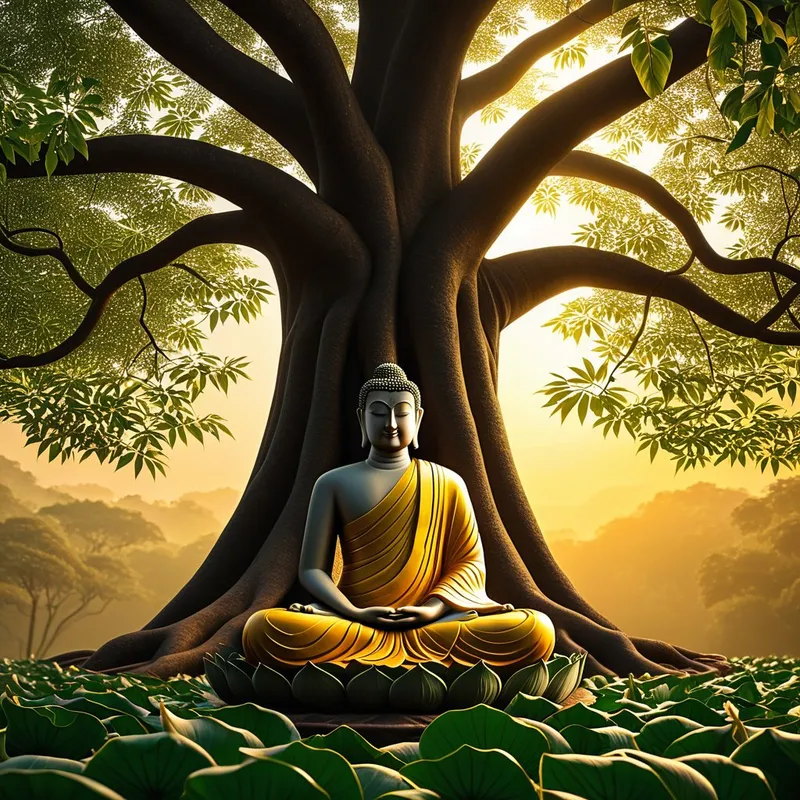
With strength returning, he walked to a grove near the village of Uruvelā. There stood a mighty Aśvattha, its heart-shaped leaves whispering in the breeze. He gathered kusha grass, fashioned a seat at the tree’s base, and sat facing east. He made a vow that shook the foundations of the cosmos: “Though only my skin, sinews, and bones remain, and my blood and flesh dry up and wither away, I will not stir from this seat until I have attained the supreme and final wisdom.”
[The earth](/myths/the-earth “Myth from Hindu culture.”/) trembled in acknowledgment.
Then came Māra, the lord of illusion, the keeper of the wheel of [death](/myths/death “Myth from Tarot culture.”/) and desire. He saw the threat to his dominion—a man seeking an escape from the cycle he governed. First, Māra sent his army: a horde of monstrous shapes, howling demons of fear, lust, doubt, and aggression. They hurled flaming rocks, loosed torrents of blood, and shrieked with the voices of a thousand sorrows. Siddhartha did not flinch. His mindfulness was an impenetrable shield; the weapons fell at his feet as flowers.
Enraged, Māra unleashed his daughters, Taṇhā, Arati, and Rāga—Discontent, Delight, and Desire. They transformed into visions of exquisite beauty, dancing, singing, promising every worldly pleasure. Siddhartha saw them as they were: transient, hollow, bound to decay. His gaze did not waver; the illusions dissolved like mist in sunlight.
Finally, Māra himself stood before the seated figure, colossal and terrible. “Who bears witness to your right to sit upon this seat of awakening?” he thundered, claiming the throne of enlightenment for himself. In response, Siddhartha reached down with his right hand and touched the earth. “This solid earth,” he said, calm as deep ocean, “is my witness.”
The earth goddess, Bhūmidevī, emerged, wringing from her hair a torrent of [water](/myths/water “Myth from Chinese culture.”/) that swelled into a flood, washing away Māra and his legions. Defeated, they vanished.
Alone beneath the tree, Siddhartha turned his attention inward, through the watches of the night. He saw with utter clarity the endless chain of his own past lives, [the law](/myths/the-law “Myth from Biblical culture.”/) of [karma](/myths/karma “Myth from Hindu culture.”/), and the arising and ceasing of all suffering. He pierced the twelve links of Paṭiccasamuppāda. As [the morning star](/myths/the-morning-star “Myth from Astrological culture.”/) glittered in the pre-dawn sky, his mind shattered the final veil of ignorance. He was awake. [The Bodhi Tree](/myths/the-bodhi-tree “Myth from Buddhist culture.”/), the Tree of Awakening, had borne its ultimate fruit. The [Buddha](/myths/buddha “Myth from Buddhist culture.”/) had come into the world.

Cultural Origins & Context
This is not a legend from a forgotten age, but the foundational narrative of a tradition that would shape continents. The story of the enlightenment under the [Bodhi Tree](/myths/bodhi-tree “Myth from Buddhist culture.”/) is the axial event of Buddhism, first preserved and transmitted orally by the Saṅgha for centuries after [the Buddha](/myths/the-buddha “Myth from Buddhist culture.”/)‘s Parinibbāna. It was codified in texts like the Mahāvagga of the Vinaya Piṭaka and the Sutta Piṭaka.
Its primary function was paradigmatic. For monastics and lay followers alike, the tale was not mere history; it was a map and a proof of concept. It established the [Bodhi](/myths/bodhi “Myth from Buddhist culture.”/) Tree as the [axis mundi](/myths/axis-mundi “Myth from Various culture.”/), the world center where the human and the transcendent intersect. The detailed confrontation with Māra served a crucial pedagogical purpose: enlightenment is not a passive reception of grace, but an active, fierce battle against the deepest conditioning of the [psyche](/myths/psyche “Myth from Greek culture.”/). The story was told to inspire perseverance (viriya) and to validate the path of mindfulness and insight as one that leads to a victory not over others, but over the inner causes of suffering itself.
Symbolic Architecture
The myth is a perfect symbolic [drama](/symbols/drama “Symbol: Drama signifies narratives, emotional expression, and the exploration of human experiences.”/) of the psyche’s [journey](/symbols/journey “Symbol: A journey in dreams typically signifies adventure, growth, or a significant life transition.”/) from identification to liberation.
The [Bodhi Tree](/symbols/bodhi-tree “Symbol: The sacred fig tree under which Siddhartha Gautama attained enlightenment, symbolizing awakening, wisdom, and the interconnectedness of all life.”/) is the archetypal [Axis](/symbols/axis “Symbol: A central line or principle around which things revolve, representing stability, orientation, and the fundamental structure of reality or consciousness.”/) Mundi. It represents the individual’s own nervous [system](/symbols/system “Symbol: A system represents structure, organization, and interrelated components functioning together, often reflecting personal or social order.”/), their [spine](/symbols/spine “Symbol: The spine symbolizes strength, support, and the foundational structure of one’s life and identity.”/), their central channel of [consciousness](/symbols/consciousness “Symbol: Consciousness represents the state of awareness and perception, encompassing thoughts, feelings, and experiences.”/), rooted in the earthly [reality](/symbols/reality “Symbol: Reality signifies the state of existence and perception, often reflecting one’s understanding of truth and life experiences.”/) of the [body](/symbols/body “Symbol: The body in dreams often symbolizes the dreamer’s self-identity, personal health, and the relationship they have with their physical existence.”/) (the touch of the [earth](/symbols/earth “Symbol: The symbol of Earth often represents grounding, stability, and the physical realm, embodying a connection to nature and the innate support it provides.”/)) and branching into the heavens of transcendent understanding. It is the still point around which the storm of transformation rages.
Māra is not an external devil, but the personification of the entire conditioned self—[the ego](/myths/the-ego “Myth from Jungian culture.”/) in its most desperate, defensive totality. He is the sum of all our attachments (taṇhā), aversions, fears, and doubts. His armies are the neurotic contents of the unconscious, his daughters the seductive lures of the [persona](/symbols/persona “Symbol: The social mask or outward identity one presents to the world, often concealing the true self.”/). The battle is entirely internal; it is [the self](/myths/the-self “Myth from Jungian culture.”/) at war with its own illusion of self.
The final temptation is not pleasure, but authority. Māra’s question, “Who is your witness?” is the ego’s ultimate challenge: “By what authority do you seek to transcend me?” The earth-touching gesture (Bhūmisparśa Mudrā) is the profound answer: not by the authority of gods or scriptures, but by the authority of reality itself—the simple, undeniable truth of what is.
The [Grass](/symbols/grass “Symbol: Grass often symbolizes growth, renewal, and a connection to nature, representing both the fragility and resilience of life.”/) Seat signifies humility and [connection](/symbols/connection “Symbol: Connection symbolizes relationships, communication, and bonds among individuals.”/) to the immediate, natural world. The Morning Star that heralds awakening symbolizes the [dawn](/symbols/dawn “Symbol: The first light of day, symbolizing new beginnings, hope, and the transition from darkness to illumination.”/) of a consciousness that sees things as they truly are, unobscured by the projections of desire and fear.
The Dreamer’s Resonance
When this myth stirs in the modern dreamer, it signals a profound interior [crossroads](/myths/crossroads “Myth from Celtic culture.”/). To dream of sitting steadfast beneath a great tree while [chaos](/myths/chaos “Myth from Greek culture.”/) swirls is to experience the ego’s structure being challenged by a deeper call from the Self.
Somatically, this may manifest as a felt sense of “sitting with” intense emotion or physical discomfort without reacting—a literal embodiment of the meditation posture. Psychologically, the “armies of Māra” appear as dream figures of oppressive bosses, seductive ex-lovers, monstrous shapes, or haunting memories that threaten to overwhelm. The dreamer is not fighting these figures but enduring their presence. This is the psyche practicing equanimity (upekkhā).
Such a dream often precedes or accompanies a conscious commitment to therapy, meditation, or a life decision that requires breaking a deep-seated pattern. The dream-ego is rehearsing the non-identification necessary to see the pattern, not be the pattern. The victory in the dream is not one of annihilation, but of dissolution—the terrifying figures simply lose their power when the dreamer’s attention remains steady and grounded.
Alchemical Translation
The alchemical process mirrored here is the Individuation journey, where the base metal of the personal complex (the prince/ascetic caught in extremes) is transmuted into the gold of integrated consciousness (the Buddha).
The [Nigredo](/myths/nigredo “Myth from Alchemical culture.”/), the blackening, is Siddhartha’s asceticism—the confrontation with [the shadow](/myths/the-shadow “Myth from Jungian culture.”/) and the despair of futile effort. The offering from Sujātā represents the necessary conjunctio, the integration of the rejected feminine principle (nourishment, acceptance, the body), without which the work cannot proceed.
The [Albedo](/myths/albedo “Myth from Alchemical culture.”/), the whitening, is the purification under the tree. The confrontation with Māra is the intense scrutiny and separation of the psyche’s contents. Each demon, each daughter, is a complex to be recognized and dis-identified from: “This is fear, but I am not the fear. This is desire, but I am not the desire.”
The earth-touching moment is the pivotal rubedo, the reddening. It is the embodiment of insight, the moment the transcendent realization becomes immanent, grounded, and real. The philosopher’s stone is not found in the heavens, but in the dirt under one’s nails.
For the modern individual, the “[Bodhi Seat](/myths/bodhi-seat “Myth from Buddhist culture.”/)” is any committed container for self-observation—the therapist’s chair, the meditation cushion, the journal page. The vow “I will not rise until…” is the commitment to see a psychological process through to its end, no matter how uncomfortable. The enlightenment is not a supernatural event, but the moment when the narrative of a lifelong wound is seen through, when the cause of one’s suffering is understood not as a fate, but as a pattern with a cause, and thus, an end. One becomes, in that sphere of life, awake.
Associated Symbols
Explore related symbols from the CaleaDream lexicon: