Bluebeard's Forbidden Room Myth Meaning & Symbolism
A tale of a forbidden chamber, a bloody key, and the confrontation with a husband's monstrous past, revealing the price of forbidden knowledge.
The Tale of Bluebeard's Forbidden Room
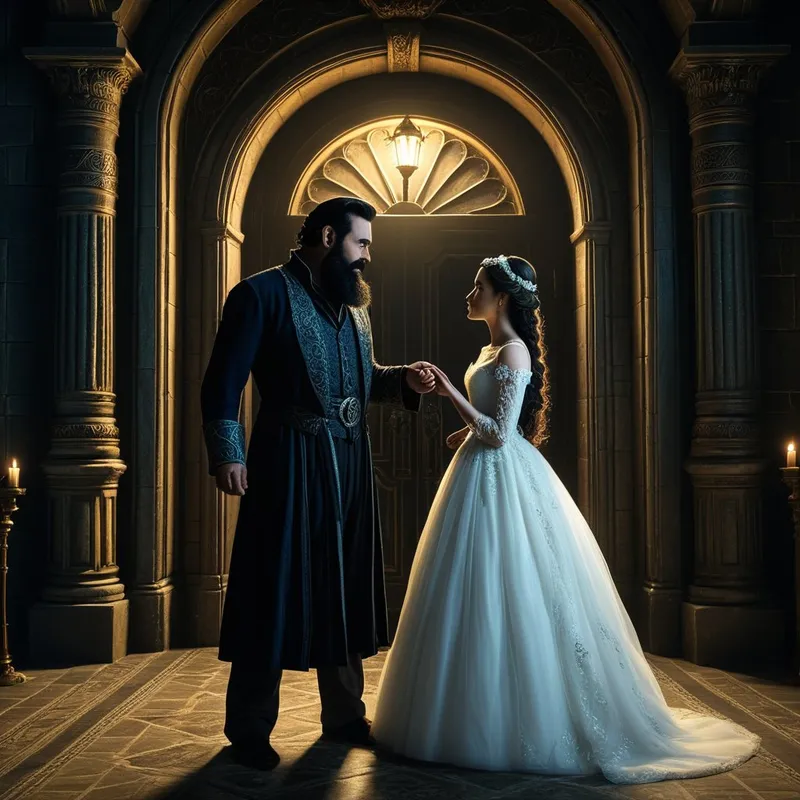
In a land of mist and ancient stone, there lived a lord of terrible wealth and terrible aspect. His name was forgotten, whispered only as Bluebeard, for the color of his beard was as deep and strange as a twilight shadow. His castle was a labyrinth of riches, filled with tapestries that whispered and gold that gleamed with a cold fire. He had taken many wives, and they had all vanished like morning dew.
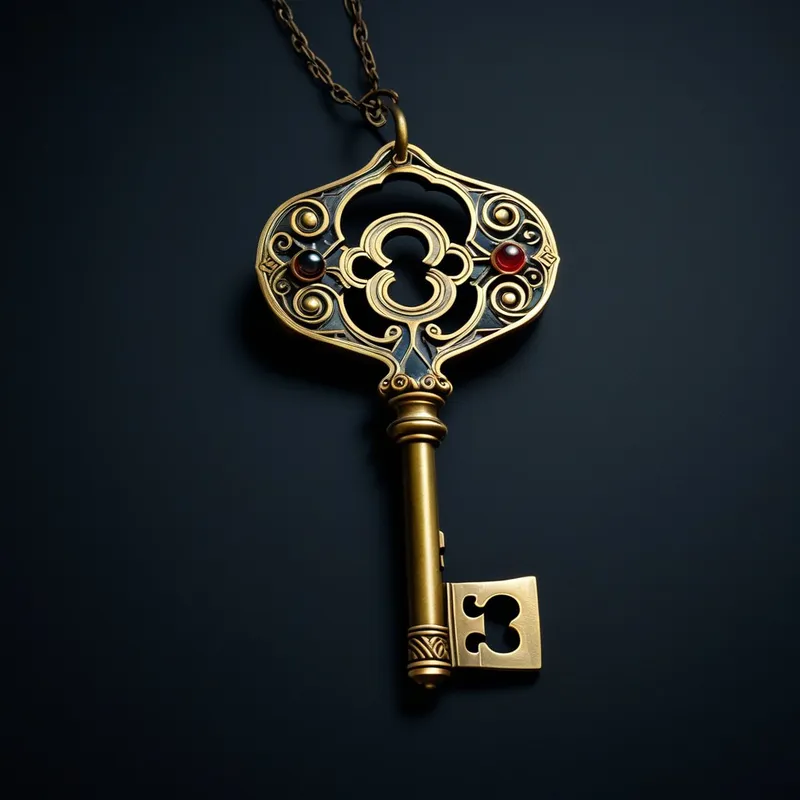
He came for a new bride, the youngest daughter of a neighboring family, drawn by his power and her family’s desperation. She saw the castle’s splendor, the feasts that lasted for days, the gardens that bloomed out of season. Yet, in the quiet moments, she felt a chill that no hearth could warm. Before departing on a journey, Bluebeard summoned her to a long, silent gallery. From a heavy ring, he selected a key, large and wrought of black iron, its bow an intricate cage.
“This,” he said, his voice echoing in the stillness, “opens every door to every treasure. Feast your eyes, command the servants, enjoy my kingdom.” Then he produced a second key, smaller, but of the same cold metal. “But this one,” he intoned, his eyes holding hers, “opens the small chamber at the end of the eastern corridor. That door you must not open. That curiosity you must forbid. Swear it to me.”
She swore. He left. The castle, for all its opulence, became a gilded cage of silence. The other keys unlocked wonders: chests of jewels, libraries of forbidden lore, halls of marble statues. But her mind was a moth, and the small key was a single, unwavering flame. The silence grew loud, a pressure in her ears. The forbidden corridor seemed to pull at her skirts as she passed.
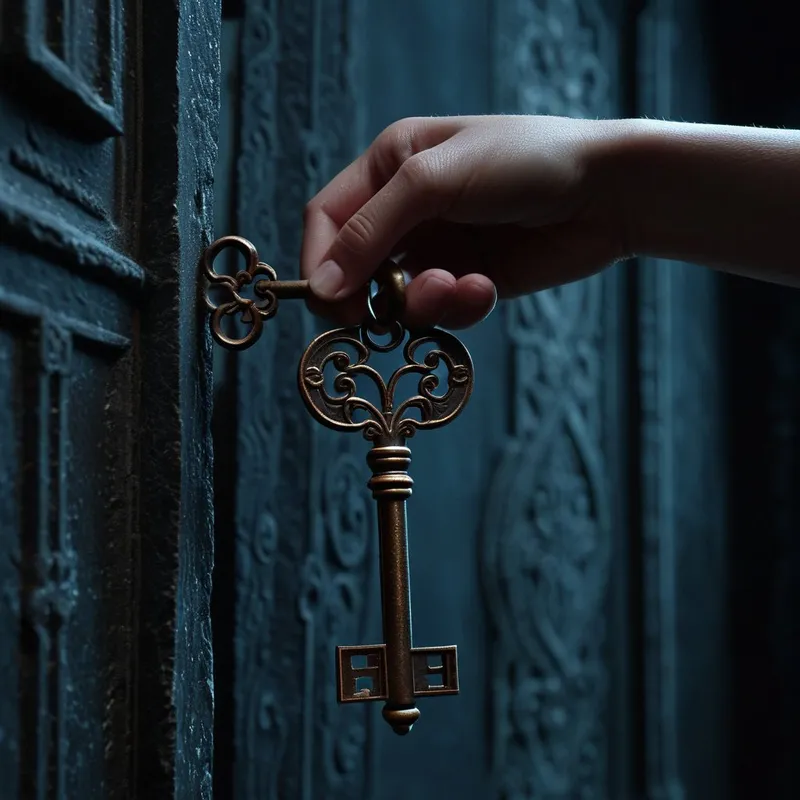
Finally, she could bear it no longer. She took the small key. It was colder than the others. The walk to the eastern corridor was a journey through a dream, each footfall echoing like a guilty heartbeat. The door was plain, oak banded with iron. The lock accepted the key with a soft, definitive click.
The door swung inward on darkness and a smell of cold stone and rust. Light from the corridor slithered in, revealing not treasure, but a scene of abomination. The floor was stained a deep, permanent crimson. Lined against the wall were the bodies of Bluebeard’s previous wives, suspended in a ghastly tableau. The horror was absolute, a truth so vile it stole the breath from her lungs. Stumbling back, she slammed the door, the key falling from her nerveless fingers. When she retrieved it, a single drop of blood marred its intricate bow. She scrubbed, she polished, she wept, but the stain was indelible—a permanent witness to her transgression.
Bluebeard returned. His first question was not of her health, but for the keys. When she handed him the ring, his finger closed around the small, stained key. “You have entered the chamber,” he stated, his voice devoid of anger, filled only with a terrible, final certainty. “You must now join its company.”
As he raised his sword, her brothers, summoned by her sister’s earlier signal, stormed the castle. In a clash of steel, they struck Bluebeard down. The bride, keeper of the terrible key and its bloody secret, inherited the castle, its wealth, and its silent, ghastly truth.
Cultural Origins & Context
The tale of Bluebeard exists in the liminal space between cautionary tale and foundational myth. Its most famous literary version was penned by Charles Perrault in 1697, but its roots are far older, echoing through pre-modern European folklore. It belongs not to the “once upon a time” of pure fantasy, but to a darker, more domestic stratum of story, often told to underscore real societal perils.
Its primary function was starkly pedagogical. In a culture where young women were passed from the authority of a father to that of a husband, the tale served as a grim lesson in wifely obedience. Curiosity—the desire for knowledge outside a husband’s grant—was framed as a fatal flaw. The bloody key was the inescapable evidence of disobedience, a symbol of a transgression that could not be hidden or undone. The story was told by firesides and in nurseries not just to entertain, but to instill a specific, fearful compliance. Yet, like all potent myths, its meaning overflowed its intended container. It also spoke to the profound anxiety surrounding the secret lives and pasts of powerful men, and the dangerous knowledge a woman might uncover if she dared to look.
Symbolic Architecture
At its core, Bluebeard’s castle is not a home, but a psychic edifice. Bluebeard himself is the personification of a certain kind of patriarchal consciousness: wealthy, powerful, charming in its outward display, but founded upon a hidden chamber of brutality and murder. He is not a monster in a distant cave; he is the lord of the manor, making the horror intimate and inescapable.
The forbidden room is the ultimate symbol of the shadow. It is the repository of everything the conscious persona—here, Bluebeard’s identity as a wealthy lord—wishes to deny, hide, and keep locked away: his violent history, his destroyed relationships (the former wives), his unintegrated brutality. The key represents the means of accessing this hidden truth. The bride’s curiosity is not mere disobedience; it is the inevitable pull of the unconscious toward wholeness, however terrible that wholeness may be.
The forbidden chamber is not empty; it is full. It contains the un-lived lives, the un-mourned deaths, and the truths that structure the castle of the self.
The indelible blood on the key is the critical symbol of integration. Once the shadow is witnessed, it cannot be unseen. The knowledge stains the knower permanently. The psyche is altered. The naive “bride” who entered the castle dies in that moment of witnessing, and a woman who carries a terrible knowledge is born in her place. The key, now stained, is no longer just an object; it is the embodied memory of the confrontation.
The Dreamer's Resonance
When this myth pattern erupts in modern dreams, it signals a profound psychological tipping point. The dreamer is not merely being “curious”; they are being compelled by the Self toward a necessary confrontation with a repressed complex.
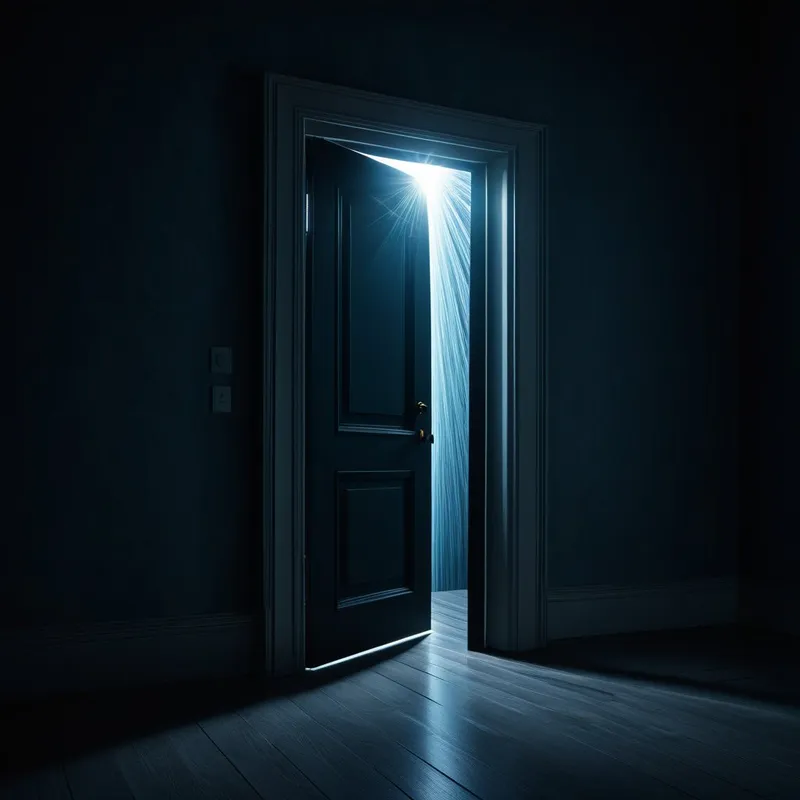
You may dream of a forbidden door in your own house you never knew existed, a locked closet, a basement stairwell that descends into darkness. The feeling is one of magnetic dread and irresistible pull. The Bluebeard’s Room in the dream is the living image of a personal shadow content: perhaps a buried trauma, a shameful memory, a denied aspect of your own capacity for cruelty or fear. The key might be a conversation you’re avoiding, a memory surfacing, or a sudden insight.
The somatic experience is key. Upon opening the door, the dreamer often wakes in a cold sweat, heart pounding—a literal confrontation with the shadow triggering a fight-or-flight response. The dream is the psyche’s way of staging the unveiling. The terror is not a warning to stop, but the inevitable shock of the encounter itself. If the dream recurs, it indicates the conscious mind is resisting the integration of what has already been seen by the unconscious. The blood is on the key; the process cannot be reversed.
Alchemical Translation
The myth of Bluebeard models the alchemical opus contra naturum—the work against nature, which in psychological terms is the work against the ego’s desire to remain innocent and unaware. The bride begins in the nigredo, the blackening: she is in the dark, both literally in the castle and metaphorically about her husband’s true nature. Her curiosity is the first stirring of the work.
The descent to the room and the witnessing of the horror is the solutio—a dissolution of her previous worldview in the bloody truth. This is not a failure, but the essential, painful breaking down of naive consciousness. The stained key is the coagulatio—the condensation of this experience into a permanent, tangible fact within her psyche. She is now “stained” with knowledge.
The triumph of the myth is not her rescue by her brothers, but her survival of the knowledge. She inherits the castle. This is the rubedo, the reddening, the final stage where the integrated self emerges.
To translate this for the modern individual: the Bluebeard complex appears when we are in a relationship with an aspect of our own life—a career, a self-image, a belief system—that is glittering on the surface but founded on a denied truth. The “journey” Bluebeard takes is the ego’s temporary absence, allowing the unconscious to press its claim. Opening the door is the act of courageous self-inquiry, however devastating. The indelible stain is the transformation of personality. We are no longer who we were before we knew. We inherit the entire castle—the wealth of our experience and the responsibility of our truth. The monster is slain not by avoiding his chamber, but by looking directly at what he has hidden, and in doing so, breaking his power to define reality from the shadows.
Associated Symbols
Explore related symbols from the CaleaDream lexicon: