
Black Tortoise Myth Meaning & Symbolism
A celestial guardian of the north, the Black Tortoise embodies winter's wisdom, enduring strength, and the alchemical union of serpent and shell.
The Tale of Black Tortoise
In the time before time, when the sky was a raw wound of stars and the earth a formless dream, the Four Cardinal Directions were not yet held. Chaos, a churning dragon of wind and dust, threatened to scatter the ten thousand things before they could find their names. From the primordial breath of the cosmos, four sacred beasts were given a sacred charge: to guard the pillars of the world.
To the cold, silent north, where the sun’s warmth is a memory and the night reigns long, was sent the spirit of endurance. It was not born of fire or flight, but of the deep, patient earth and the dark, flowing waters. It took a form of profound stillness: the Black Tortoise, known as Xuanwu.
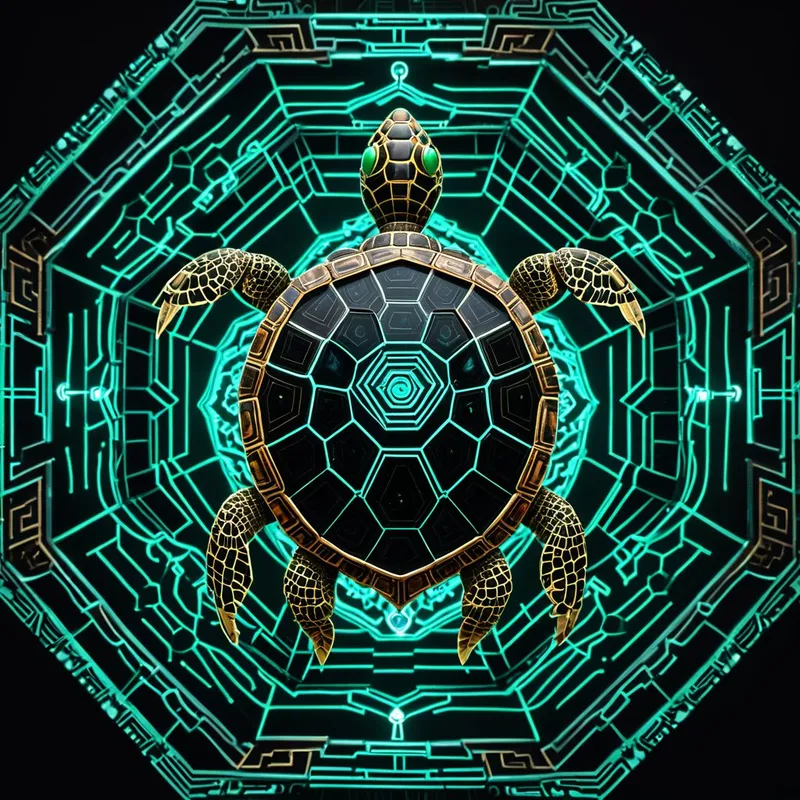
Picture him in that ancient winter. His shell is not mere bone, but a vault of the night sky itself, a carapace of polished obsidian in which the constellations of the northern heavens are forever fixed—a map of eternal order against the void. He moves not with haste, but with the geological certainty of continents adrift. Wrapped around him, in a perfect, eternal embrace, is a great serpent, its scales the color of deep river jade, its eyes holding the cold intelligence of abyssal currents. They are one creature, two natures fused: the tortoise, the unmoving mountain; the serpent, the coiling, knowing river.
His vigil was not one of battle cries, but of immense, silent bearing. While the Qinglong brought spring rains and the Zhuque summer’s fire, the Black Tortoise faced the howling winds of winter. He did not fight the cold; he became it. He absorbed the stillness, the retreat, the necessary death that precedes renewal. His domain was the hidden world: the seed sleeping under frost, the root gripping stone in the dark, the secret wisdom that grows only in silence and time.
Legends whisper that when the demonic spirits of chaos and flood rose from the northern wastes, they did not break upon his shell in clash and fury. Instead, they were ensnared by the serpent’s patient coil, drawn into the profound gravity of his stillness, and dissolved into the orderly patterns on his star-charted back. His triumph was not conquest, but integration. He held the line not by repelling the dark, but by containing it, transforming its chaotic potential into the structured promise of the coming spring. Thus, the north was secured, not by a wall, but by a sacred, living embodiment of endurance and deep, cyclical knowing.

Cultural Origins & Context
The myth of the Black Tortoise has its roots deep in China’s astrological and cosmological systems, evolving over millennia from simple animal totems to a complex Feng Shui and Taoist deity. Initially, the four celestial animals—the Azure Dragon, Vermilion Bird, White Tiger, and Black Tortoise—were asterisms, groups of stars used to mark the seasons and divide the heavens.
As Chinese philosophy matured, particularly with the development of concepts like Yin and Yang and the Wu Xing (Five Phases), the Black Tortoise’s symbolism crystallized. He became the guardian of the north, the direction associated with winter, the element of Water (representing depth, flow, and potential), and the color black (symbolizing the primordial, the mysterious, and the womb of creation). In Daoism, his veneration grew, and he was often worshipped as Zhenwu, a martial god who subdues demons not through brute force, but through supreme spiritual power and mastery over the watery, chaotic elements—a direct evolution from his mythic role as the stabilizer of the north.
His story was passed down not just by court astronomers and philosophers, but by geomancers, Daoist priests, and folk storytellers. For the common person, the Black Tortoise was a promise of protection for the northern wall of a home or city, a symbol that the hidden, difficult forces of life—winter, cold, retreat, the unknown—were not merely destructive, but were held within a greater, sacred order that guaranteed eventual renewal.
Symbolic Architecture
The Black Tortoise is not a symbol of action, but of being. Its power lies in its paradoxical nature, a union of opposites that creates an unshakable whole.
The shell is the conscious mind, the defined ego, and the laws of heaven. The serpent is the unconscious, the instinctive body, and the mysteries of earth. Only in their sacred marriage is the individual truly whole.
The Tortoise Shell represents structure, boundary, defense, and celestial order. It is the container, the skull that holds the brain, the home that shelters the soul, the ritual that gives shape to chaos. It is the wisdom of knowing one’s limits, of creating a sacred space for the inner work. The constellations etched upon it signify that personal order is a microcosm of cosmic order.
The Entwined Serpent symbolizes the primal, chthonic life force—the libido, the unconscious drives, the flowing, adaptive intelligence that cannot be fully contained or rationalized. It is the wisdom of the blood, the gut, and the deep, emotional currents. Its embrace with the tortoise shows that this raw power is not to be expelled or feared, but integrated, directed, and partnered with.
Together, they form the archetype of the Ultimate Container. Psychologically, this represents the ego’s capacity to healthily contain and relate to the contents of the unconscious, transforming chaotic impulses (the “northern demons”) into structured potential. It is the symbol of resilience, not as brittle hardness, but as flexible, rooted endurance. The Black Tortoise teaches that true strength is not found in relentless forward charge, but in the ability to withdraw, to consolidate, to “hibernate” with one’s inner serpent, and emerge with integrated power.
The Dreamer's Resonance
When the Black Tortoise emerges in the modern dreamscape, it often signals a profound somatic and psychological process of consolidation and boundary-forming. This is not the time for the dreamer’s inner hero or lover, but for their inner sage and protector.
You may dream of finding a massive, dark shell—in a forest, a basement, or a desert. Touching it feels cold and immensely solid. This somatic experience points to a psyche seeking, or building, necessary defenses. It may reflect a need for emotional or psychic shielding from external demands, a call to retreat and “go into one’s shell” for self-preservation and introspection.
Dreams of a serpent slowly coiling around you or a still object can feel terrifying or deeply calming. This is the unconscious life force making itself known, seeking connection with the conscious self. The body may register this as a tingling along the spine, a feeling of being held, or a primal fear. The psyche is negotiating the integration of instinctual drives—perhaps related to survival, creativity, or sexuality—into a more structured sense of self.
A dream of standing on a frozen landscape under a clear, starry sky, feeling a deep, quiet awe rather than fear of the cold, directly invokes the Black Tortoise’s domain. It signifies the dreamer entering a necessary “winter” phase: a period of emotional coolness, introspection, and hidden growth. The somatic sense is one of stillness, lowered metabolic rate (psychically and physically), and a focus on core, essential truths.
Alchemical Translation
The myth of the Black Tortoise provides a masterful model for the alchemical stage of individuation known as coagulatio—the making solid. This is the process following the dissolution (solutio) of old identities, where the psychic elements must be brought together and given enduring form.
The alchemical work is not to slay the dragon of chaos, but to invite the serpent to inscribe its wisdom upon the inner shield.
The modern individual, fragmented by the demands of life, often experiences a chaotic flood of thoughts, emotions, and roles—the “northern demons” of anxiety, overwhelm, and identity loss. The heroic impulse might be to fight this flood, to build a dam of sheer willpower. The Black Tortoise’s way is different.
First, one must withdraw to the north—to consciously enter a period of introspection, to turn away from the bright, social “south” and embrace the quiet, shadowy work. This is the creation of the “shell”: establishing rituals, boundaries, and a disciplined inner space for reflection.
Second, one must encounter the inner serpent. This is facing the coiled, instinctual self—the repressed emotions, the bodily wisdom, the shadow aspects. The task is not to let it run wild or to cut it off, but to engage with it, to feel its coils, to understand its nature.
Finally, the alchemical marriage: the serpent inscribes the shell. The insights from the unconscious (the serpent) become integrated into the structure of the conscious personality (the shell). What was chaotic impulse becomes embodied wisdom; what was raw fear becomes grounded resilience. The individual no longer feels attacked by their own depths, but supported by them. They achieve the Black Tortoise’s power: an endurance that is dynamic, a wisdom that is both celestial and chthonic, a self that is a sacred, contained universe, capable of facing any winter.
Associated Symbols
Explore related symbols from the CaleaDream lexicon: