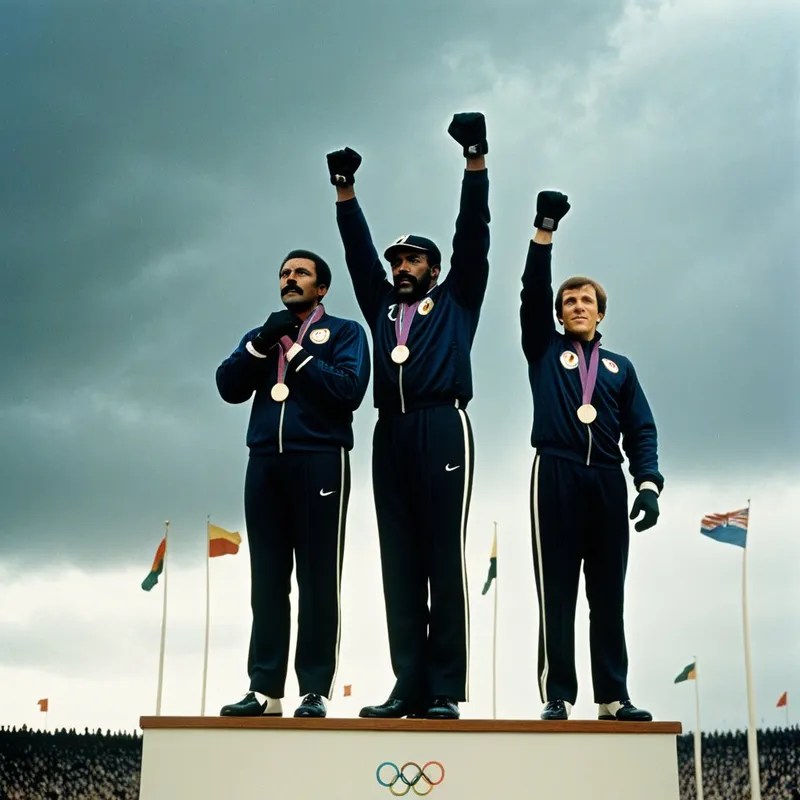
Black Power Salute Myth Meaning & Symbolism
A myth of two athletes who, on a global altar, raised a fist against a silent sky, transforming a gesture into an eternal declaration of being.
The Tale of Black Power Salute
The air in the Coliseum of the Sun was thick, not with the usual sweat of competition, but with a heavier, more ancient tension. It was the hour of crowning, where victors are anointed with gold, silver, and bronze—metals mined from the earth’s own bones. Two warriors, Tommie and John, stood upon the third tier of the sacred dais. They wore the skins of their nation, but their souls were tuned to a different, deeper frequency.
As the first notes of their homeland’s anthem began to coil through the speakers, a hush fell—not of reverence, but of a collective, instinctual sensing. The world watched, a billion eyes focused on that raised stone platform. Then, they moved.
In perfect, slow-motion unison, they bowed their heads as if in prayer to a different god. From their sides, they drew not weapons, but their own hands, sheathed in the skin of the night. They raised them. Fists, clenched tight as hearts, punched a hole in the silent sky. The gloves were black. Their socks were black, a declaration of shared poverty. The beads around their necks whispered of lynching trees. On the chest of one, a scarf the color of dignity; on the other, a jacket unzipped to the truth.
For those twenty-seven seconds, time stopped. The anthem played to an altar of defiance. The silver and bronze medals hung not as prizes, but as ironic, gleaming weights. The roar of the crowd was absent, replaced by a vacuum of shock, a soundless scream that echoed in the marrow of history. They did not speak. The gesture was the word. The fist was the sentence. And in that suspended moment, a new myth was forged in the furnace of global witness—not of conquest in a race, but of a stand against the very architecture of the world.
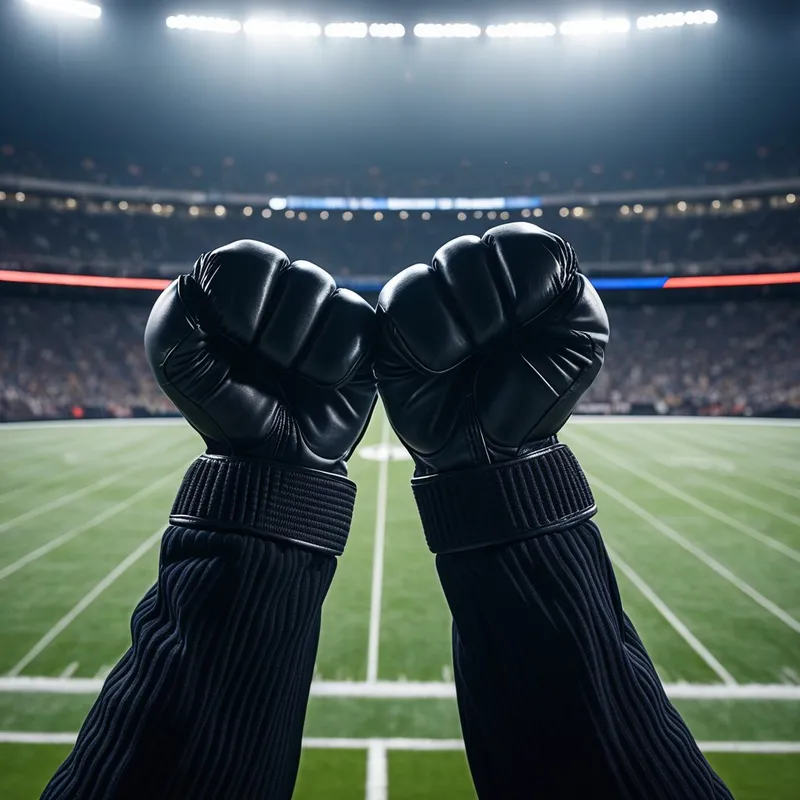
Cultural Origins & Context
This is not an ancient myth passed down on papyrus, but a modern one, born in the full glare of the twentieth century’s electronic eye. Its setting is the 1968 Olympiad, a stage designed for narratives of national triumph and human unity. Its tellers were not bards, but broadcasters, photographers, and journalists, whose images and reports seared the event into the global consciousness. The figures, Tommie Smith and John Carlos, were real men, athletes of supreme discipline, who chose this most consecrated arena of sport to perform a sacred, political ritual.
The myth was incubated in the cauldron of the American Civil Rights era and the burgeoning global Pan-African consciousness. It was given form by the Olympic Project for Human Rights. Its societal function was immediate and dual: it was a devastating critique, holding a mirror to the unfulfilled promises of the nation they represented; and it was a powerful act of creation, conjuring into being a new, undeniable symbol of collective identity, pride, and demand. Passed down through documentaries, history books, murals, and endless digital reproduction, it functions as a foundational pillar in the modern mythology of peaceful, dignified resistance.
Symbolic Architecture
The myth’s power is an alchemy of potent symbols compressed into a single, silent gesture. The raised fist is its central glyph, an archetype older than Rome. It is the fist of the worker, the rebel, the solidarity of the collective. Here, sheathed in black, it becomes specifically the fist of Black Power—not a threat of violence, but a declaration of latent strength, of a will no longer bowed.
The bowed head does not signify submission, but a turning of the gaze inward to the source of power, and downward in remembrance of those whose backs bore the weight of history.
The Olympic podium, a site of apotheosis for the individual, is subverted into a world altar for a communal sacrifice. Smith and Carlos offered their moment of personal glory, their medals, and their careers as libations to a cause greater than themselves. The black socks symbolized Black poverty, the beads acknowledged racial terror, and the unzipped jacket stood in for the blue-collar worker. Every detail was a deliberate rune in a spell of truth-telling. Together, they transformed a celebration of human physical achievement into a profound meditation on human dignity.
The Dreamer's Resonance
When this myth surfaces in the modern dreamscape, it rarely appears as a historical replay. Instead, the dreamer may find themselves on a stage of their own making—a corporate meeting, a family gathering, a public square—compelled to raise a hand or voice in a way that feels both terrifying and utterly necessary. The somatic feeling is often one of electric tension in the arm and chest, a clenched jaw, a heart pounding against the ribs like a fist against a door.
Psychologically, this dream signals a critical moment of integrating the Shadow with the Persona. The dreamer’s "Olympic podium" represents their hard-won social standing or acceptance. The act of raising the "fist"—which could be an unpopular opinion, a hidden vulnerability, or a repressed identity—is the Self demanding that this accepted persona bear the weight of the whole, authentic truth. It is the psyche’s rebellion against its own internalized oppression, a declaration that to be truly honored, one must first be fully seen.
Alchemical Translation
The alchemical journey modeled here is the transmutation of silent suffering into sacred symbol. The prima materia is the raw, often inarticulate pain of injustice, otherness, or alienation. The nigredo, the blackening, is the conscious recognition and bearing of this darkness—represented by the black gloves, socks, and beads.
The podium moment is the albedo, the whitening, where this dark material is brought into the searing light of conscious awareness and public witness. The heat of global scrutiny and condemnation is the furnace.
The true gold forged is not a medal, but an integrated Self. It is the individual who can stand, exposed and authentic, at the intersection of personal achievement and collective truth, and declare, "I am this, too."
The final stage, the rubedo or reddening, is the enduring legacy. The athletes were cast out from the official narrative, their medals tarnished in the eyes of the powers that were. But in the soul of the world, their gesture was purified into an eternal symbol. For the modern individual undergoing individuation, this myth teaches that psychic wholeness often requires a sacred rebellion—a willing sacrifice of comfortable, partial recognition for the difficult, complete truth of one’s being. The power saluted is, ultimately, the power of the Self, reclaimed and raised high against the inner sky of one’s own conscience.
Associated Symbols
Explore related symbols from the CaleaDream lexicon: