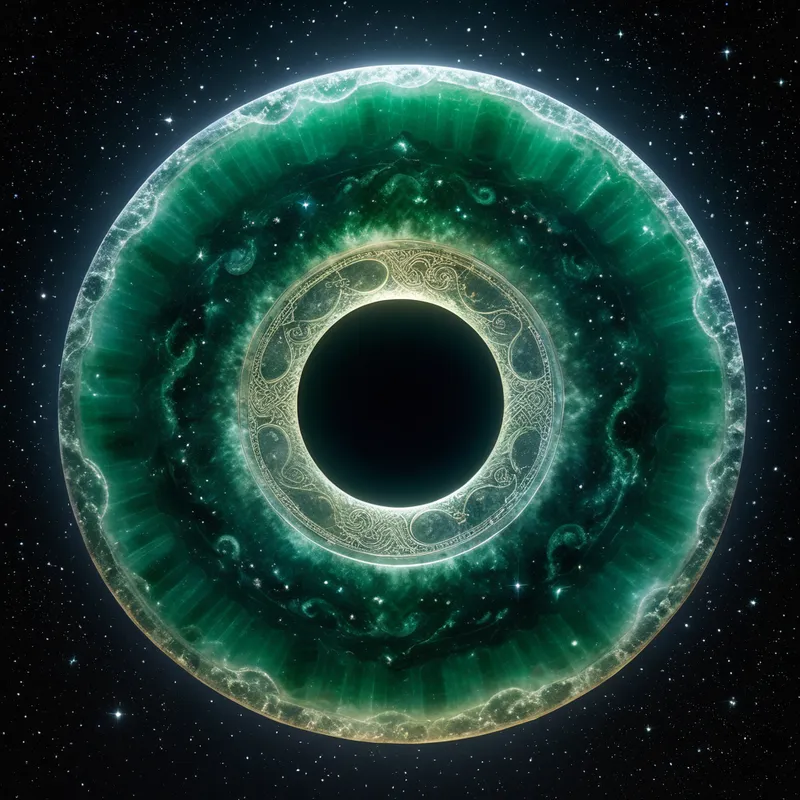
Bi Discs Myth Meaning & Symbolism
A myth of celestial jade discs forged from cosmic chaos, representing the eternal quest for wholeness and the sacred pattern within the self.
The Tale of Bi Discs
Before the ten thousand things had names, there was only the Hundun—a swirling, breathless egg of mist and potential. Within its formless embrace, the Yu Huang stirred, and with his awakening came a desire. Not for dominion, but for a pattern. A sacred geometry to hold the chaos and give it a heartbeat.
He called upon the Gong Gong, not the tempestuous rebel of later tales, but the divine artisan in his first, purest aspect. "Shape for me a symbol," intoned the Emperor, his voice the sound of stars cooling. "Let it hold the Dao within its curve. Let its center be a gateway, and its circumference, the boundary of all that is and will be."
Gong Gong descended to the still-cooling crust of the young earth, to a mountain whose peak pierced the lowest heavens. There, he found the substance of his craft: not common stone, but the congealed essence of the sky itself—Yu, celestial jade. It was cold to the touch, yet thrummed with a captive light. For nine cycles of the sun and moon, he did not strike it. He listened. He felt the chaotic dance of energies trapped within its green depths—the clashing of Yang and the yielding of Yin, the memory of thunder and the patience of deep earth.
His tools were not hammer and chisel, but his own focused will and the abrasive kiss of quartz sand and water. He began to turn the raw block, grinding against the primal grain, feeling for the perfect circle that was already there, waiting to be revealed. The conflict was immense. The jade resisted, not with malice, but with the inertia of primordial formlessness. Sparks of rebellious energy, echoes of the Hundun, would flare and threaten to crack the nascent disc. Gong Gong’s breath became the wind that cooled them; his unwavering intent became the template.
Finally, as the dawn of the tenth cycle bled across the sky, he pierced the center. In that moment, a soundless tone reverberated through all levels of existence. The chaotic light within the jade settled, organizing itself into a serene, radiant grain that flowed in perfect concentric circles from the central void to the flawless outer edge. The first Bi was born. It was not merely made; it was uncovered—the latent order within chaos made manifest. Yu Huang received it, and holding it aloft, saw the orderly procession of the seasons and the fixed paths of the stars reflected in its polish. The Bi became the model, the celestial template from which the rhythms of heaven and the sacred duties of earth would henceforth flow.
Cultural Origins & Context
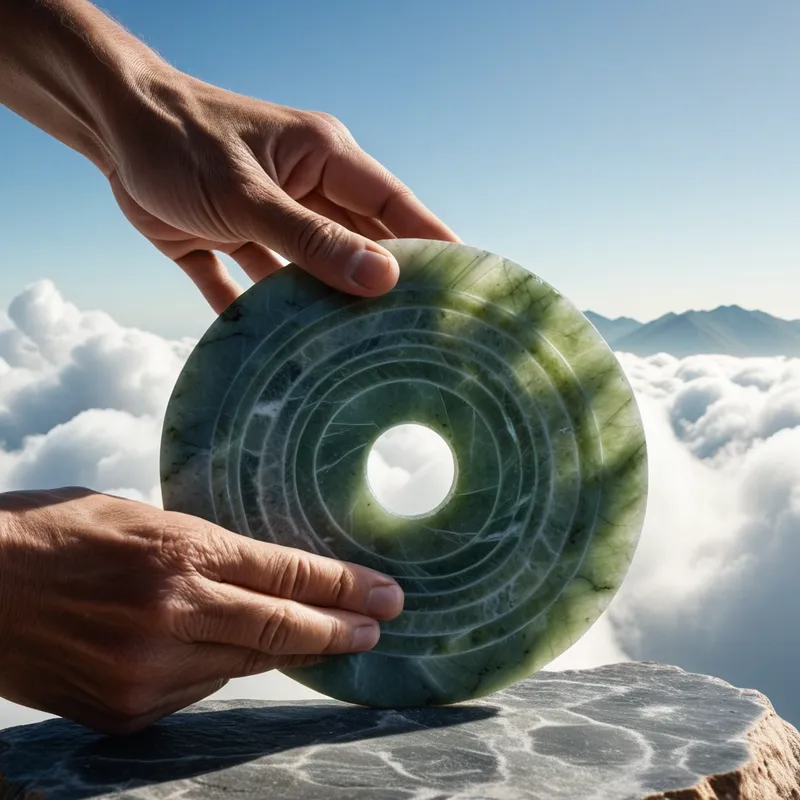
The myth of the Bi Disc’s origin is woven into the very fabric of early Chinese cosmological thought, less a single narrative and more a foundational assumption expressed through ritual and artifact. These stories resided in the hands of court ritualists and the minds of Hundred Schools thinkers, passed down not as epic poetry but as the sacred rationale behind material culture. The physical Bi discs, found in Neolithic Liangzhu culture tombs (3400-2250 BCE) and reaching their apogee in the Zhou and Han dynasties, are the myth made stone.
They functioned as the ultimate ritual intermediaries. Placed on the chest of the noble dead, they were a passport of the soul, their central hole a conduit for ascent to the round heaven. In state ceremonies, they embodied the Mandate of Heaven itself—the perfect, unassailable order that legitimized the ruler’s authority. The mythos surrounding them answered a profound cultural need: to articulate and materialize the concept of a benevolent, structured cosmos (Li) emerging from and forever governing the latent chaos. The Bi was the proof that order was not imposed, but revealed; it was the original pattern at the heart of things.
Symbolic Architecture
The Bi Disc is a master symbol of psychic and cosmic architecture. Its form is its meaning: a perfect circle with a concentric circular hole. This is not a symbol of emptiness, but of structured potential.
The center is not a lack, but a gateway. The circumference is not a limit, but a definition. Between them flows the substance of the self.
The raw, veined jade represents the unconstellated psyche—the Self in its primordial, chaotic state, full of conflicting energies and latent patterns. The act of grinding and polishing is the long, arduous process of consciousness engaging with this inner chaos. The central piercing is the critical moment of insight, the creation of an inner axis or punctum around which the personality can organize. The resulting concentric grain patterns symbolize the layers of the mature psyche—the persona, the ego, the personal and collective unconscious—all now arranged in harmonious, radiating relation to the central, numinous void of the true Self.
The Dreamer's Resonance
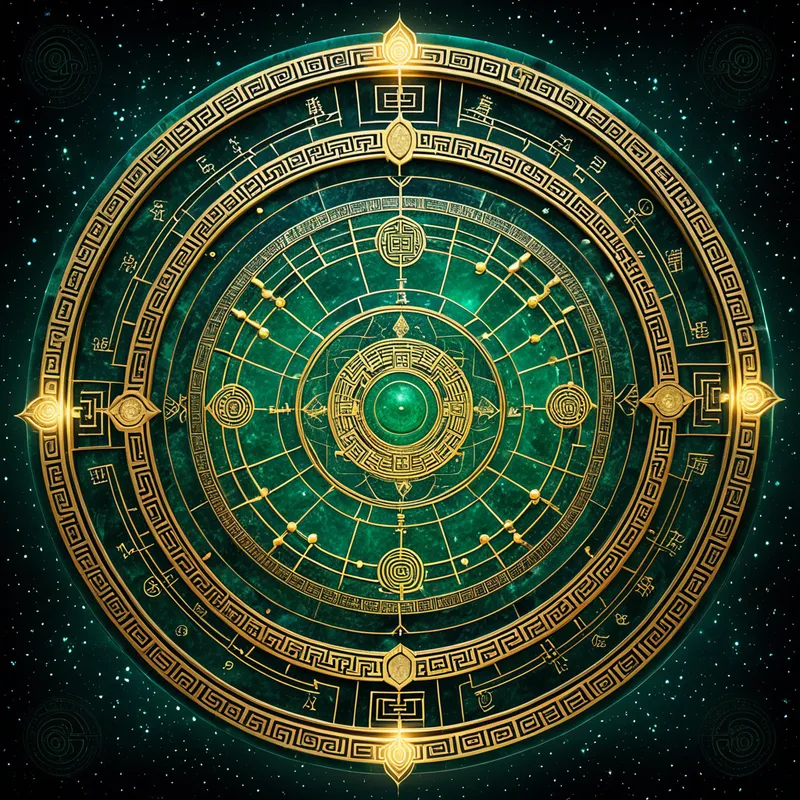
When a Bi Disc appears in modern dreams, it seldom arrives as a museum artifact. It may manifest as a spinning wheel of light in the chest, a perfect hole in the center of a chaotic scene, or a mandala that forms spontaneously during a period of intense inner turmoil. Its appearance signals a profound somatic and psychological process: the psyche’s innate drive toward integration during a crisis of fragmentation.
The dreamer may be experiencing a "Hundun" state in waking life—career upheaval, relational breakdown, or a loss of identity where everything feels formless and without direction. The dream Bi is the psyche’s own "Gong Gong" at work, attempting to find the pattern within the pain. Somatic sensations might accompany it: a tightness in the solar plexus relaxing into a circular flow, or a feeling of centrifugal pressure settling into a calm, centered rotation. The dream is an announcement from the depths: A process of ordering is underway. The chaos is not meaningless; it is the raw material from which your wholeness is being revealed.
Alchemical Translation
The myth of the Bi Disc provides a flawless model for the alchemical process of individuation. The "prima materia" is the confused, suffering, or conflicted state of the individual. The "artisan" is the conscious ego, not as a dictator, but as a devoted servant to the deeper Self, applying the disciplined attention (the grinding sand of daily reflection and ordeal) necessary for the work.
The goal is not to create something new, but to discover the eternal form that has always been latent within the stone of one's being.
The "piercing of the center" is the crucial stage of the nigredo giving way to the albedo. It is the moment when one stops trying to add qualities to oneself (more achievement, more approval) and instead courageously confronts the central void—one's core wounds, mysteries, and the terrifying freedom of the authentic self. This is not an act of destruction, but of revelation. From this sacred wound, this gateway, order flows. The disparate aspects of the personality—ambitions, fears, talents, shadows—begin to re-organize not around the ego's demands, but around this new, authentic center. They become the concentric, harmonious grains of the now-individuated person. One becomes a vessel for the Dao, a living Bi Disc, where the circle of one's life perfectly contains the sacred mystery at its heart.
Associated Symbols
Explore related symbols from the CaleaDream lexicon:
- Circle — The Bi Disc is the circle perfected, representing heaven, eternity, and the complete, cyclical nature of the cosmos and the self.
- Stone — Specifically celestial jade (Yu), representing the durable, precious substance of the soul that must be worked upon to reveal its inner virtue.
- Sky — The Bi is a symbol of heaven, its round form mirroring the celestial dome and representing the realm of perfect, archetypal order.
- Order — The myth’s core theme is the revelation of cosmic and psychic Li from chaos, modeling the journey from confusion to harmonious structure.
- Chaos — The primordial Hundun is the essential raw material, the unformed psyche or life circumstance that contains the latent pattern within its turmoil.
- Temple — The Bi Disc functions as a portable, microcosmic temple—a sacred space and ritual object that mediates between the human and the divine order.
- Light — The inner radiance of the polished jade represents the illuminated consciousness, virtue (De), and the clarity that emerges from inner work.
- Dream — The process of fashioning the Bi mirrors the psyche’s nocturnal work of integration, shaping chaotic experiences into meaningful symbolic patterns.
- Spirit — The Bi is a conduit for the soul (Hun), facilitating its journey and representing the refined, enduring aspect of being.
- Journey — The grinding and piercing process is the quintessential inner journey from fragmentation to wholeness, a pilgrimage to the center of the self.
- Jadeite