Bhaya Myth Meaning & Symbolism
The myth of Bhaya, born from the churning ocean, reveals fear as a primordial force that must be acknowledged and integrated for true power.
The Tale of Bhaya
Listen. Before the worlds settled into their rhythms, when the gods and the demons were not yet enemies but partners in a desperate gamble, they gathered at the shore of the Kshirasagara. Their purpose was to churn the ocean of milk, to wrest from its depths the nectar of immortality. They took the great serpent Vasuki, wound him around the mountain Mandara, and began to pull. The gods at the tail, the demons at the head. The mountain spun. The ocean frothed and roared.
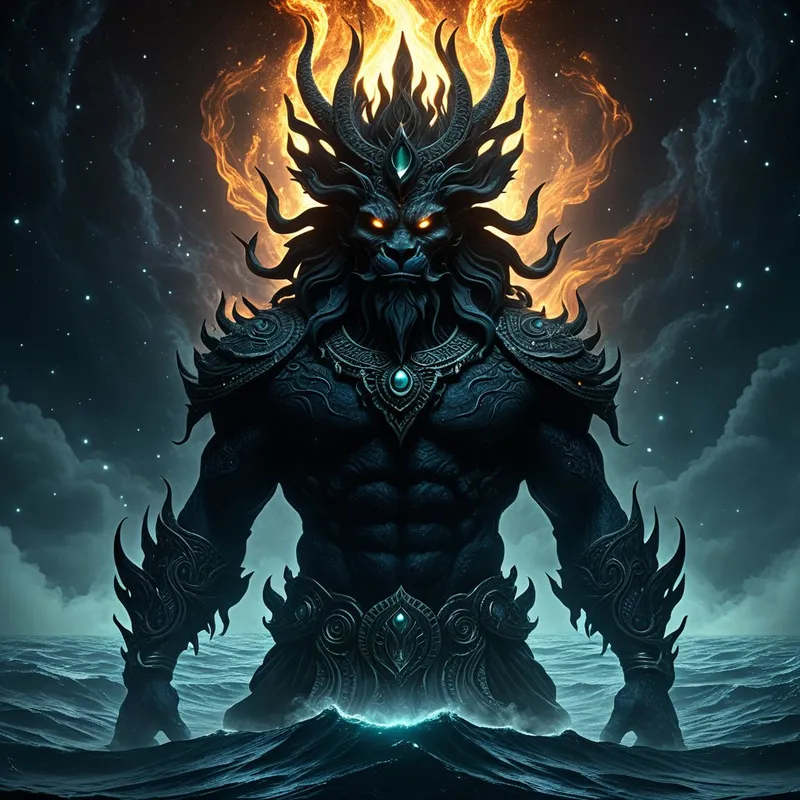
From the seething depths, wonders and horrors were born. The moon, the goddess of wine, the wish-fulfilling cow. But then the waters darkened. A thick, viscous shadow began to coalesce, not a thing but an absence that drank the light. It rose, a formless terror given form—a being of shuddering darkness, of cold that stopped the heart, of a silence that screamed. This was Bhaya, Fear incarnate, the first and most primal poison of the churning.
A wave of paralysis swept the shores. The mighty Asuras trembled. The radiant Devas faltered, their divine light guttering. The churning ceased. The great work was doomed, frozen by this entity that was not an enemy to fight, but a condition to endure. To look upon Bhaya was to know the essence of dread, the terror that lives in the marrow of all beings, god or demon.
It was then that Vishnu, who had taken the form of the great tortoise Kurma beneath the mountain, did not strike. He did not banish. In a movement that was both surrender and mastery, he extended his hand. Not in attack, but in acknowledgment. He drew Bhaya close. He did not vanquish the shadow; he embraced it. He integrated the terror into his own boundless being. And as he did, the shadow lost its absolute power. It was contained, not as a prisoner, but as a recognized part of the cosmic order. The paralysis broke. The churning could resume, now with a deeper, more terrible knowledge at its heart.
Cultural Origins & Context
The myth of Bhaya emerges from the grand narrative of the Samudra Manthan, a central cosmological event detailed in texts like the Mahabharata and the Puranas. This was not a bedtime story for the faint of heart, but a foundational parable recited by sages and bards to explain the nature of creation itself. The churning represents the immense, often painful, labor required to distill immortality (amrita) from the chaotic potential of existence. In this process, both treasures and poisons must arise.
Bhaya’s appearance is no accident. In a culture with a sophisticated philosophical understanding of the mind, as seen in the Upanishads and Samkhya thought, fear (bhaya) is recognized as one of the fundamental afflictions (kleshas) that bind the soul. The myth gives this abstract, internal affliction a cosmic, external form. By placing Bhaya’s birth in this primordial event, the storytellers established fear not as a personal failing, but as a universal, archetypal force present at the very genesis of the ordered world. Its societal function was profound: to teach that the path to power and immortality (spiritual or societal) necessarily involves confronting the deepest, most paralyzing terrors of the collective psyche.
Symbolic Architecture
Bhaya is the ultimate Shadow, in the Jungian sense. He is not merely an emotion, but an autonomous psychic entity born from the unconscious (the churning ocean) when we engage in any great, transformative work. He represents everything the conscious self refuses to acknowledge: vulnerability, annihilation, the unknown, the loss of control.
The treasure you seek is guarded by the dragon of your deepest dread. The nectar of wholeness is poisoned at its source by the very fear of being whole.
The gods and demons represent the polarized aspects of the psyche—our noble aspirations and our base desires. Both are rendered impotent by Bhaya. This is a critical insight: in the face of primal, archetypal fear, all our constructed identities and strategies collapse. The hero’s sword is useless here. Vishnu’s response is the myth’s masterstroke. He models the only solution to the Shadow: integration. He does not destroy Bhaya, for to destroy a part of the psyche is to fracture the self. He contains it, takes it into himself. This transforms fear from a paralyzing external monster into a managed, internal force. The power of the Shadow, when integrated, becomes part of the individual’s strength and stability.
The Dreamer's Resonance
When this myth stirs in the modern soul, it often manifests in dreams of profound, objectless terror. Not a dream of being chased, but a dream of being in the presence of—a dark, formless entity in the corner of the room that saps all will to move. The room itself might feel like it’s breathing, or the dreamer might be paralyzed, unable to scream. This is the somatic signature of Bhaya: a freeze response, the nervous system flooded with the pure essence of dread.
Psychologically, this dream pattern signals that the dreamer is on the brink of a significant psychic churning. Perhaps they are about to embark on a new career, end a relationship, create a piece of art, or finally face a buried trauma. The unconscious is bringing up the foundational, paralyzing fear that guards the threshold to this transformation. The dream is not a warning to stop, but an announcement: "The great work has begun. And here is its first and greatest obstacle—not a problem to solve, but a presence to endure and know."

Alchemical Translation
The alchemy of the Bhaya myth maps perfectly onto the Jungian process of individuation—the journey toward becoming an integrated, whole self. The "nectar of immortality" is the symbolic prize of this journey: a state of psychic wholeness and timeless essence. But the process of churning the psyche to find it will inevitably bring up the poison first.
The first stage is Nigredo, the blackening. This is the emergence of Bhaya—the confrontation with the personal and collective shadow, the depression, the confusion, the primal fear that everything is meaningless or too terrifying to face. The ego, whether it identifies as a "god" (virtuous persona) or a "demon" (repressed desires), is paralyzed.
The transmutation begins not when you slay the darkness, but when you realize the darkness is not other. It is a disowned part of the self, waiting to be reclaimed.
Vishnu’s act is the Albedo, the whitening. It is the conscious, willing engagement with the shadow. In personal terms, this is the difficult, introspective work of asking, "What does this fear represent? What part of me have I exiled that feels this terror?" It is sitting with the anxiety without fleeing into distraction. It is journaling about the dread. It is speaking of it in therapy. This is the "embrace"—not a condoning of fear-based actions, but a deep acceptance of the fearful feeling as a valid part of the human experience.
The final stage is Rubedo, the reddening. The integrated fear loses its autonomous, terrifying power. It becomes a source of depth, resilience, and wisdom. The individual who has "contained their Bhaya" does not become fearless. Instead, they develop a profound relationship with fear. They can feel its chill and yet continue to churn, to create, to love, and to live with a potency that is now informed by, and not crippled by, the deep waters of the unconscious. The immortal nectar they drink is the realization that they are vast enough to hold both the light and the terrible, beautiful dark.
Associated Symbols
Explore related symbols from the CaleaDream lexicon: