Beltane Fires Myth Meaning & Symbolism
A myth of sacred fires lit at the dawn of summer, marking the union of the divine couple and the purification of the land and soul.
The Tale of Beltane Fires
Listen, and hear the tale of the turning. The world holds its breath in the dark hour before dawn, on the cusp of Beltane. The cold grip of winter is a memory, but the full heat of summer is a promise not yet kept. In this liminal space, the people stir.
They gather on the high hills, where the land touches the sky. Their breath mists in the chill, but their eyes are fixed on the east, waiting for the first sliver of the sun. The community's sacred fire, carefully kept alive through the long months, has been extinguished. Every hearth in the land is dark and cold. This is the night of no fire, the great emptiness before the making.
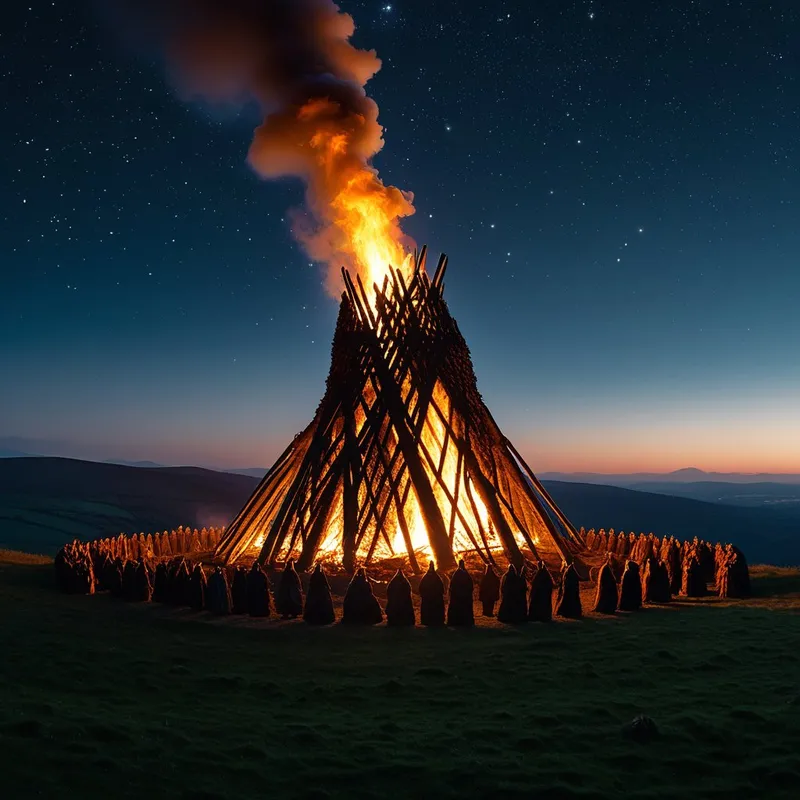
Then, the signal. The druids, the keepers of the old ways, step forward. With sacred woods—oak for strength, rowan for protection, hawthorn for the threshold—they build two great piles. Not one fire, but two, set a pace apart. The air crackles with anticipation. In the profound silence, they strike the new fire. Not with common flint, but with the friction of oak on oak, a sacred birth of spark and smoke. A tiny flame catches, is nurtured with breath and prayer, and leaps to life.
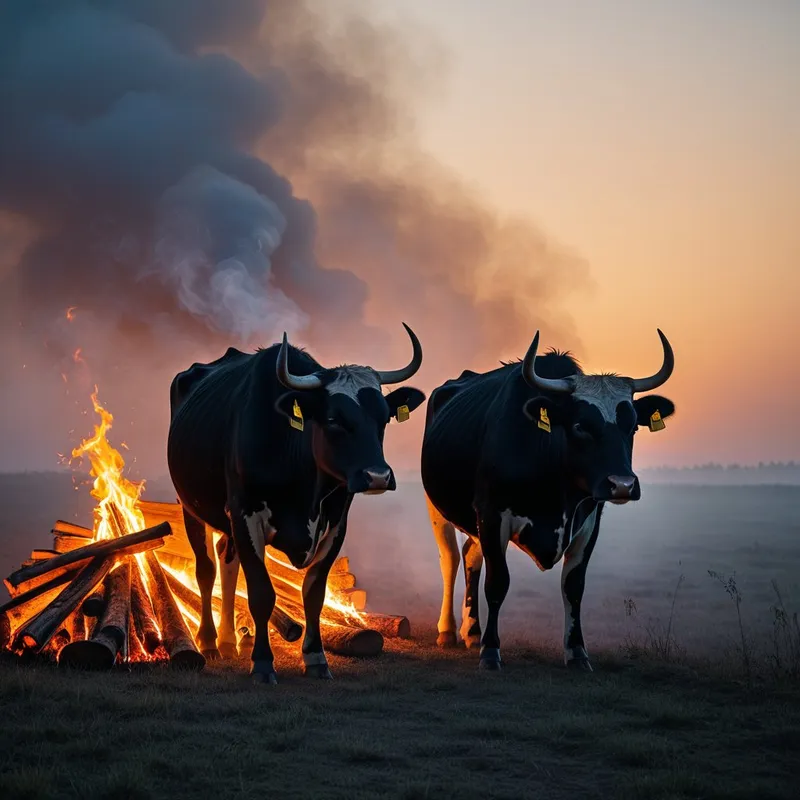
The first fire is lit, and from it, the second. Twin pillars of flame roar into the dark sky, their light banishing the last shadows of the year's dark half. It is a declaration. The people erupt in sound—shouts, songs, the beating of drums. They drive their precious cattle, the wealth of their lives, between the two fires. The beasts low, their hides washed in the heat and smoke, purified for the summer pastures. The people themselves leap over the flames, the young and the brave, their laughter a spell against misfortune.
And as the sun finally crests the horizon, gilding the world in gold, the myth is felt, not told. It is the story of the Dagda and the Mórrígan, or of the young, shining god of the growing sun embracing the earthy, potent goddess of the land. Their union is not a tale of old, but a happening. The fires are their passion, the smoke their breath mingling, the fertility of the land and flock the direct result of their sacred marriage. The Beltane fires are the wedding torches of the world itself, and every leap across them is a participation in the myth, a personal vow to carry that creative spark into the season of light.
Cultural Origins & Context
The myth of the Beltane fires is not preserved in a single, canonical text like those of Greece or Rome. It is a folk myth, woven into the very fabric of seasonal practice across the Celtic world—from Ireland and Scotland to Wales and Gaul. It was passed down not by bards reciting epic poetry, but through communal ritual. The myth was the ritual; its narrative was enacted, not merely narrated.
The primary tellers of this myth were the community itself, guided by the learned class—the druids in earlier times, and later, knowledgeable elders. Its societal function was profoundly pragmatic and deeply spiritual. On a practical level, it marked the critical transition from the indoor, protective life of winter to the outdoor, expansive life of summer. Driving cattle between the fires served as a literal fumigation and purification before moving them to common grazing lands, helping prevent the spread of disease.
On a spiritual level, the festival was a massive act of sympathetic magic and community binding. Extinguishing all hearth fires and relighting them from a common, sacred source symbolically extinguished the old year's struggles and misfortunes, and rebirthed the community with a unified, blessed flame. It reinforced social cohesion and reaffirmed the sacred contract between the people, their animals, and the land. The myth encoded essential knowledge about the cycles of life, the importance of purification, and the sacred nature of fertility in a subsistence agricultural society.
Symbolic Architecture
At its core, the Beltane fire myth is an archetypal drama of opposites seeking union and the necessary purification required to achieve it.
The Twin Fires themselves are the primary symbol. They represent the fundamental dualities of existence: heaven and earth, sun and soil, spirit and matter, masculine and feminine, the conscious and the unconscious. The space between them is the liminal bridge where transformation occurs.
To pass through the sacred fire is to be unmade of the old soot and fear, and remade in the elemental light of a new possibility.
The Cattle and the People passing through represent the embodied self—our instincts, our physicality, our "herd" mentality, and our personal identities—undergoing this alchemical process. The smoke is the transformative agent, not destroying, but cleansing and altering.
The Sacred Union of the deities is the ultimate goal of the ritual: the integration of these opposites within the cosmos and, by reflection, within the individual and the community. Fertility here is not merely biological, but psychic—the fertile ground of a harmonious and creative life. The fire is the agent of this union, for in its heat, distinctions melt and a new, third thing—the living spark of summer—is born.
The Dreamer's Resonance
When this myth stirs in the modern unconscious, it often manifests in dreams of thresholds, trials by element, and potent unions. A dreamer may find themselves:
- Standing between two great sources of light or energy, feeling pulled in both directions yet knowing they must move forward.
- Walking through a corridor of flame that feels purifying rather than destructive, emerging feeling lighter, renewed.
- Witnessing or participating in a symbolic marriage or union between two powerful, archetypal figures (a radiant king and an earthy queen, a solar being and a telluric spirit).
- Engaging in a ritual of community cleansing or rebirth.
Psychologically, these dreams signal a somatic and psychic process of purification and integration. The dreamer is at a personal "Beltane"—a turning point from an inward, perhaps contracted or dormant phase (a psychological winter) into an outward, expressive, and fertile phase. The fire represents the often intense psychic energy required to burn away old defenses, outdated self-concepts, or accumulated resentments (the "soot" of the past year). The process can feel exhilarating but also demanding, requiring a brave "leap" of faith into a new way of being.
Alchemical Translation
For the modern individual seeking wholeness or individuation, the Beltane myth provides a powerful model for psychic transmutation.
Stage 1: The Extinguishing (Nigredo). This is the conscious, often difficult decision to let an old pattern, identity, or narrative die. It is the "dark hearth"—the voluntary acceptance of emptiness and uncertainty. One must put out the familiar, smoldering fires of habit to make space for a new, sacred flame.
Stage 2: The Kindling (Albedo). In the darkness, one must generate the new spark from within. This is the hard, friction-filled work of self-reflection, of rubbing one's own inner conflicts (the oak on oak) until a genuine insight—a true spark—is born. This spark is the nascent Self, fragile and requiring careful nurturing.
Stage 3: The Purifying Passage (Citrinitas). Here, one must guide all aspects of oneself—the instinctual (the cattle), the emotional, the intellectual—through the transformative fire of conscious integration. This is the disciplined practice of facing one's shadows, not to destroy them, but to be cleansed by their acknowledgment. It is the leap over the flame of a feared challenge.
The goal is not to choose one fire or the other, but to become the living bridge that holds their tension and transmits their combined power.
Stage 4: The Sacred Union (Rubedo). The final stage is the red glow of achieved integration. The opposites within—reason and intuition, strength and vulnerability, action and receptivity—are not at war, but in a sacred, fertile marriage. This internal union manifests externally as creativity, vitality, and the ability to engage in deeply connected relationships. The individual becomes a vessel for the "fertility" of a fully lived life, carrying the sacred fire of their own authentic being into the world. They have, in essence, become a living Beltane flame.
Associated Symbols
Explore related symbols from the CaleaDream lexicon: