Beltane Myth Meaning & Symbolism
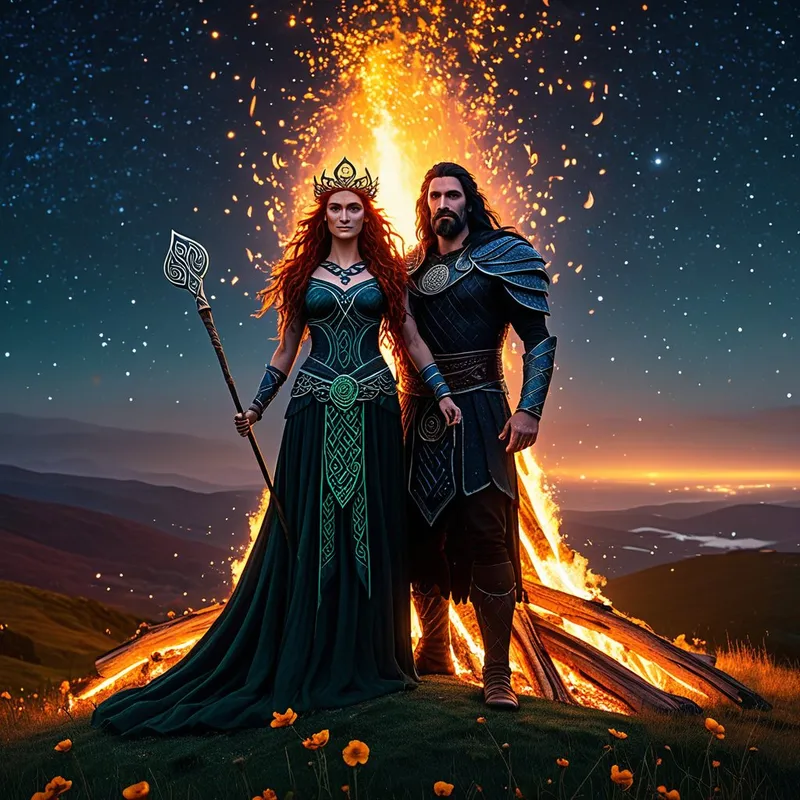
A myth of sacred fire dividing the year, where the Dagda and the Mórrígan unite to bless the land, symbolizing the sacred marriage of opposites.
The Tale of Beltane
Listen. The wheel of the year groans, caught between the unyielding grip of winter’s memory and the soft, insistent push of the green world. The great herds, thin-flanked and restless, low in their pens. The people’s breath still fogs the morning air, but the earth beneath their feet whispers of warmth to come. This is the hinge. This is the crack between the worlds.
On this night, the Sídhe stir, their gates grown thin as mist. The familiar paths through the oak wood become strange; what was solid may be spirit, and what was spirit may walk with solid step. It is a time of profound danger, and of even more profound promise.
For the land itself is in a state of betrothal. The sovereign earth, the Flaithis, lies fallow yet potent, awaiting its consort. And he comes. Not with a crown, but with a club. He is the Dagda, the Good God, his belly vast with the potential of all things, his great hammer capable of both killing and resurrecting. He carries the weight of the tribe’s hope—for milk, for grain, for life itself.
He seeks the one who holds the key. She is the Mórrígan, the Great Queen. She is the land incarnate, often seen as a trio of sisters—maiden, mother, and fearsome crone. She is the river that floods, the crow that feasts on battlefields, the stone upon which kings are made or broken. She is the untamed will of the world. He finds her not in a hall, but at a ford, a place of crossing and decision. She is washing the armor of the doomed, her hair like a storm cloud, her eyes holding the depth of a tarn.
There is no courtship of sweet words. This is a negotiation of powers. The Dagda offers his strength, his generative magic, the surety of the sun’s return. The Mórrígan offers her sovereignty—the very right of the land to bear fruit, the mystical contract that blesses a people. Their union is not gentle, but it is total. It is the striking of a spark on tinder-dry moss. As they join, the energy that arcs between them does not fade into the dark. It gathers. It concentrates.
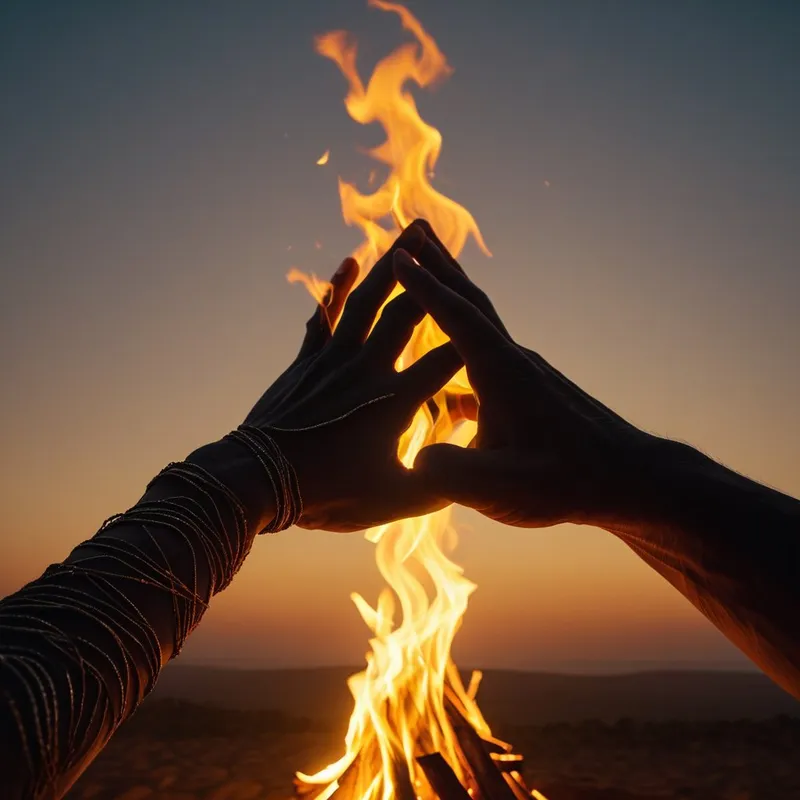
And on the hilltops, the people act out this sacred drama below. They douse every hearth in the tribe, creating a symbolic void, a collective inhalation. Then, with the friction of oak on oak—the holy wood—they birth a new fire. This is no ordinary flame. This is the Teine Éiginn, the need-fire, drawn directly from the elemental world, purified of all past ill. It crackles with the promise of the gods’ union. Through this fire they drive their cattle, a baptism of smoke and spark to burn away sickness and ill-luck. They leap the flames, young and old, their shadows dancing giants against the hillside, carrying prayers for fertility, health, and protection across the threshold. They take brands from this central sun back to their dark homes, re-lighting the world from this single, sacred source. The union above begets the fire below; the fire below sustains the life to come. The hinge has turned. Summer begins.
Cultural Origins & Context
The mythic heart of Beltane (from the Old Irish Beltaine, likely “bright fire”) beats within the pastoral rhythm of the early Celtic world. It was less a single, codified “story” told start-to-finish, and more a pervasive, lived cosmological reality embedded in ritual. The narratives we piece together—of the Dagda and the Mórrígan, of the symbolic battle between the Cailleach and the spirit of summer—are gleaned from medieval Irish manuscripts like the Lebor Gabála Érenn and later folklore, filtered through the lens of Christian scribes yet retaining deep, older patterns.
The primary tellers of this “myth” were the people themselves, through their actions. The druids, as the spiritual intermediaries, would have overseen the precise rituals—the timing by the stars, the kindling of the need-fire, the invocations. But every member of the tuath (the tribe) participated in the drama. By extinguishing home fires, leaping the communal blaze, and driving livestock, they were not merely observing a myth; they were enacting it, physically aligning their community’s fate with the cosmic marriage of the divine forces that governed fertility and protection. The myth’s function was utterly pragmatic: to ensure survival. It was a psychic and physical technology for navigating the perilous threshold between seasons, when the boundaries of the worlds were fluid and required a great, concentrated act of magic to secure the bounty of the coming summer.
Symbolic Architecture
At its core, the myth of Beltane is an archetypal blueprint for the sacred marriage, the Hieros Gamos. This is not a romance, but a necessary conjugation of complementary cosmic principles.
The fire is not merely a tool, but the visible manifestation of the tension and resolution between opposites. It is the child of the union, and the catalyst for all that follows.
The Dagda represents the fertilizing, expansive, solar principle. He is concentrated potential, the will to generate and sustain life. The Mórrígan represents the receptive, lunar, telluric principle. She is the vessel of sovereignty, the land that must be “won” or rightly partnered with to yield its gifts. She is also the principle of fate and raw power—she cannot be controlled, only allied with. Their meeting at the ford is profoundly symbolic: a ford is a liminal space, a point of decision and transition, perfectly mirroring the Beltane threshold itself.
The need-fire, ritually created, symbolizes a break with the past and the generation of wholly new, untainted energy. It is purified life-force. The acts of driving cattle through it and leaping over it are rites of passage and purification—a symbolic death of the old, vulnerable state and a rebirth into a protected, blessed state. The entire ritual is a grand act of sympathetic magic, where the human community mirrors the divine act to guarantee its efficacy in their own world.
The Dreamer's Resonance
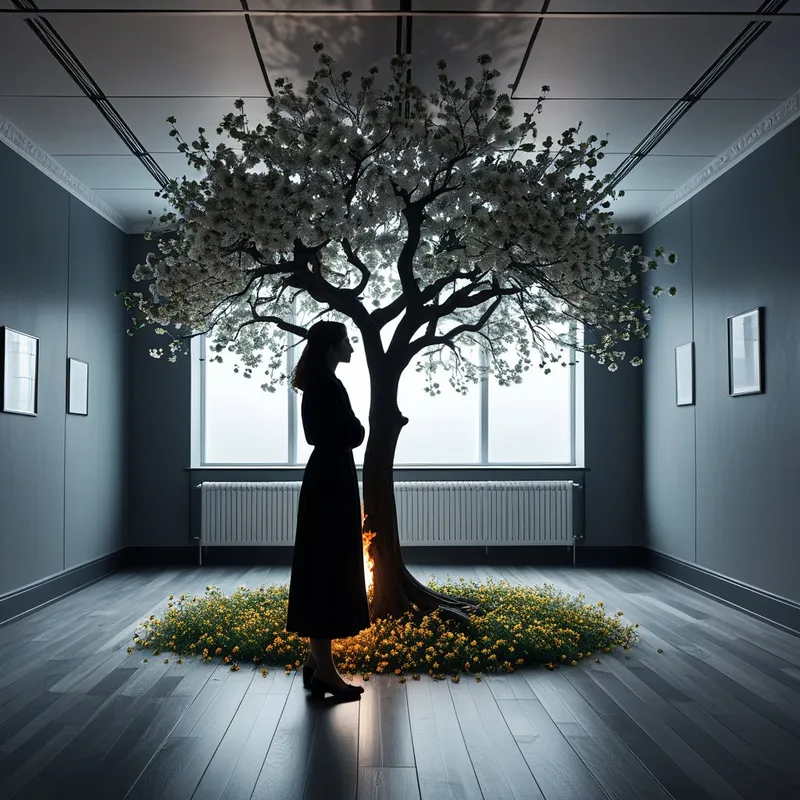
When the pattern of Beltane stirs in the modern psyche, it often manifests in dreams of potent thresholds, forbidden unions, or transformative fire. One might dream of standing before two diverging paths in a misty wood, feeling an urgent pull to choose. This is the somatic echo of the “hinge” of the year, the body’s wisdom recognizing a critical point of personal transition.
Dreams of a mysterious, compelling, or even intimidating figure (of any gender) who must be approached or allied with—not romantically, but essentially—point to the encounter with the “Mórrígan” aspect of one’s own psyche. This is the part of us that holds our inner sovereignty, our deepest will and fate, which we often ignore or fear. The dream conflict mirrors the Dagda’s negotiation: how do I rightfully engage with my own powerful, untamed nature to make my life fertile?
Recurring dreams of fire—especially a contained, ritualistic fire or a wildfire that purges but does not destroy—signal a deep psychological process of purification and the generation of new psychic energy. The dreamer is at their own internal Beltane, preparing to leap from a spent condition into a new, energized phase of life.
Alchemical Translation
For the individual on the path of individuation, Beltane models the crucial alchemical stage of Coniunctio—the sacred marriage. This is the internal union of the conscious and unconscious, the masculine and feminine principles within (not as gender, but as psychic attitudes), the logical ego and the intuitive, somatic self.
The modern “need-fire” is not kindled on a hill, but in the heart. It is the deliberate, often friction-filled generation of a new attitude, a new center of psychic gravity that is purified of outdated complexes and parental influences.
The “extinguishing of all hearths” is the necessary, often frightening, step of letting go of old identities, securities, and ways of being that have provided warmth but now limit growth. It creates the void, the nigredo, where new fire can be born. The “leap through the flames” is the act of courage required to commit to this new, integrated self, trusting the process of transformation. The “driving of cattle” represents bringing one’s instinctual nature, one’s raw drives and talents (the “herd” of the psyche), through this transformative energy to be blessed and aligned with one’s sovereign purpose.
Ultimately, the myth guides us to stop seeing the “Mórrígan” within—the fierce, fateful, sovereign self—as an enemy or a threat. It teaches us to meet her at the ford of decision, to negotiate an alliance. The fertile, creative, and empowered life—the “summer” of the soul—depends not on conquering this inner other, but on performing the sacred, internal Beltane rite: the courageous kindling of a unifying fire at the very threshold of change.
Associated Symbols
Explore related symbols from the CaleaDream lexicon: